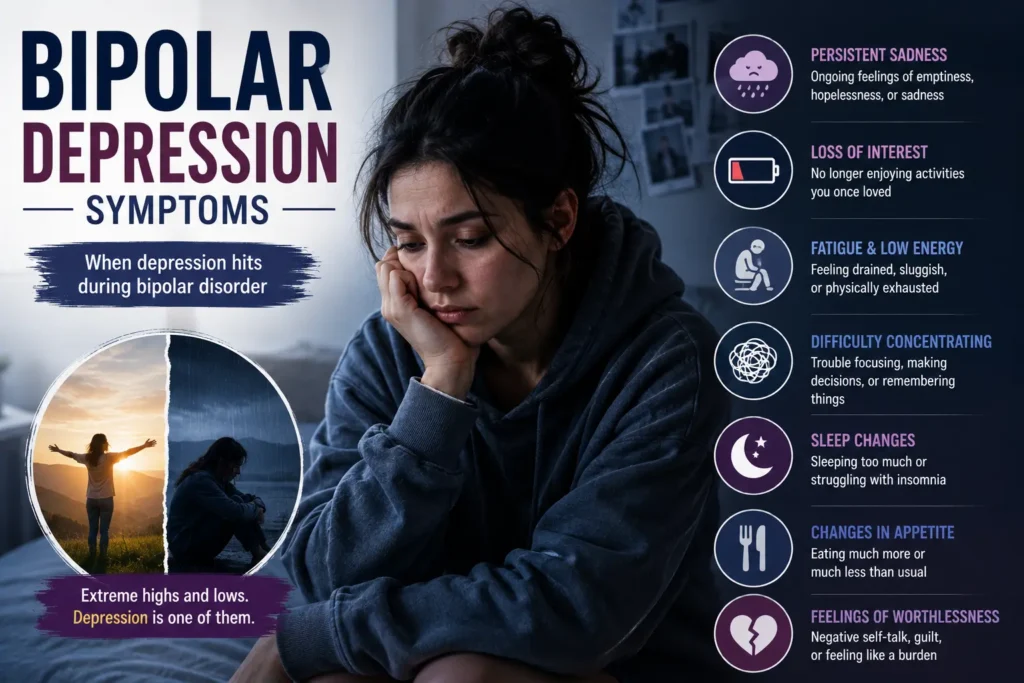
Bipolar Depression Symptoms: Bipolar depression involves the same core symptoms as major depressive disorder—low mood, low energy, loss of interest, and changes in sleep or appetite—but it occurs as one phase of a broader condition that also includes manic or hypomanic episodes.This matters clinically, because standard antidepressants alone can sometimes trigger a switch into mania or hypomania in someone with bipolar disorder, which is why an accurate diagnosis changes the treatment approach. Bipolar depression also tends to include certain features — such as more frequent oversleeping, weight gain, and mixed symptoms — more often than typical unipolar depression, though these patterns aren’t universal. For the complete symptom picture across all mood episodes, see our guide to bipolar disorder symptoms or our overview of bipolar symptoms generally.
Table of Contents
Introduction
Depression is depression, right? Not quite. Two people can describe nearly identical feelings — persistent sadness, no energy, no interest in anything — and still be dealing with fundamentally different conditions underneath. One may have major depressive disorder. The other may have bipolar disorder, currently in its depressive phase.
The distinction isn’t just academic. Treating bipolar depression the same way you’d treat unipolar depression can backfire, since certain antidepressants used alone carry a risk of triggering a manic or hypomanic switch in someone with an underlying bipolar diagnosis, according to guidance reflected in psychiatric literature and the American Psychiatric Association’s treatment guidelines. That’s a big part of why getting this specific piece right matters so much.
This guide focuses entirely on the depressive side of bipolar disorder — what it looks like, how it differs from standard depression, and what that difference means for diagnosis and treatment. For a broader look at the condition itself, see bipolar disorder and what bipolar disorder is.
Key Takeaways
- Bipolar depression shares core symptoms with major depressive disorder but occurs as part of a broader mood disorder that also involves mania or hypomania.
- Bipolar depression often involves more oversleeping, increased appetite, and physical heaviness compared to typical unipolar depression, though this varies by individual.
- Mixed features — depressive symptoms combined with manic or hypomanic ones — occur more often in bipolar depression than in unipolar depression.
- Antidepressant medication alone can sometimes trigger a manic or hypomanic switch in bipolar disorder, which is why accurate diagnosis changes treatment.
- Bipolar depression is frequently misdiagnosed as unipolar depression, especially if past hypomanic episodes were mild or went unmentioned.
- Warning signs like suicidal thoughts or severe hopelessness require immediate attention, regardless of the underlying diagnosis.
What Bipolar Depression Actually Is
Bipolar depression refers to a major depressive episode that occurs within the context of bipolar disorder — meaning the same person also experiences, or has experienced, episodes of mania or hypomania. The depressive episode itself is diagnosed using the same DSM-5 criteria described by the American Psychiatric Association as major depressive disorder, but the surrounding diagnosis is different because of the presence of “up” episodes elsewhere in the person’s history.
This distinction is why bipolar depression isn’t its own separate diagnostic category in the DSM-5 — it’s a phase within Bipolar 1 or Bipolar 2, rather than a standalone condition. For most people with Bipolar 2 in particular, depressive episodes tend to make up a much larger share of their overall symptom experience than hypomanic ones. For the broader comparison between the two, see Bipolar 1 vs Bipolar 2.
Core Symptoms of Bipolar Depression
A major depressive episode, whether it occurs in bipolar disorder or on its own, generally involves most of the following, present most of the day, nearly every day, for at least two weeks:
- Persistent sad, empty, or hopeless mood
- Loss of interest or pleasure in nearly all activities
- Significant changes in appetite or weight
- Sleep disturbance — insomnia or sleeping much more than usual
- Fatigue or loss of energy
- Feelings of worthlessness or excessive, inappropriate guilt
- Difficulty concentrating, thinking, or making decisions
- Psychomotor changes — noticeably slowed movements/speech, or restlessness
- Recurrent thoughts of death or suicide
These criteria are identical to those used for major depressive disorder. What differs is context: in bipolar depression, this episode sits within a broader pattern that also includes elevated mood states. For a full breakdown of every episode type, see bipolar disorder symptoms.
How Bipolar Depression Tends to Differ From Unipolar Depression
While the diagnostic checklist is the same, certain patterns are reported more often in bipolar depression than in typical unipolar depression:
- More hypersomnia. Sleeping excessively, rather than insomnia, is reported more frequently in bipolar depression.
- Increased appetite and weight gain. This “atypical” pattern shows up more often in bipolar depressive episodes than in unipolar depression.
- Heavier physical slowing. A pronounced sense of physical heaviness or sluggishness (sometimes called psychomotor retardation) is more commonly reported.
- Earlier onset. Bipolar depression often first appears at a younger age compared to typical unipolar depression.
- More frequent, shorter episodes. Some people with bipolar depression experience more numerous depressive episodes over a lifetime, though each may be somewhat shorter.
- Mixed features. Symptoms of depression combined with restlessness, racing thoughts, or irritability at the same time occur more often in bipolar depression.
- Family history. A family history of bipolar disorder specifically, rather than depression alone, is a meaningful clue pointing toward bipolar depression.
None of these differences are definitive on their own — the only way to reliably distinguish bipolar depression from unipolar depression is a thorough history that specifically screens for past hypomanic or manic symptoms.
Comparison Table: Bipolar Depression vs Unipolar Depression
| Feature | Bipolar Depression | Unipolar (Major) Depression |
| Sleep pattern | More often hypersomnia | More often insomnia |
| Appetite | More often increased | Often decreased, but variable |
| Physical energy | Heavier, more pronounced slowing | Variable |
| Age of first episode | Often younger | Often, though not always, later |
| Episode frequency | Can be more frequent over a lifetime | Variable |
| Family history | Often includes bipolar disorder | Often depression, not necessarily bipolar disorder |
| Antidepressant response | Can trigger manic/hypomanic switch if used alone | Standard first-line treatment |
| Presence of “up” episodes | Yes, elsewhere in history | No |
This table reflects general clinical patterns and is not a diagnostic tool — only a full clinical evaluation can reliably tell the two apart.
Mixed Features: When Depression and Mania Overlap
Some depressive episodes include symptoms of mania or hypomania occurring at the same time — a pattern clinicians call “mixed features.” This might look like:
- Persistent low mood or hopelessness combined with racing thoughts
- Depressive symptoms alongside noticeable restlessness or agitation
- Fatigue and low motivation paired with irritability and a short temper
Mixed features carry particular significance because the combination of low mood and elevated energy or agitation is associated with a higher risk profile, so it’s worth describing this pattern clearly and specifically to a healthcare provider rather than framing it as ordinary depression.
Why Bipolar Depression Is Frequently Misdiagnosed as Unipolar Depression
A depressive episode is often what actually brings someone to treatment, since hypomanic or manic periods can feel productive, pleasant, or simply go unmentioned. If a clinician doesn’t specifically ask about past periods of elevated mood, reduced sleep need, or increased energy, bipolar disorder can be missed entirely, and the depressive episode gets treated as standalone major depressive disorder.
This misdiagnosis matters because of how differently the two conditions are typically treated. For the full diagnostic process used to tell them apart, see bipolar disorder diagnosis.
Myths vs Facts About Bipolar Depression
| Myth | Fact |
| “Bipolar depression looks totally different from regular depression.” | The core symptoms overlap heavily; the difference lies in the presence of manic or hypomanic episodes elsewhere in the person’s history. |
| “If antidepressants haven’t worked, it’s just treatment-resistant depression.” | Poor response to antidepressants, especially with a family history of bipolar disorder, is sometimes a clue that the underlying condition is bipolar depression. |
| “People with bipolar depression are always aware of their manic episodes.” | Milder hypomanic episodes can go unnoticed or unmentioned, especially if they felt pleasant or productive. |
| “Bipolar depression is rare compared to unipolar depression.” | Depressive episodes are a major, common feature of bipolar disorder, particularly in Bipolar 2. |
For a broader look at misconceptions, see bipolar disorder myths.
Bipolar Depression in Bipolar 1 vs Bipolar 2
Depressive episodes occur in both types, but they play a different role in each:
- In Bipolar 1, depressive episodes may or may not occur, since only a manic episode is required for diagnosis.
- In Bipolar 2, depressive episodes are a required part of the diagnostic picture, alongside at least one hypomanic episode, and tend to make up a larger share of the overall illness course.
We compare these patterns directly in Bipolar 1 vs 2 depression and in our broader Bipolar 1 vs Bipolar 2 comparison.
Risk Factors for Bipolar Depression
Risk factors mirror those for bipolar disorder overall, per the National Institute of Mental Health:
- A family history of bipolar disorder specifically, not just depression
- A first depressive episode occurring at a younger age
- A depressive episode with atypical features (oversleeping, increased appetite, heavy physical slowing)
- A poor or unusual response to standard antidepressant treatment
- A history of rapid, unexplained mood shifts, even if brief
For the full picture of causes, see bipolar disorder causes.
Warning Signs That Need Immediate Attention
Regardless of the underlying diagnosis, certain symptoms during a depressive episode require urgent attention:
- Any thoughts of suicide, self-harm, or feeling like a burden to others
- A sense of complete hopelessness with no perceived way forward
- Significant withdrawal combined with giving away possessions or saying goodbye to people
- Agitation combined with hopelessness (possible mixed features)
- Signs of psychosis during a severe depressive episode
If you or someone you know is having thoughts of suicide, contact the 988 Suicide & Crisis Lifeline (call or text 988 in the US) or your local emergency number immediately. This is a sensitive topic — if you’re personally struggling right now, please reach out to a crisis line or trusted professional rather than managing it alone.
Diagnosis: Why It Requires a Full History
Diagnosing bipolar depression accurately requires more than assessing the current depressive symptoms — it requires a full mood history, using DSM-5 criteria as the standard referenced by Mayo Clinic and Cleveland Clinic. A thorough evaluation typically asks about:
- Any past periods of unusually high energy, reduced sleep need, or elevated mood, even brief ones
- Family history of bipolar disorder
- Age at first depressive episode
- Response to any prior antidepressant treatment, including any unusual reactions
For the complete diagnostic process, see bipolar disorder diagnosis.
Treatment Considerations Specific to Bipolar Depression
Bipolar depression is generally treated differently from unipolar depression. Key considerations include:
- Mood stabilizers or atypical antipsychotics are often used as a foundation, sometimes instead of or alongside an antidepressant, per treatment guidelines reflected by the American Psychiatric Association.
- Antidepressants used without a mood stabilizer carry a risk of triggering a manic or hypomanic switch in someone with bipolar disorder, which is why they’re generally not used as a sole treatment once bipolar disorder is identified.
- Psychotherapy, including approaches tailored to mood disorders, plays an important supporting role alongside medication.
For the full treatment overview across bipolar disorder generally, see bipolar disorder treatment, and for type-specific detail, see Bipolar 1 treatment and Bipolar 2 treatment.
Lifestyle Strategies That Support Recovery
- Protect your sleep schedule. Both oversleeping and sleep disruption can worsen bipolar depression, so consistency matters.
- Track your mood alongside energy and sleep. This can help you and your provider notice mixed features or early shifts toward hypomania.
- Limit alcohol. Alcohol can worsen depressive symptoms and interact with medication.
- Stay connected, even when motivation is low. Withdrawal tends to deepen depressive episodes, so maintaining some social contact, even minimal, can help.
- Don’t adjust medication on your own. Because of the antidepressant-switch risk in bipolar disorder, any medication changes should go through your prescribing provider.
For broader day-to-day management strategies, see living with Bipolar 1 and living with Bipolar 2.
Complications of Untreated Bipolar Depression
Untreated or misdiagnosed bipolar depression is associated with longer depressive episodes, increased risk of a manic or hypomanic switch from unmonitored antidepressant use, and a higher likelihood of recurrence. For the full picture, see bipolar disorder complications and bipolar disorder prognosis.
Checklist: Could This Be Bipolar Depression?
- [ ] Current depressive symptoms lasting two weeks or more
- [ ] A history of any period of unusually high energy, reduced sleep need, or elevated mood, even briefly
- [ ] A family history of bipolar disorder specifically
- [ ] Depressive episodes that started at a younger age
- [ ] More oversleeping and increased appetite than a typical “textbook” depressive episode
- [ ] A poor or unusual response to standard antidepressant treatment
- [ ] Periods where low mood and high energy or agitation occurred together
If several of these apply, it’s worth raising directly with a psychiatrist, especially if you’ve already been treated for depression without much improvement.
Frequently Asked Questions
How is bipolar depression different from regular depression? The individual symptoms overlap heavily, but bipolar depression occurs within a condition that also includes manic or hypomanic episodes, which changes both the underlying diagnosis and the recommended treatment approach.
Can antidepressants make bipolar disorder worse? Antidepressants used alone, without a mood stabilizer, can sometimes trigger a manic or hypomanic switch in someone with bipolar disorder, which is why an accurate diagnosis matters before starting treatment.
Why do I feel depressed even though I’ve had periods of high energy? This pattern is consistent with bipolar disorder, where depressive episodes and elevated mood episodes both occur, sometimes separated by long stretches of stability.
Is bipolar depression more severe than unipolar depression? Severity varies by individual rather than by diagnosis alone, though bipolar depression is associated with certain patterns — like more frequent episodes over a lifetime — that can affect overall course.
Can you have bipolar depression without ever having a manic episode? Yes — in Bipolar 2, depressive episodes occur alongside hypomania rather than full mania, meaning someone can have significant depressive symptoms without ever experiencing a classic manic episode.
How long do bipolar depressive episodes usually last? Per DSM-5 criteria, major depressive episodes generally last at least two weeks, though the exact duration varies by individual and by treatment.
What should I tell my doctor if I think my depression might actually be bipolar? Mention any past periods of unusually high energy, reduced sleep need, increased confidence, or impulsivity, even if they felt positive at the time, along with any family history of bipolar disorder.
Summary
Bipolar depression shares its core symptom list with major depressive disorder, but it’s part of a broader condition that also includes manic or hypomanic episodes — a distinction that meaningfully changes how it should be treated. Certain patterns, like oversleeping, increased appetite, mixed features, and a family history of bipolar disorder, can hint at this underlying difference, but only a full clinical history can confirm it. If depression hasn’t responded the way you expected, or if you’ve noticed brief stretches of unusually high energy in the past, it’s worth raising both directly with a psychiatrist.
For related reading, see our bipolar disorder statistics, bipolar disorder glossary, or our broader guide to bipolar symptoms if you want the full picture across every mood episode type.
This article is for educational purposes and is not a substitute for a professional diagnosis. If you are experiencing thoughts of suicide or self-harm, please contact the 988 Suicide & Crisis Lifeline (call or text 988) or your local emergency services immediately.