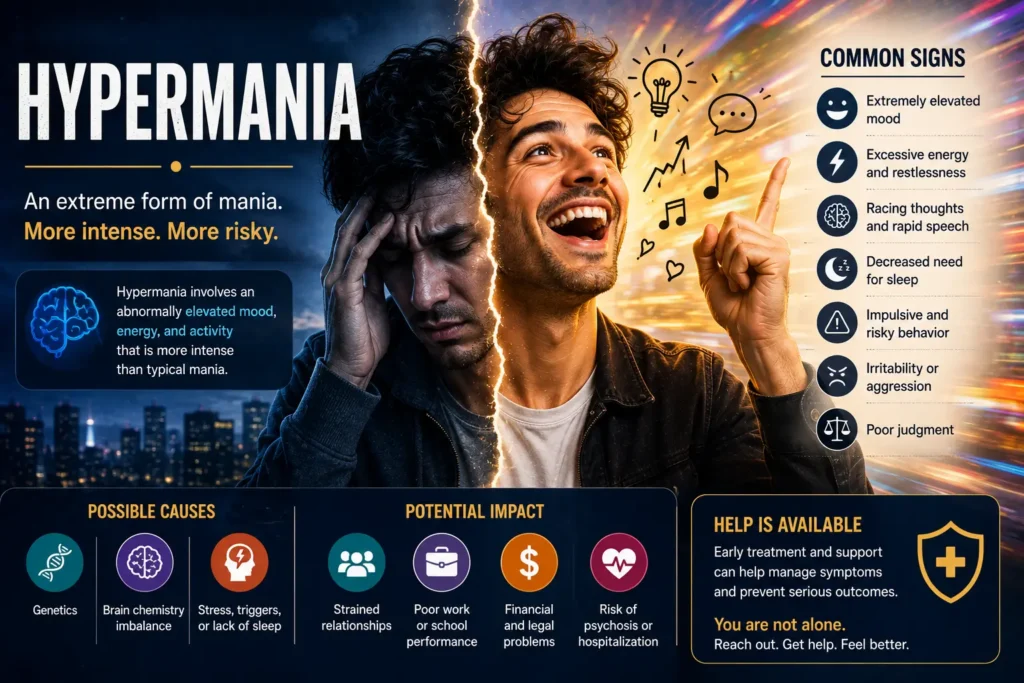
“Hypermania” is not a recognized clinical term in the DSM-5 or any official psychiatric diagnostic system. It shows up in everyday language in two main ways: as an informal way of describing an unusually intense or extreme manic episode, and — more often — as a misspelling or mix-up of “hypomania,” which is a real, clinically defined milder form of elevated mood. If you’re researching symptoms, treatment, or diagnosis, the accurate terms to look for are “mania” and “hypomania.”
Table of Contents
Key Takeaways
- Hypermania is not a DSM-5 diagnosis or a term used in clinical practice.
- Most searches for “hypermania” are either looking for hypomania or trying to describe unusually severe mania.
- The “hyper-” prefix causes confusion because it sounds like it should mean “more than mania,” but no such formal category exists.
- Clinicians diagnose mood episodes using established categories: hypomanic episode, manic episode, and manic episode with psychotic features.
- If you’re trying to describe a severe or extreme experience of mania, the correct clinical language is covered in our guides on mania symptoms and psychosis in mania.
Why “Hypermania” Isn’t a Real Diagnosis
Psychiatric diagnosis in the United States and most of the world follows the DSM-5, published by the American Psychiatric Association, or the ICD-11, published by the World Health Organization. Neither system includes “hypermania” as a diagnostic category or a recognized clinical specifier.
This matters because using inaccurate terminology when researching symptoms or talking to a healthcare provider can lead to confusion. If you search for treatment, symptoms, or medication information under “hypermania,” you’re likely to land on unreliable or non-clinical sources, since legitimate medical organizations don’t use the term.
The two real, clinically defined categories that people are usually trying to describe are:
- Hypomania — a milder, shorter period of elevated mood and energy that doesn’t cause severe impairment
- Mania — a more severe, longer-lasting period of elevated mood and energy that does cause significant impairment, and can include psychosis
Where the Confusion Comes From
Mix-Up With “Hypomania”
The most common reason people search “hypermania” is a simple mix-up with “hypomania.” The prefix “hypo-” means “under” or “less than,” which is counterintuitive for a condition involving elevated energy — it actually refers to the episode being less severe than full mania, not more. “Hyper-,” on the other hand, means “above” or “excessive,” which intuitively (but incorrectly) seems like it should describe an intense manic state. This mismatch between how the prefix sounds and what it clinically means is a major source of the confusion.
Informal Use to Describe Extreme Mania
Separately, some people use “hypermania” informally — in blogs, forums, or casual conversation — to describe an unusually intense or extreme manic episode, sometimes one involving psychosis or severe impairment. This isn’t a clinical usage, but it reflects a real experience: some manic episodes are genuinely more severe than others, even within the single diagnostic category of “mania.”
Dictionary Definitions vs. Clinical Use
General dictionaries sometimes include an entry for “hypermania” as an informal synonym for extreme mania, which can make it look more official than it is. It’s worth noting that a dictionary entry reflects how a word is used in everyday language — it doesn’t mean the term is used in psychiatric diagnosis or treatment planning.
Hypermania vs. Hypomania vs. Mania: A Clarifying Comparison
| Term | Clinical Status | What It Actually Refers To |
| Hypermania | Not a recognized diagnosis | Informal/mistaken term, usually meaning hypomania or an unusually intense manic episode |
| Hypomania | Official DSM-5 term | A milder elevated mood episode lasting at least 4 days, without severe impairment or psychosis |
| Mania | Official DSM-5 term | A more severe elevated mood episode lasting at least 7 days (or requiring hospitalization), causing significant impairment, sometimes with psychosis |
For a full side-by-side comparison of the two real clinical categories, see mania vs hypomania.
If You Meant “Hypomania”: What to Know
Hypomania is a genuine, diagnosable mood state most commonly associated with bipolar II disorder. It involves elevated or irritable mood, increased energy, and related symptoms, but without the severe impairment seen in full mania.
- For symptoms, see hypomania symptoms
- For a full overview, see hypomania
- For treatment options, see hypomania treatment
- For the specific hypomanic episode structure, see hypomanic episode
If You Meant “Severe Mania”: What to Know
If what you’re actually trying to describe is an unusually intense or extreme manic episode — possibly involving psychosis, hospitalization, or significant risk-taking — the accurate clinical language falls under mania and its specifiers, most associated with bipolar I disorder.
| Symptom Severity Marker | What It Indicates |
| Standard manic episode | Meets full DSM-5 criteria; significant impairment in daily functioning |
| Manic episode with psychotic features | Includes delusions or hallucinations; considered a psychiatric emergency |
| Manic episode requiring hospitalization | Severity or safety risk requires inpatient stabilization |
- For general symptoms, see mania symptoms
- For the psychotic form specifically, see psychosis in mania
- For treatment approaches, see mania treatment
- For what can set off an episode, see mania triggers
Why Using the Correct Term Matters
Using accurate terminology isn’t just a technicality — it has practical consequences:
It affects the quality of information you find. Searching an informal or incorrect term often surfaces unreliable sources rather than evidence-based medical information from organizations like the Mayo Clinic, Cleveland Clinic, or NHS.
It affects communication with healthcare providers. Describing symptoms using recognized clinical language — hypomania, mania, mixed features, psychotic features — helps a psychiatrist or therapist understand exactly what you’re experiencing and reach an accurate diagnosis faster.
It supports more accurate self-understanding. Knowing the real distinction between hypomania and mania helps you recognize your own patterns more precisely, which matters for tracking symptoms and identifying mania triggers or early warning signs.
Myths vs. Facts About “Hypermania”
| Myth | Fact |
| “Hypermania is a more extreme diagnosis than mania.” | There’s no separate diagnostic category beyond mania; severity within mania is described using specifiers like “with psychotic features,” not a different name. |
| “Hypermania and hypomania are two different conditions.” | Hypomania is the real clinical term; “hypermania” is a mix-up or informal usage, not a distinct condition. |
| “If a dictionary defines it, it must be a real diagnosis.” | Dictionaries describe how words are used in general language, not clinical or diagnostic accuracy. |
| “Doctors sometimes use ‘hypermania’ in official records.” | Clinicians use DSM-5 or ICD-11 terminology — hypomanic episode, manic episode, or manic episode with psychotic features — not “hypermania.” |
| “There’s no harm in using the wrong term.” | Using inaccurate terminology can lead to unreliable search results and less precise communication with healthcare providers. |
For more general misconceptions about the broader condition, see bipolar disorder myths.
Warning Signs Worth Knowing, Regardless of Terminology
Whether you’re researching hypomania or more severe mania, these are the signs worth paying attention to:
- Noticeably reduced need for sleep without feeling tired
- Rapid speech, racing thoughts, or jumping between topics
- Increased impulsivity, spending, or risk-taking behavior
- Grandiosity or an inflated sense of importance
- Hallucinations or delusions — a sign of a more severe, psychotic episode
When to Seek Emergency Help
If symptoms include hallucinations, delusions, extreme agitation, or any thoughts of self-harm or harming others, treat this as a medical emergency. In the US, call 988 (Suicide & Crisis Lifeline) or 911. In the UK, contact the Samaritans at 116 123 or call 999. Don’t wait for a scheduled appointment if safety is a concern.
Frequently Asked Questions
Is hypermania a real medical condition? No. It’s not a recognized diagnosis in the DSM-5 or ICD-11. It’s typically a misspelling of “hypomania” or an informal way of describing an especially severe manic episode.
What’s the difference between hypermania and hypomania? Hypomania is the real, clinically defined term for a milder elevated mood episode. “Hypermania” isn’t an official term at all — it’s most often confused with hypomania due to how the prefixes sound.
Can hypermania mean something more severe than mania? There’s no official diagnostic category “beyond” mania. Severity within mania is described using specifiers like “with psychotic features,” not a separate name.
Why do dictionaries have an entry for hypermania if it’s not real? General dictionaries document informal and everyday usage of words, which is different from clinical or diagnostic terminology used by psychiatrists.
Should I use the word hypermania when talking to my doctor? It’s fine to mention if that’s the term you came across, but describing your specific symptoms — sleep changes, energy levels, mood, any hallucinations — will help your doctor more than the term itself.
Is “hyper mania” (two words) the same as hypomania? Yes, this is typically the same mix-up — people searching “hyper mania” as two words are almost always looking for information on hypomania.
Summary
“Hypermania” isn’t a real diagnosis — it’s a term that usually results from confusing “hypomania” with a more severe-sounding word, or from informally trying to describe an unusually intense manic episode. The accurate clinical terms are hypomania, for the milder elevated mood state most associated with bipolar II, and mania, for the more severe form most associated with bipolar I. Using the correct terminology leads to better information, clearer communication with healthcare providers, and a more accurate understanding of what you or a loved one may be experiencing.
To explore the real clinical categories in depth, see our guides on hypomania, mania, and mania vs hypomania.