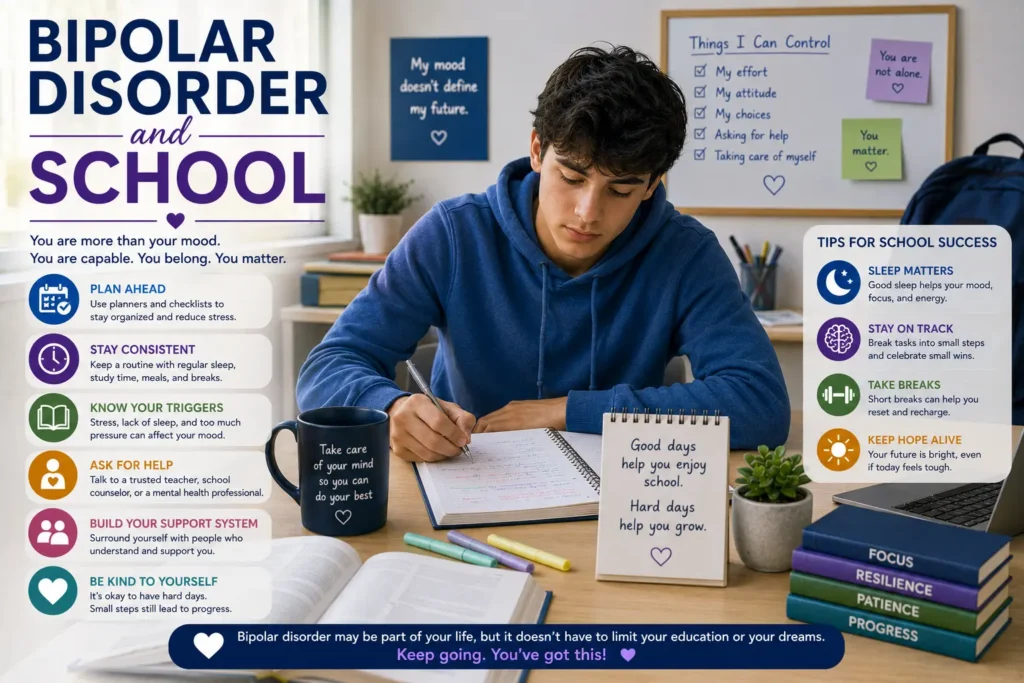
Students with Bipolar Disorder and Schoolr can succeed academically with the right combination of consistent treatment, protected sleep and routine, and appropriate school accommodations. The condition affects concentration, energy, and mood in ways that directly collide with school demands — early classes, exams, social pressure — but these challenges are manageable with planning. Whether you’re a student navigating this yourself, a parent supporting a child, or an educator trying to understand a student’s needs, the same core principle applies: structure and early recognition of warning signs prevent most school-related crises.
Table of Contents
Introduction
School runs on schedules, deadlines, and sustained attention — three things bipolar disorder can directly disrupt. A manic episode might show up as racing thoughts during an exam. A depressive episode might look like missed assignments and days of not getting out of bed. For younger students, mood episodes can also be misread as behavioral problems rather than symptoms of a medical condition.
This guide covers bipolar disorder across the school years — from children and teenagers still living at home to college students managing things independently for the first time. If you’re new to the condition itself, start with what bipolar disorder is and the general symptoms, since how those symptoms show up varies meaningfully by age.
Key Takeaways
- Bipolar disorder can appear at any school stage, though diagnosis in children is less common and often more complex than in teens or adults.
- Sleep disruption — common during exam periods and college life — is one of the strongest known triggers for episodes.
- Legal protections like IEPs, 504 Plans, and college disability services can provide real academic accommodations.
- Mood episodes can be mistaken for laziness, defiance, or typical teenage moodiness, which often delays diagnosis.
- College presents specific risks: irregular schedules, less parental oversight, and higher substance use exposure.
- A written plan — shared with the right school staff — prevents most academic crises from spiraling.
How Bipolar Disorder Looks at Different School Stages
| Age Group | Common Presentation |
| Children | Diagnosis is more complex; mood may appear as extreme irritability, explosive outbursts, or dramatic shifts rather than “classic” mania — often requires careful evaluation to distinguish from other conditions |
| Teenagers | Mood episodes may be dismissed as normal teen moodiness; sleep changes, risk-taking, withdrawal, and academic decline are common signs worth taking seriously |
| College students | Reduced structure and parental oversight often expose symptoms that were previously managed at home; irregular sleep and substance use are common triggers |
For a deeper look at how symptoms present across ages, see our guides on bipolar symptoms in children and bipolar symptoms in teenagers. If diagnosis is still in progress, our pages on bipolar diagnosis in children and bipolar diagnosis in teenagers explain how clinicians approach evaluation at these ages, which differs from diagnosis in adults.
How Mood Episodes Affect School Performance
| Mood State | Effect on Academic Life |
| Mania | Racing thoughts that disrupt focus during tests, impulsive decisions (skipping class, risky behavior), reduced sleep leading to exhaustion, conflict with teachers or peers |
| Hypomania | Bursts of productivity and confidence that can look positive short-term but often crash into missed deadlines afterward |
| Depression | Difficulty concentrating, missed assignments, absenteeism, withdrawal from friends and activities, physical fatigue |
| Mixed episodes | Agitation combined with low mood — can look like irritability or acting out without an obvious trigger |
Understanding the distinction between mania and hypomania is especially useful for older students and parents, since hypomanic “productive” phases are easy to mistake for a positive trend rather than an early warning sign.
Recognizing Warning Signs at School
Teachers, parents, and students themselves are often the first to notice patterns before a formal diagnosis. Common signs worth paying attention to include:
- A noticeable drop in grades without an obvious cause
- Sudden changes in sleep — needing far less or far more than usual
- Explosive irritability that feels disproportionate to the situation
- Withdrawal from friends, clubs, or activities the student previously enjoyed
- Risky behavior, including substance use, that’s out of character
- Alternating stretches of high energy and low motivation
Our page on early signs of bipolar disorder covers these patterns in more depth, and can help distinguish typical adolescent ups and downs from signs that warrant a professional evaluation.
Getting a Diagnosis While in School
If symptoms are affecting school life, an evaluation by a psychiatrist, psychologist, or pediatric mental health specialist is the appropriate next step — not a school counselor alone, though counselors can be a helpful starting point for referrals. Diagnosis typically involves a clinical interview, symptom history, and sometimes input from parents or teachers about patterns over time, especially for younger students. Our guide on how bipolar disorder is diagnosed walks through what this process generally looks like, and bipolar misdiagnosis explains why getting an accurate diagnosis sometimes takes longer than expected, particularly in younger patients whose symptoms can overlap with other conditions.
School Accommodations and Legal Protections
K-12 Students
In the U.S., students with a documented mental health condition like bipolar disorder may qualify for support through:
| Support Option | What It Provides |
| 504 Plan | Accommodations like extended test time, flexible deadlines, or a quiet testing space, without a full special education designation |
| Individualized Education Program (IEP) | More extensive support for students whose symptoms significantly affect learning, potentially including specialized instruction |
| Informal teacher accommodations | Case-by-case adjustments arranged directly with teachers, often a starting point before formal plans are in place |
Getting a 504 Plan or IEP typically requires documentation from a healthcare provider and a formal request to the school’s special education or student services office. Requirements vary by school district and country, so it’s worth confirming the specific process locally.
College Students
College accommodations work differently than K-12 support — the responsibility shifts to the student to initiate contact with the school’s disability services office, usually with documentation from a treatment provider. Common college accommodations include:
- Extended time on exams
- Flexibility on attendance policies during documented medical episodes
- Priority registration to build a schedule that protects sleep consistency
- Access to a reduced course load without losing full-time student status
- Permission for excused absences tied to medical appointments
Unlike K-12, parents generally can’t access or request these accommodations directly once a student turns 18, due to privacy protections — the student needs to initiate the process themselves, which is worth planning for before starting college.
College-Specific Risks and Strategies
College introduces a unique set of challenges that often coincide with when bipolar disorder first becomes apparent or significantly worsens — the typical age of onset frequently overlaps with the college years.
| Risk Factor | Why It Matters | Practical Response |
| Irregular sleep schedules | Sleep disruption is a major trigger for mood episodes | Protect a consistent sleep window even during exam periods or social events |
| Increased alcohol and substance exposure | Can trigger episodes and interact with medications | Be intentional about limits, and understand medication interactions with a provider |
| Reduced parental oversight | Treatment adherence becomes fully the student’s responsibility | Set up your own reminders and check-ins rather than relying on someone else to notice a slip |
| Academic pressure and unstructured time | Stress is a known trigger, and college often lacks the daily structure of home life | Build a personal routine around classes, meals, and sleep, even without external structure |
| Distance from established care providers | Continuity of treatment can break when moving away from home | Set up care with a campus health center or local provider before symptoms escalate, not after |
Our guide to lifestyle changes for bipolar disorder and how to manage bipolar disorder covers routine-building strategies that apply directly to college life.
Treatment Continuity During the School Year
Consistent treatment is the single strongest protective factor for academic stability. This generally means:
- Staying on a prescribed treatment plan, including medication and therapy, even during busy or stressful academic periods
- Never stopping medication without medical guidance, even if symptoms feel well-controlled
- Coordinating with campus health services or a local provider if moving away from home for college
- Using therapy approaches like cognitive behavioral therapy to build coping skills specific to academic stress
A Practical Checklist for Students and Parents
- [ ] Confirm a diagnosis with a qualified mental health professional, not just school observation
- [ ] Set up a consistent treatment plan with a psychiatrist and/or therapist
- [ ] Identify personal early warning signs and write them down
- [ ] Explore whether a 504 Plan, IEP, or college disability accommodation is appropriate
- [ ] Build a sleep-protective daily routine, especially around exam periods
- [ ] Identify a trusted school contact (counselor, professor, RA) who can help if symptoms escalate
- [ ] Create a plan for what happens if an episode occurs during exams or major deadlines
- [ ] For college students: set up local care before symptoms become urgent, not after
Myths vs. Facts About Bipolar Disorder and School
| Myth | Fact |
| “A student with bipolar disorder can’t succeed academically.” | With consistent treatment and appropriate accommodations, many students with bipolar disorder perform well academically. |
| “Bipolar disorder in kids is just normal moodiness.” | While diagnosis in children requires careful evaluation, persistent and extreme mood episodes are not the same as typical childhood moodiness. |
| “Accommodations give students an unfair advantage.” | Accommodations create equal access to learning for a documented medical condition — they don’t lower academic standards. |
| “College students should just push through episodes to keep up.” | Pushing through a significant episode without treatment often worsens outcomes; using accommodations and medical leave when needed supports better long-term academic success. |
For a wider set of common misconceptions, see our bipolar disorder myths page.
When to Seek Immediate Help
Contact a school counselor, healthcare provider, or emergency services if a student shows:
- Thoughts of suicide or self-harm
- Signs of psychosis, including hallucinations or delusions
- Behavior that puts their safety or others’ safety at risk
- Inability to attend to basic needs (eating, sleeping, hygiene) for several days
In the U.S., the 988 Suicide & Crisis Lifeline is available by call or text at any time, and many campuses have their own crisis lines through student health or counseling services. If there’s immediate danger, call 911 or go to the nearest emergency room. In some cases, short-term hospitalization during a severe episode is the safest path to stabilization and shouldn’t be seen as an academic failure.
Frequently Asked Questions
Can a student with bipolar disorder go to college? Yes. Many students with bipolar disorder attend and complete college successfully, particularly with consistent treatment and use of available disability accommodations.
What accommodations can students with bipolar disorder get? Common accommodations include extended test time, flexible attendance policies, priority registration, and excused absences for medical appointments — available through a 504 Plan or IEP in K-12, and through disability services in college.
Is bipolar disorder common in children? Diagnosis in children is less common than in teens or adults and requires careful clinical evaluation, since symptoms can overlap with other conditions. A qualified specialist should make this determination rather than assuming based on mood alone.
How can parents support a teenager with bipolar disorder at school? Stay engaged with the school’s support team, help maintain treatment consistency, protect sleep routines, and communicate openly with teachers about what accommodations or flexibility might help.
Do I need to tell my professors I have bipolar disorder? Not necessarily in detail — most accommodation requests through a college’s disability services office don’t require disclosing your full diagnosis to individual professors, only documentation that a condition exists.
What triggers bipolar episodes in students specifically? Sleep disruption, academic stress, substance use, and irregular routines are common triggers in school and college settings, similar to triggers in other areas of life but often intensified by exam schedules and social pressures.
Summary
Bipolar disorder and school demands can collide in ways that feel overwhelming, but they’re manageable with the right structure. Consistent treatment, early recognition of warning signs, protected sleep, and appropriate accommodations — whether a 504 Plan, an IEP, or college disability services — give students a real path to academic success. Whether you’re the student, a parent, or someone supporting one, the goal isn’t a perfect academic record. It’s a plan sturdy enough to hold up through the inevitable rough stretches.
This article is for educational purposes and isn’t a substitute for personalized medical or educational guidance. If a student is experiencing symptoms of bipolar disorder, consider consulting a licensed healthcare professional and the school’s student services or disability office.