
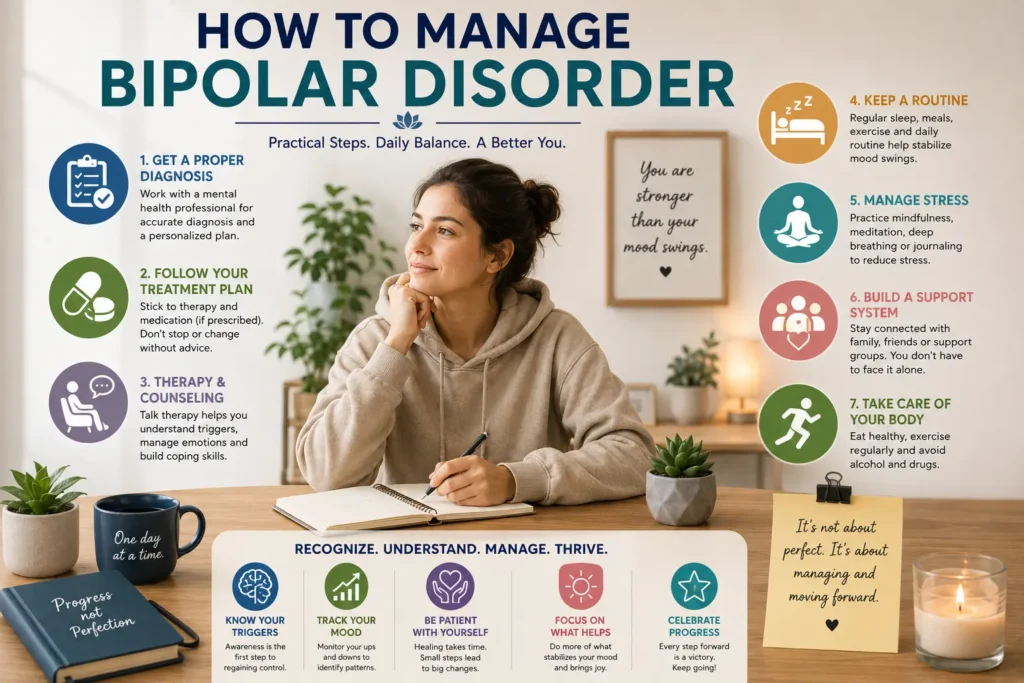
How to Manage Bipolar Disorder: Managing bipolar disorder well usually means combining consistent medical treatment with daily habits that protect your mood—steady sleep, a predictable routine, stress management, mood tracking, and a support system that can spot warning signs early.
There’s no single fix. It’s an ongoing process of working with a psychiatrist or therapist while building self-management skills around it. This guide focuses on the day-to-day management side; if you’re looking for information on bipolar disorder treatment itself, including medication and therapy options, that’s covered in more depth in our dedicated guide.
Table of Contents
Key Takeaways
- Bipolar disorder can’t be managed through lifestyle changes alone — professional treatment is the foundation, and self-management works alongside it, not instead of it.
- Sleep is one of the most powerful levers for mood stability; disrupted sleep is a common trigger for both mania and depression.
- Mood tracking helps you and your provider catch early warning signs before a full episode develops.
- A predictable daily routine supports the body’s internal clock, which tends to be more sensitive to disruption in bipolar disorder.
- Building a support network — family, friends, or a support group — gives you an outside perspective when you can’t always trust your own read on your mood.
- Management looks different across bipolar 1, bipolar 2, and other types, so it helps to understand your specific diagnosis first.
Why “Managing” Bipolar Disorder Is Different From “Treating” It
Treatment and management aren’t the same thing, even though people often use the words interchangeably.
Treatment refers to the clinical side: medication, therapy, and psychiatric monitoring. It’s what a doctor or therapist prescribes and oversees. You can read more about the specific options in our guide to bipolar disorder treatment.
Management is broader. It’s everything you do day to day to support that treatment and reduce the chances of a mood episode — your sleep habits, how you handle stress, how closely you track your mood, and how prepared you are when early warning signs show up.
Neither one works well without the other. Self-management strategies without proper medical treatment tend to fall short for a biological condition like bipolar disorder. But medication without any self-management often leaves people vulnerable to triggers that could have been caught early.
Start With an Accurate Diagnosis
Good management starts with knowing exactly what you’re managing. Bipolar disorder isn’t one uniform condition — bipolar 1, bipolar 2, and cyclothymia involve different patterns of mood episodes, and your management plan should reflect that. If you haven’t been formally diagnosed yet, or you’re unsure which type applies to you, it’s worth reading our guides on bipolar disorder diagnosis and bipolar disorder symptoms before going further, and bringing what you learn to a licensed mental health professional.
The Foundation: Working With a Treatment Team
Self-management strategies are most effective when they’re built together with a psychiatrist or therapist, not created in isolation. A typical treatment team might include:
| Provider | Role |
| Psychiatrist | Prescribes and monitors medication, adjusts treatment over time |
| Therapist or psychologist | Provides talk therapy, coping skills, and ongoing support |
| Primary care doctor | Monitors overall physical health, which affects mood stability |
| Support group or peer network | Offers shared experience and practical, lived-in advice |
If you haven’t started treatment yet, that’s the first step — self-management works best as a supplement to professional care, not a replacement for it.
Building a Daily Routine That Protects Your Mood
Bipolar disorder is closely tied to the body’s internal clock, known as the circadian rhythm. Irregular routines — going to bed at different times, skipping meals, inconsistent activity levels — can throw that rhythm off and contribute to mood instability.
A therapy called Interpersonal and Social Rhythm Therapy (IPSRT) is built entirely around this idea: that keeping daily routines consistent helps stabilize mood. You don’t need to be in formal IPSRT to borrow its core principle.
Practical ways to build routine stability:
- Wake up and go to sleep at roughly the same time every day, including weekends
- Eat meals on a consistent schedule
- Schedule medication at the same time each day
- Build in regular physical activity, even if it’s just a daily walk
- Block off time for relaxation or wind-down before bed
Small, boring consistency tends to matter more than any single “big” intervention.
Sleep: The Single Biggest Lever
Sleep deserves its own section because of how strongly it’s linked to mood episodes in bipolar disorder. Sleep loss can trigger mania or hypomania, and oversleeping is often a sign of an oncoming depressive episode.
A few evidence-informed sleep habits that help:
| Habit | Why It Helps |
| Consistent sleep and wake times | Supports circadian rhythm stability |
| Aim for 7–9 hours nightly | Sleep deprivation is a known trigger for manic symptoms |
| Limit screens and stimulation before bed | Reduces sleep-onset delay |
| Track sleep alongside mood | Helps identify early warning signs before an episode develops |
| Avoid caffeine and alcohol close to bedtime | Both interfere with sleep quality and mood regulation |
Some people use sleep-tracking apps or a simple written log to catch shifts early. Since sleep disturbance is often one of the first signs of an approaching episode, this is one of the more actionable tools available for self-management, separate from medication itself.
Mood Tracking: Catching Patterns Before They Become Episodes
A mood diary or tracking app is one of the most commonly recommended self-management tools for bipolar disorder — and one of the easiest to actually start using.
What to track:
- Daily mood rating (a simple 1–10 scale works)
- Sleep duration and quality
- Energy level
- Stressful events or major changes
- Medication adherence
- Physical symptoms (appetite changes, restlessness, fatigue)
Over weeks and months, patterns tend to emerge. You might notice your mood dips two days after a poor night’s sleep, or that irritability creeps in before a manic episode fully develops. That information is genuinely useful — both for you and for your psychiatrist, who can use it to fine-tune treatment.
Many people find it easier to stick with tracking through a phone app rather than paper, simply because it takes less effort in the moment. The specific tool matters far less than consistency.
Identifying and Managing Personal Triggers
Everyone with bipolar disorder tends to have a slightly different set of triggers. Common ones include:
- Disrupted sleep
- High stress or major life changes
- Conflict in relationships
- Substance use, including alcohol
- Seasonal changes
- Skipping medication doses
Once you notice a pattern, you can build a plan around it. If work stress reliably worsens your mood, that might mean setting firmer boundaries or building in more recovery time. If travel across time zones disrupts your sleep and triggers symptoms, that might mean adjusting your sleep schedule in advance of a trip. To better understand what tends to set off manic symptoms specifically, our guide on mania triggers goes into more detail.
Stress Management Techniques That Actually Help
Stress doesn’t cause bipolar disorder, but it’s one of the most consistent triggers for episodes in people who already have it. Reducing stress load — and building better tools to handle the stress you can’t avoid — is a core part of day-to-day management.
Useful approaches include:
- Pacing your commitments. Overloading your schedule increases the odds of a stress-triggered episode. It’s okay to say no or scale back.
- Practicing grounding or breathing techniques. Simple breathing exercises can help in the moment when stress starts to spike.
- Delaying big decisions during high stress or mood shifts. Ask a trusted person to weigh in before making major financial, relationship, or career decisions during unstable periods.
- Scheduling downtime, not just to-do lists. Recovery time is part of a functioning routine, not a luxury.
Nutrition, Exercise, and Substance Use
These day-to-day physical habits don’t replace medication, but they meaningfully support mood stability.
| Area | What Helps |
| Exercise | Regular movement supports mood regulation and sleep quality |
| Diet | Consistent meal timing helps stabilize energy and mood; limiting excess sugar and caffeine can reduce mood swings for some people |
| Alcohol | Best avoided or minimized — it interferes with medication and sleep, and can trigger episodes |
| Recreational drugs | Can trigger both manic and depressive episodes and interfere with treatment |
| Hydration | Supports general physical stability, which indirectly supports mood |
None of these are a treatment for bipolar disorder on their own. They work best as supporting habits around your actual medical care.
Building a Support Network
Bipolar disorder can distort your own read on your mood — during a manic episode, for example, it’s common to feel completely fine, even as the people around you notice something is off. That’s exactly why an outside perspective matters.
Ways to build support:
- Loop in a small number of trusted people — family or close friends — on what your early warning signs look like
- Ask them to gently flag it if they notice those signs, without it feeling like an accusation
- Consider a bipolar-specific support group, in person or online, for shared experience and practical tips
- If you have a partner or family member involved in your care, family-focused therapy approaches can help everyone get on the same page
Support networks work best when they’re set up in advance, during a stable period — not improvised in the middle of a crisis.
Medication Adherence: Why It’s Central to Management
No amount of routine-building, sleep hygiene, or stress management fully substitutes for consistent medication when it’s part of your treatment plan. Missed doses are one of the most common triggers for relapse.
A few practical adherence strategies:
- Use a pill organizer or medication reminder app
- Tie medication timing to an existing daily habit (like brushing your teeth)
- Keep a small backup supply for travel
- Talk openly with your psychiatrist about side effects rather than stopping on your own — many side effects can be managed or the medication adjusted
If you’re weighing whether medication is necessary at all, it’s worth reading about bipolar disorder treatment without medication — including why most treatment guidelines still consider medication central to managing the condition safely.
The Role of Therapy in Ongoing Management
Therapy gives structure to a lot of the self-management ideas covered here. A few approaches commonly used alongside medication:
- Cognitive behavioral therapy (CBT) — helps identify and shift unhelpful thought patterns; see our guide on cognitive behavioral therapy for bipolar disorder
- Dialectical behavior therapy (DBT) — focuses on emotional regulation and distress tolerance; see our guide on dialectical behavior therapy for bipolar disorder
- Psychoeducation — helps you and often your family understand the condition and treatment adherence
- Family-focused therapy — improves communication and reduces conflict in the household
For a broader overview of therapy options, visit our full guide to bipolar therapy.
A Weekly Self-Management Checklist
| Task | Frequency |
| Take medication as prescribed | Daily |
| Log mood, sleep, and energy | Daily |
| Maintain consistent sleep/wake times | Daily |
| Check in with a support person | Weekly |
| Review mood log for patterns | Weekly |
| Attend therapy or psychiatry appointments | As scheduled |
| Reassess stress load and commitments | Weekly |
This isn’t a rigid prescription — it’s a starting template you can adjust with your treatment team.
Dos and Don’ts of Day-to-Day Management
| Do | Don’t |
| Keep a consistent sleep schedule | Pull all-nighters or drastically shift sleep times |
| Track mood and sleep patterns | Rely only on memory to notice changes |
| Loop in a support person on your warning signs | Isolate during early symptoms |
| Talk to your psychiatrist about side effects | Stop medication abruptly without medical guidance |
| Build in recovery time after stressful periods | Overload your schedule during a stable phase |
Warning Signs That Need Immediate Attention
Self-management tools are meant to catch problems early — but some signs need a faster response than a routine check-in:
- Thoughts of suicide or self-harm
- Rapidly escalating manic symptoms, such as little to no sleep for several days, reckless spending, or dangerous risk-taking
- Psychotic symptoms, including hallucinations or delusions
- A sudden, severe depressive crash
- Inability to care for basic needs (eating, hygiene, safety)
If you or someone you know is experiencing any of these, contact a psychiatrist, crisis line, or emergency services right away. Self-management strategies support long-term stability, but they aren’t a substitute for emergency care during an acute crisis.
Frequently Asked Questions
Can bipolar disorder be managed without medication? For most people, medication remains a core part of safely managing bipolar disorder. Lifestyle strategies can meaningfully support stability, but they generally aren’t sufficient as a stand-alone treatment. See our guide on bipolar disorder treatment without medication for a closer look at this question.
What is the best daily routine for bipolar disorder? There’s no single “best” routine, but consistency matters more than the specifics — regular sleep and wake times, regular meals, scheduled medication, and built-in downtime tend to support mood stability across bipolar 1, bipolar 2, and related diagnoses.
How do I know if my mood swings are getting worse? Mood tracking is the most reliable way to catch this early. Look for changes in sleep, energy, and irritability that build over several days, rather than a single bad day. If you’re unsure whether what you’re noticing fits a manic or depressive pattern, our guide on bipolar disorder symptoms can help you compare.
Does stress cause bipolar disorder? No — bipolar disorder has a strong biological and genetic basis, covered in more detail in our guide to bipolar disorder causes. Stress doesn’t cause the condition, but it’s a well-documented trigger for episodes in people who already have it.
Can lifestyle changes reduce the number of bipolar episodes? Consistent sleep, routine, and stress management are associated with fewer and less severe mood episodes for many people, particularly alongside proper medical treatment. Our guide on lifestyle changes for bipolar disorder covers this in more depth.
Is it normal to need ongoing support long after diagnosis? Yes. Bipolar disorder is typically a lifelong condition, and most people continue working with a treatment team indefinitely, even during long stable periods. Our guide on bipolar disorder prognosis explains what long-term outlook typically looks like.
What should I do if I notice early warning signs of mania? Contact your psychiatrist as soon as possible, avoid major decisions until things stabilize, and lean on your support network. Catching early signs — before sleep loss and impulsivity escalate — often makes a real difference in how severe the episode becomes.
Summary
Managing bipolar disorder isn’t about a single fix — it’s a combination of consistent medical treatment and daily habits that protect your mood: steady sleep, routine, stress management, mood tracking, and a support system that can catch warning signs you might miss on your own. None of these self-management tools replace medication or therapy, but layered together with proper treatment, they give you real influence over how stable your day-to-day life feels. If you’re building or adjusting your management plan, the best next step is an honest conversation with your psychiatrist or therapist about what’s working and what isn’t.
This article is for educational purposes and is not a substitute for professional medical advice. If you are having thoughts of suicide or self-harm, please contact a crisis line or emergency services in your area immediately.