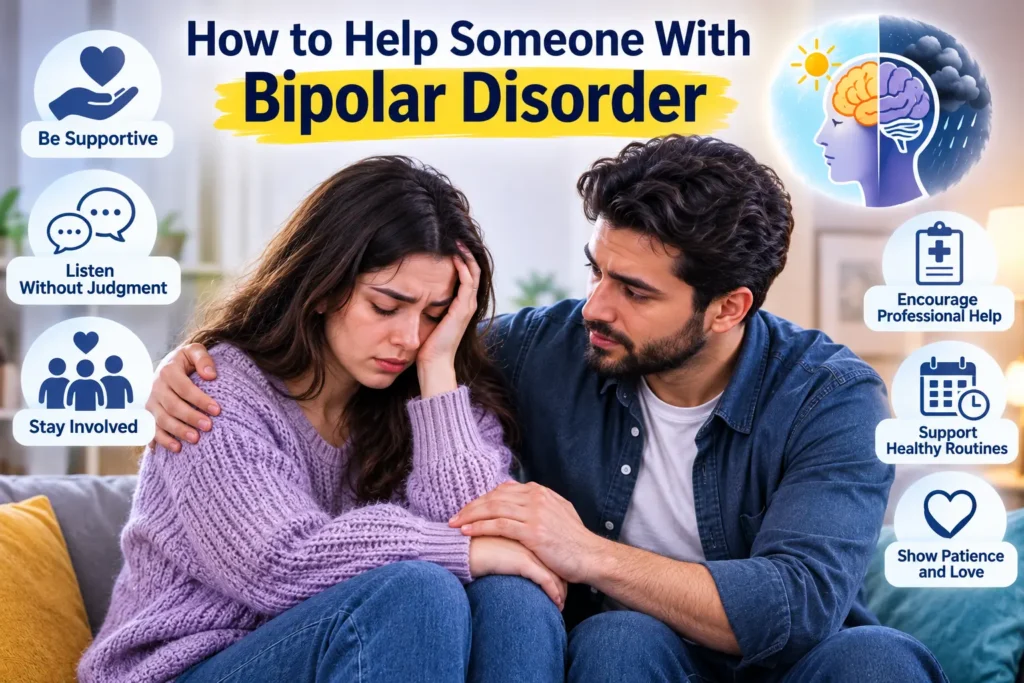
How to Help Someone With Bipolar Disorder The most helpful things you can do are: learn the person’s individual warning signs, respond calmly rather than reactively during episodes, encourage (not enforce) treatment, build a crisis plan together while things are stable, and protect your own mental health along the way. Bipolar disorder is a treatable medical condition, not a character flaw, and consistent, low-drama support makes a measurable difference in how well someone manages it.
Table of Contents
Key Takeaways
- Support looks different in mania, depression, and stable periods — a one-size-fits-all approach doesn’t work.
- Learning a person’s personal early warning signs is often more useful than memorizing textbook symptoms.
- Pushing too hard during an episode can backfire; calm, boundaried responses tend to work better than confrontation.
- A written crisis plan, created during a stable period, saves critical time in an emergency.
- Caregiver burnout is common and predictable — supporting someone well starts with not neglecting yourself.
Understanding What You’re Supporting
Before jumping into strategies, it helps to know what you’re actually responding to. Bipolar disorder involves shifts between manic or hypomanic episodes and depressive episodes, on top of a person’s baseline personality. For the full clinical picture — symptoms, subtypes, and how it’s diagnosed — see our complete guides to bipolar disorder and what bipolar disorder actually is.
This guide won’t re-explain the diagnostic criteria. Instead, it focuses on one question: what actually helps, day to day, when you’re the one supporting someone through it.
Start by Learning Their Personal Pattern, Not Just the Textbook Version
Two people with bipolar disorder can look completely different during an episode. One person gets talkative and can’t sleep; another gets irritable and picks fights. One person withdraws during depression; another masks it well until they crash.
Ask your loved one, during a calm period, questions like:
- “What’s usually the first sign, for you, that things are shifting?”
- “What helps when you’re starting to feel manic or depressed?”
- “What makes things worse when I try to help?”
This single conversation often does more good than any generic advice, because it turns you from a guesser into someone who can recognize their specific pattern early. For a general overview of what those patterns can include, see early signs of bipolar disorder and bipolar disorder symptoms.
How to Help During a Manic or Hypomanic Episode
Mania and hypomania can feel exciting and confusing to witness — the person may seem more confident, energetic, and talkative than usual, which can make it hard to tell where “having a good week” ends and an episode begins. For the clinical distinction, see our guide on mania vs. hypomania.
What tends to help:
- Stay calm and avoid matching their intensity or arguing about grandiose plans in the moment
- Gently raise concerns using “I” statements: “I’m noticing you haven’t slept in two days, and I’m worried”
- Protect finances if possible — hide credit cards, involve a trusted third party, or set spending alerts, ideally agreed upon in advance
- Encourage (don’t force) contact with their psychiatrist or therapist
- Reduce stimulation — loud environments, big decisions, and conflict tend to escalate mania
What tends to make things worse:
- Trying to “logic” someone out of a manic state — it rarely works and can increase irritability
- Confrontation in front of others, which can trigger shame or anger
- Enabling risky decisions “to keep the peace” (large purchases, driving after no sleep, sudden trips)
Details on causes and triggers behind manic episodes are covered in causes of mania and mania triggers.
How to Help During a Depressive Episode
Bipolar depression can look identical to major depressive disorder from the outside — low energy, hopelessness, loss of interest, trouble concentrating — but it’s part of the same underlying condition as the manic phase.
What tends to help:
- Show up consistently, even in small ways (a text, sitting with them, running an errand)
- Avoid phrases like “just snap out of it” or “think positive” — depression isn’t a mindset problem
- Help with basic tasks without taking over completely (offer to do dishes together rather than doing everything for them)
- Ask directly about suicidal thoughts if you’re worried — this does not “plant the idea” and can open a critical conversation
- Encourage professional support gently, without ultimatums
What tends to make things worse:
- Taking withdrawal personally
- Excessive cheerleading (“but you have so much to be happy about!”)
- Ignoring warning signs out of fear of overreacting
If you notice signs that go beyond low mood — see the Warning Signs and Emergency Help sections below.
Supporting Someone Between Episodes
The period between episodes is when a lot of the most useful support happens, even though it gets the least attention.
- Protect routine. Consistent sleep, meals, and daily structure are strongly linked to mood stability in bipolar disorder. Helping maintain a predictable schedule is genuinely protective. See mania and sleep for how sleep disruption specifically affects mood.
- Support treatment consistency. This might mean helping track appointments, understanding medication basics, or simply not undermining the value of treatment. Our guides on bipolar medications and bipolar therapy explain the main treatment categories.
- Talk about relapse prevention together. Many people with bipolar disorder benefit from identifying personal relapse triggers in advance. See bipolar relapse prevention for a structured approach.
- Celebrate stability without walking on eggshells. Stable periods are real progress, not just “the calm before the next episode.”
Build a Crisis Plan Before You Need One
Waiting until a crisis to figure out what to do adds panic and delay to an already difficult moment. Build a simple plan together while things are calm.
| Crisis Plan Element | What to Include |
| Warning signs | This person’s specific early signs of mania and depression |
| Contacts | Psychiatrist, therapist, and one trusted backup contact |
| Medication info | Current medications, dosages, and pharmacy |
| Preferred hospital | If hospitalization has happened before, note where |
| De-escalation notes | What has helped in past episodes; what to avoid |
| Emergency numbers | Crisis line, local emergency services |
For more on what hospitalization involves and when it becomes necessary, read hospitalization for bipolar disorder.
A Practical Support Checklist
Use this as a quick reference, not a rulebook — every relationship is different.
- [ ] I know this person’s early warning signs for both mania and depression
- [ ] I know who to contact in a mental health emergency
- [ ] We’ve talked about what kind of support actually helps them
- [ ] I have a plan for protecting finances during manic episodes, if needed
- [ ] I check in during stable periods, not just during crises
- [ ] I have my own outlet for stress (friend, therapist, support group)
- [ ] I know the difference between supporting someone and taking over their life
Communication Scripts That Actually Work
Knowing what to say is often harder than knowing what to do. A few starting points:
- Instead of “You need to calm down” → “I can see you have a lot of energy right now — can we sit with that for a minute?”
- Instead of “Why can’t you just get out of bed?” → “I’m not going anywhere. Is there one small thing I can help with today?”
- Instead of “You’re being irrational” → “I hear you. Can we talk about this again tomorrow when we’ve both had some rest?”
- Instead of silence around suicidal thoughts → “I’ve noticed you seem really low. Are you having thoughts of hurting yourself?”
These aren’t scripts to recite word-for-word — they’re a starting tone: calm, specific, and non-judgmental.
Dos and Don’ts When Supporting Someone With Bipolar Disorder
| Do | Don’t |
| Learn their specific warning signs | Assume every episode looks like the last one |
| Respond calmly, even during conflict | Escalate with arguments or ultimatums |
| Encourage professional treatment | Try to be their only source of “treatment” |
| Set boundaries around your own limits | Sacrifice your wellbeing indefinitely |
| Ask directly about suicidal thoughts when concerned | Avoid the topic out of fear |
| Celebrate stable periods | Treat stability as just a pause before the next crisis |
Myths vs Facts About Supporting Someone With Bipolar Disorder
| Myth | Fact |
| If you love someone enough, you can help them “snap out of” an episode | Bipolar disorder is a medical condition requiring treatment, not willpower or love alone |
| You should always agree with someone during mania to avoid conflict | Calm, honest concern is more helpful than agreement with unsafe decisions |
| Talking about suicide will make someone more likely to attempt it | Directly and calmly asking about suicidal thoughts is a recognized, safe way to open the conversation |
| Supporters should handle everything themselves | Professional treatment, not family or friends alone, should lead clinical care |
| Once someone is stable, ongoing support isn’t necessary | Bipolar disorder is a lifelong, relapsing condition that benefits from ongoing support even in stable periods |
For a broader myth-busting resource on the condition itself, see bipolar disorder myths.
Avoiding Caregiver Burnout
Supporting someone with a chronic mental health condition is genuinely demanding, and burnout among caregivers and family members is common and well recognized in mental health research. Signs to watch for in yourself include:
- Chronic exhaustion or resentment
- Neglecting your own health, work, or relationships
- Feeling responsible for every mood shift in your loved one
- Isolating from your own support network
What helps:
- Individual therapy or counseling for yourself
- Peer support groups for family members and caregivers
- Clear boundaries about what you will and won’t manage
- Accepting that you cannot prevent every episode, no matter how well you support them
Our guide on bipolar disorder and family covers family-wide dynamics in more depth, including relationship-specific strain and family therapy options.
Warning Signs That Need Immediate Attention
Reach out for professional or emergency help if you notice:
- Talk of suicide, self-harm, or feeling like a burden
- Giving away possessions, saying goodbye, or sudden calm after a period of despair
- Signs of psychosis — hearing voices, paranoia, delusions (see psychosis in mania)
- No sleep for multiple consecutive days
- Reckless behavior that puts safety at risk
- Complete withdrawal from food, hygiene, or communication
Emergency Help
If someone is in immediate danger of harming themselves or others, call 911 (US) or go to the nearest emergency room.
988 Suicide & Crisis Lifeline (US): Call or text 988, available 24/7, for free and confidential support.
If you are supporting someone in crisis right now, use these resources immediately — everything else in this guide can wait. And if the weight of supporting someone is affecting your own mental health, that’s worth addressing with a professional too, not just something to push through.
Frequently Asked Questions
What should I never say to someone with bipolar disorder? Avoid dismissive phrases like “just think positive,” “you’re overreacting,” or “you don’t seem bipolar.” These minimize a medical condition and can make someone less likely to open up in the future.
How do I get someone with bipolar disorder to accept treatment if they refuse? You can’t force treatment unless there’s an imminent safety risk that meets a legal threshold for intervention. What helps more is calm, repeated, non-judgmental encouragement, and addressing specific fears (side effects, stigma, cost) rather than issuing ultimatums. See stopping bipolar medication for related guidance if treatment has already started and stopped.
Is it my fault if I say the wrong thing during an episode? No single comment causes an episode. Mood episodes are driven by underlying biological and neurological factors, not triggered solely by a conversation. That said, calm communication does reduce conflict and stress in the moment.
Can I set boundaries with someone who has bipolar disorder without being cruel? Yes — boundaries and compassion aren’t opposites. Clear limits (“I can’t lend money during a manic episode” or “I need us to revisit this conversation tomorrow”) protect the relationship long-term.
How is helping someone with bipolar 1 different from bipolar 2? The core support principles are similar, but Bipolar 1 involves full manic episodes (sometimes with psychosis) that may require more urgent intervention, while Bipolar 2 involves hypomania, which is less severe but paired with significant depressive episodes. See our full Bipolar 1 vs Bipolar 2 comparison for details.
Should I monitor their medication for them? Generally, adults should manage their own medication with support, not surveillance, unless a healthcare provider specifically recommends otherwise for safety reasons. Reminders and encouragement are usually more effective — and better for the relationship — than monitoring.
What’s the difference between helping and enabling? Helping supports someone’s stability, safety, and treatment. Enabling shields someone from the consequences of harmful choices (repeatedly covering manic spending, for example). If you’re unsure where the line is in your situation, a family therapist can help clarify it.
Do support groups for caregivers actually help? Yes. Peer support groups reduce isolation and give caregivers practical, lived-experience strategies — not just information, but reassurance that these challenges are common and manageable.
Summary
Helping someone with bipolar disorder isn’t about fixing every mood swing — it’s about learning their personal pattern, responding calmly instead of reactively, encouraging consistent treatment, and building a plan before a crisis hits. Support works best when it’s paired with clear boundaries and real attention to your own wellbeing; burnout helps no one. For more on the condition itself and its broader impact on relationships, explore our guides on bipolar disorder and family, bipolar disorder treatment, and living with bipolar disorder.
This article is for educational purposes and does not replace personalized medical advice. If you or someone you know is experiencing a mental health crisis, contact a healthcare professional or crisis service immediately.