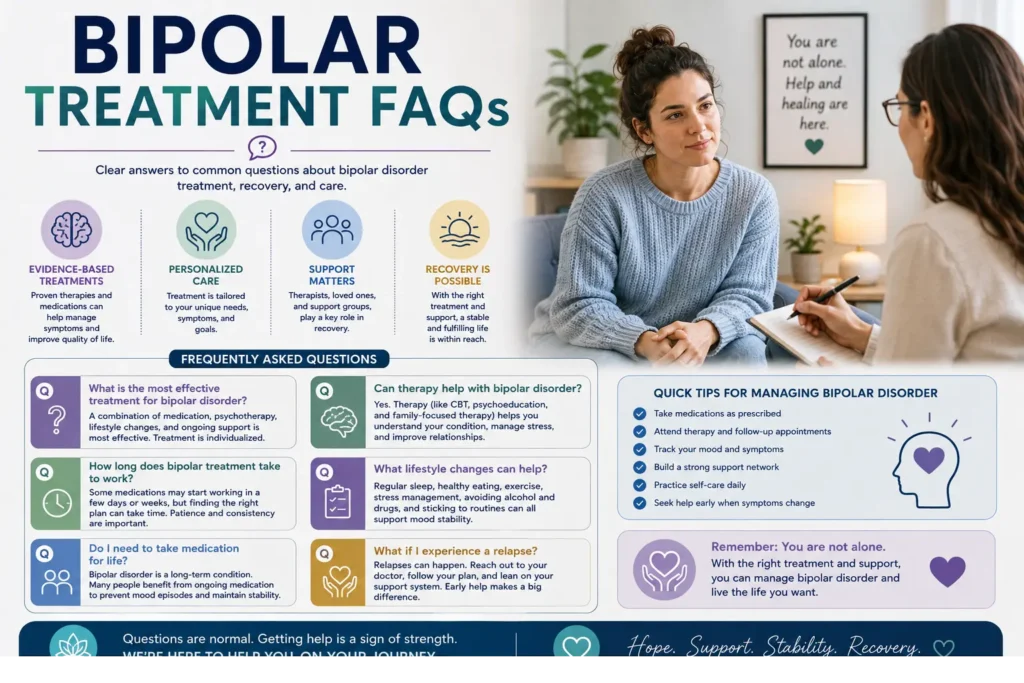
Bipolar Treatment FAQs: Bipolar disorder is treated with a combination of mood-stabilizing medication, targeted psychotherapy, and lifestyle structure—not with any single fix. Most people need ongoing, long-term management rather than a short course of treatment. Below, we answer the questions people ask most often about how bipolar treatment actually works, what it costs, how long it takes, and what to do when things go wrong.
Table of Contents
Introduction
If you or someone you love has just been told “it’s bipolar disorder,” the diagnosis often raises more questions than it answers. What happens now? Do I have to take medication forever? Does therapy actually help, or is it just for talking about feelings?
This guide answers the real questions people search for after diagnosis — in plain English, backed by how psychiatry and clinical psychology actually approach bipolar care today. For background on the condition itself, see our guide to what bipolar disorder is and bipolar disorder symptoms. If you’re still working through a diagnosis, our bipolar disorder diagnosis guide walks through that process in detail.
We won’t re-explain diagnosis, causes, or the difference between bipolar types here — those live in their own dedicated guides, linked throughout. This article is focused entirely on treatment: what it involves, why it works the way it does, and how to navigate it.
Key Takeaways
- Bipolar disorder has no cure, but it’s highly manageable with the right combination of treatments.
- Medication is the foundation of treatment for most people; therapy adds skills that medication alone can’t provide.
- Treatment plans differ for Bipolar 1 and Bipolar 2, since the two involve different mood episode patterns.
- Stopping treatment early is the single biggest predictor of relapse.
- A good treatment plan is built with a psychiatrist, often alongside a therapist, and adjusted over time — it’s rarely “one and done.”
How Is Bipolar Disorder Treated? (The Short Version)
Modern bipolar treatment rests on three pillars:
- Medication — to stabilize mood chemistry and prevent extreme highs and lows.
- Psychotherapy — to build coping skills, catch early warning signs, and manage the life disruption that mood episodes cause.
- Lifestyle structure — sleep, routine, and stress management, because bipolar disorder is unusually sensitive to disruptions in daily rhythm.
None of these three works as well alone as they do combined. The American Psychiatric Association and organizations like the National Institute of Mental Health (NIMH) both frame bipolar disorder as a chronic condition managed through ongoing, combined care — similar in structure to how diabetes or hypertension is managed, rather than something “cured” once.
For a full breakdown of this approach, see our complete bipolar disorder treatment guide.
Frequently Asked Questions About Bipolar Medication
What medications are used to treat bipolar disorder?
Treatment usually draws from a few drug classes:
| Medication Class | Examples (Generic Names) | Main Purpose |
| Mood stabilizers | Lithium, valproate, lamotrigine | Prevent mood episode swings |
| Atypical antipsychotics | Quetiapine, olanzapine, aripiprazole, risperidone | Treat mania, mixed episodes, and sometimes depression |
| Anticonvulsants (also mood stabilizers) | Carbamazepine, valproate | Prevent manic and depressive relapse |
| Antidepressants (used cautiously) | SSRIs, usually combined with a mood stabilizer | Bipolar depression, only under close supervision |
Lithium remains one of the oldest and most studied treatments for bipolar disorder and is particularly well-supported for reducing suicide risk over the long term, according to the American Psychiatric Association. The right medication — or combination — depends on which type of episode is most disruptive, whether the diagnosis is Bipolar 1 or Bipolar 2, and how the person responds and tolerates side effects.
Why can’t antidepressants be used alone for bipolar depression?
Because in someone with bipolar disorder, an antidepressant taken without a mood stabilizer can trigger a manic or hypomanic episode. This is one of the more important differences between treating bipolar depression and treating standard major depression, and it’s why a bipolar diagnosis changes the entire treatment approach — not just the diagnosis label. See bipolar 1 vs 2 depression for how depressive episodes differ across types.
How long does it take for bipolar medication to work?
Timelines vary by symptom and drug:
| Medication | Typical Time to Notice Effect |
| Antipsychotics for acute mania | Days to 1–2 weeks |
| Lithium for mood stabilization | 1–3 weeks, full effect over months |
| Lamotrigine for depressive prevention | Several weeks (dose is increased slowly) |
Because doses are often started low and increased gradually — especially with lamotrigine, to avoid a rare but serious skin reaction — patience is part of the process. Never adjust dosing without your prescriber’s guidance.
Do I have to take medication for life?
For most people with Bipolar 1, yes — long-term or lifelong maintenance treatment is standard, because relapse risk after stopping medication is high, even years into stability. Bipolar 2 sometimes allows more individualized long-term planning, but stopping medication is a decision made with a psychiatrist, never independently. Our bipolar 1 prognosis and bipolar 2 prognosis guides go deeper on long-term outlook.
What are the side effects of bipolar medications?
Side effects differ by drug but commonly include weight changes, drowsiness, tremor, and (for some antipsychotics) metabolic changes like blood sugar or cholesterol shifts. Lithium requires periodic blood tests to monitor levels and kidney/thyroid function. Side effects are a normal part of the conversation with your prescriber — many are manageable through dose adjustment or switching medications, and none should be silently endured.
Can I drink alcohol while on bipolar medication?
Alcohol can interfere with mood stability, interact with medications, and worsen impulsivity during manic or depressive episodes. Most prescribers recommend minimizing or avoiding alcohol entirely. This is a conversation worth having directly with your care team, since interactions vary by medication.
Frequently Asked Questions About Therapy
What type of therapy works best for bipolar disorder?
A few therapy types have the strongest evidence base:
- Cognitive Behavioral Therapy (CBT) — helps identify and interrupt distorted thought patterns that fuel mood episodes. See our CBT for bipolar disorder guide.
- Dialectical Behavior Therapy (DBT) — builds emotional regulation and distress tolerance skills, especially useful for mood instability and impulsivity. See DBT for bipolar disorder.
- Psychoeducation — teaches the person and often their family to recognize early warning signs before a full episode develops.
- Interpersonal and Social Rhythm Therapy (IPSRT) — focuses specifically on keeping daily routines (sleep, meals, activity) stable, since irregular rhythms are a known trigger.
- Family-focused therapy — improves communication and reduces household stress, which lowers relapse risk.
Can therapy replace medication?
No. For Bipolar 1 in particular, therapy alone is not considered sufficient to manage manic episodes, which can involve risk to safety and functioning. Therapy is most effective as an addition to medication, not a substitute for it. It’s worth exploring what therapy without medication can and can’t realistically achieve before deciding to skip medication.
How often do I need therapy sessions?
This depends on where someone is in treatment. During or right after an episode, weekly sessions are common. Once stable, many people shift to biweekly or monthly maintenance sessions. Your therapist will typically adjust frequency based on mood stability, not a fixed calendar.
Frequently Asked Questions About the Treatment Process
What happens right after a bipolar diagnosis?
Typically: a psychiatric evaluation to confirm the diagnosis and episode type, a discussion of medication options, and a referral to a therapist if one isn’t already involved. Severe manic or depressive episodes may require a higher level of care first — see hospitalization for bipolar disorder — before outpatient treatment begins.
Do treatment plans differ for Bipolar 1 and Bipolar 2?
Yes, meaningfully. Bipolar 1 involves full manic episodes that can require higher doses of antipsychotics or mood stabilizers and sometimes hospitalization. Bipolar 2 involves hypomania (a milder high) paired with often more prominent depressive episodes, so treatment tends to weight depression management more heavily. Full comparisons are in our Bipolar 1 vs 2 treatment guide and Bipolar 1 vs 2 chart.
How do I know if my treatment is working?
Signs of effective treatment include fewer and less severe mood episodes, longer stretches of stability, improved sleep, and better day-to-day functioning at work or home — not necessarily the complete absence of mood shifts. Tracking mood, sleep, and medication in a simple log (paper or app) helps you and your psychiatrist spot patterns early.
What if my current treatment isn’t working?
Tell your prescriber directly rather than stopping medication on your own. “Not working” can mean several different things — wrong dose, wrong medication, undiagnosed mixed features, or an unaddressed trigger like poor sleep or substance use — and each has a different fix. Treatment-resistant cases sometimes move to combination therapy, different drug classes, or options like ECT (electroconvulsive therapy), which remains one of the most effective treatments for severe, treatment-resistant mood episodes according to the APA.
Can bipolar disorder go into remission?
Yes — many people reach long stretches with minimal or no symptoms, sometimes called “euthymia” or a stable mood state. Remission doesn’t mean the condition is gone permanently; ongoing treatment is usually what maintains it. This is different from a cure, and understanding that distinction helps set realistic expectations. Our recovery from bipolar disorder guide covers what sustained stability realistically looks like.
Myths vs. Facts About Bipolar Treatment
| Myth | Fact |
| “Once you feel stable, you can stop medication.” | Feeling stable is often a sign the medication is working — stopping it is one of the most common causes of relapse. |
| “Therapy is only useful during a crisis.” | Ongoing therapy — even during stable periods — helps prevent future episodes and build long-term coping skills. |
| “Bipolar medication changes your personality.” | Properly managed medication treats mood symptoms; it isn’t intended to flatten personality, and persistent emotional blunting is worth raising with a prescriber. |
| “If one medication doesn’t work, nothing will.” | Finding the right medication or combination often takes trial and adjustment — this is a normal part of care, not a sign of a dead end. |
For a deeper myth-busting resource, visit our full bipolar disorder myths guide.
Lifestyle Questions People Ask
Does diet or exercise affect bipolar disorder?
Regular exercise and consistent sleep patterns are consistently linked to better mood stability, largely because they support the daily rhythm that bipolar disorder is sensitive to. No specific diet treats bipolar disorder, but consistency in eating and sleep timing supports medication effectiveness. For a broader look, see lifestyle changes for bipolar disorder.
Why does sleep matter so much in bipolar treatment?
Sleep disruption is both a trigger and an early warning sign for mood episodes — particularly mania. Many treatment plans include specific sleep-protection strategies, since restoring regular sleep can itself help stabilize mood. This connection is explored further in mania and sleep.
Can lifestyle changes alone manage bipolar disorder?
For most people, no — lifestyle changes support treatment but don’t replace medication or therapy, especially for Bipolar 1. They’re one part of a broader plan covered in how to manage bipolar disorder.
Warning Signs and Emergency Help
What are warning signs that treatment needs to change?
- Rising energy, decreased need for sleep, or racing thoughts (possible early mania)
- Deepening low mood, hopelessness, or loss of interest lasting more than a couple of weeks
- Increased irritability, impulsivity, or risky decision-making
- Missed medication doses becoming more frequent
Catching these early — often with help from a therapist trained in relapse-prevention planning — can prevent a full episode.
When is bipolar disorder a medical emergency?
Seek emergency care immediately if there are thoughts of suicide or self-harm, symptoms of psychosis (hallucinations or delusions), or dangerous impulsive behavior during a manic episode. In the U.S., the 988 Suicide & Crisis Lifeline is available by call or text, 24/7. This isn’t a decision to wait out — it warrants immediate professional support.
Checklist: Getting the Most Out of Bipolar Treatment
- Take medication exactly as prescribed, and never stop abruptly without medical guidance
- Keep a simple daily mood, sleep, and medication log
- Attend therapy sessions consistently, even when feeling stable
- Protect a regular sleep schedule
- Identify your personal early warning signs with your care team
- Build a relapse-prevention plan with trusted people in your life
- Limit alcohol and recreational substance use
- Keep follow-up appointments for medication monitoring (like lithium blood levels)
Summary
There’s no single “fix” for bipolar disorder — effective treatment combines medication, therapy, and lifestyle structure, adjusted over time by a psychiatrist and often a therapist. Medication forms the foundation, especially for Bipolar 1, while therapy adds the coping skills and early-warning awareness that medication alone can’t provide. Most people need long-term, ongoing management rather than a short-term treatment course, and stopping treatment early remains the most common cause of relapse.
If you’re just starting this process, our bipolar disorder treatment guide is the best next step, and our bipolar disorder glossary can help make sense of clinical terms you’ll encounter along the way.
This article is for educational purposes and isn’t a substitute for personalized medical advice. Always consult a licensed psychiatrist or healthcare provider about your specific treatment plan.