Dialectical Behavior Therapy for Bipolar Disorder: Dialectical behavior therapy (DBT) is a structured, skills-based psychotherapy that helps people with bipolar disorder manage intense emotions, reduce impulsive behavior, and stay more stable between mood episodes.
It isn’t a replacement for medication, but growing research shows it works well alongside it — especially for people who struggle with emotional dysregulation, self-harm urges, or unstable relationships. DBT is not the same as cognitive behavioral therapy for bipolar disorder, though the two are often confused.
Table of Contents
Key Takeaways
- DBT was originally created for borderline personality disorder but has since been adapted for bipolar disorder because both conditions involve difficulty regulating emotion.
- DBT combines individual therapy, group skills training, phone coaching, and therapist consultation teams.
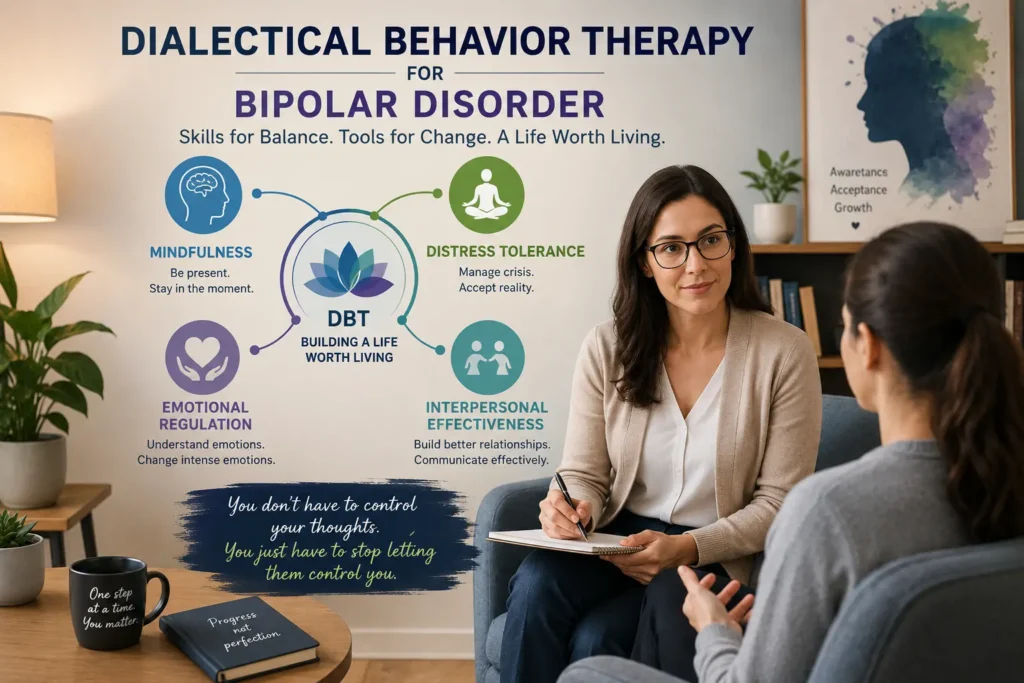
- The four core skill areas are mindfulness, distress tolerance, emotion regulation, and interpersonal effectiveness.
- Research, including a 2023 systematic review and a 2024 JAMA Psychiatry randomized trial, supports DBT’s benefit for mood symptoms and suicide risk reduction in bipolar disorder.
- DBT works best as an add-on to medication and psychiatric care, not as a stand-alone treatment for bipolar disorder.
- It’s most useful for people with frequent emotional crises, self-harm behavior, or relationship instability alongside their mood episodes.
What Is Dialectical Behavior Therapy?
Dialectical behavior therapy is a form of talk therapy developed by psychologist Marsha Linehan in the late 1980s. The word “dialectical” refers to holding two seemingly opposite ideas at once — in this case, accepting yourself exactly as you are while also working to change unhelpful patterns.
DBT was first designed to help people with chronic suicidal thinking and borderline personality disorder. Over time, clinicians noticed that many of its tools — especially the emotion regulation and distress tolerance skills — mapped well onto the struggles people with bipolar disorder describe: sudden mood shifts, urges to act impulsively, and trouble calming down once emotions spike.
Unlike general counseling, DBT follows a manualized structure. That means therapists work from a defined curriculum, sessions build on each other in a set order, and skills are taught, practiced, and reviewed like a class rather than an open-ended conversation.
Why DBT Is Used for Bipolar Disorder
Bipolar disorder is primarily a biological mood disorder, and medication remains the foundation of treatment. But mood episodes don’t happen in a vacuum. Stress, conflict, sleep disruption, and poor emotional coping can trigger or worsen both manic and depressive episodes.
This is where DBT fits in. It doesn’t treat the underlying neurobiology of bipolar disorder — no therapy does — but it gives people tools to:
- Notice early warning signs of a mood shift before it escalates
- Tolerate intense urges (spending sprees, risky sex, self-harm) without acting on them immediately
- Reduce conflict in relationships that often gets worse during mood episodes
- Build a more consistent daily routine, which is protective against both mania and depression
Clinicians frequently recommend DBT for people whose bipolar disorder overlaps with emotional dysregulation, a history of self-harm, or a co-occurring diagnosis like borderline personality disorder. If you’re unsure which type of bipolar disorder you’re dealing with, understanding your diagnosis first will help you and your therapist decide how DBT should be tailored to you.
The Four Core Modules of DBT
Standard DBT is taught through four skill modules, usually in a weekly group format that runs alongside individual therapy.
1. Mindfulness
Mindfulness is considered the foundation of DBT — the other three modules build on it. It teaches people to observe their thoughts and emotions without immediately reacting to them. For someone with bipolar disorder, this might mean noticing “I feel unusually energized and irritable today” as information, rather than automatically acting on that energy.
2. Distress Tolerance
This module focuses on getting through a crisis without making it worse. Skills include things like radical acceptance (acknowledging a painful reality instead of fighting it) and structured techniques for riding out an intense urge until it passes. This is especially relevant during mixed or manic episodes when impulsive decisions can have lasting consequences.
3. Emotion Regulation
This is often the most directly relevant module for bipolar disorder. It teaches people to identify what they’re feeling, understand what’s driving the emotion, and reduce their vulnerability to emotional spikes — for example, by protecting sleep, eating regularly, and avoiding mood-altering substances.
4. Interpersonal Effectiveness
Bipolar episodes frequently strain relationships. This module teaches how to ask for what you need, say no, and manage conflict while still respecting the relationship and your own self-respect.
| DBT Module | Main Goal | How It Helps in Bipolar Disorder |
| Mindfulness | Stay present and nonjudgmental | Catch early mood shifts before they escalate |
| Distress Tolerance | Survive a crisis without making it worse | Reduce impulsive or risky behavior during mania/mixed states |
| Emotion Regulation | Understand and manage emotions | Lower emotional intensity and reactivity |
| Interpersonal Effectiveness | Communicate needs and boundaries | Protect relationships strained by mood episodes |
How DBT Treatment Is Structured
A full DBT program typically has four components running at the same time:
| Component | What It Involves | Typical Frequency |
| Individual therapy | One-on-one sessions with a DBT therapist focused on personal goals and applying skills | Weekly |
| Skills training group | Structured class teaching the four modules | Weekly, 1.5–2.5 hours |
| Phone coaching | Brief calls or texts with the therapist between sessions during a crisis | As needed |
| Therapist consultation team | Therapists meet to support each other and stay consistent with the model | Weekly (for clinicians, not clients) |
Comprehensive DBT programs usually run six months to a year, though shorter, adapted versions exist for bipolar disorder specifically, sometimes combining individual sessions with family or caregiver involvement.
What the Research Actually Shows
DBT for bipolar disorder is a newer research area than DBT for borderline personality disorder, but the evidence base is growing.
A 2023 systematic review in the International Journal of Bipolar Disorders looked at studies applying DBT-based interventions to people with bipolar I or II disorder. Most of the included studies were small pilot trials, but they consistently pointed toward DBT improving <cite index=”3-1″>core mood symptoms in patients with bipolar disorder</cite>, with benefits seen across depressive symptoms and emotional dysregulation.
A more recent randomized clinical trial published in JAMA Psychiatry in 2024 tested DBT specifically in adolescents with bipolar disorder, comparing it to standard psychosocial care. This followed an earlier pilot trial in which adolescents were randomized to <cite index=”8-1″>DBT versus psychosocial treatment as usual, with all participants also receiving medication management from a study psychiatrist</cite>. These trials focused heavily on reducing mood symptoms, suicidal thinking, and self-harm behavior.
A 2025 meta-analysis pooling data from multiple trials analyzed outcomes across <cite index=”2-1″>343 patients with bipolar disorder, most of whom received DBT in combination with standard pharmacological treatment</cite>, reinforcing that DBT is generally studied and used as an addition to medication rather than a replacement for it.
It’s worth being clear about the limits of this research: sample sizes remain small, few large-scale randomized trials exist, and DBT is still considered a second- or third-line psychotherapy option in most bipolar disorder treatment guidelines rather than a first-line treatment. That doesn’t mean it’s ineffective — it means more large studies are needed before it can be recommended as broadly as medication.
DBT vs. Other Bipolar Disorder Therapies
DBT isn’t the only evidence-based therapy used for bipolar disorder, and it isn’t necessarily the right starting point for everyone. Understanding how it differs from other options can help you and your provider choose the right fit.
| Therapy | Primary Focus | Best Fit For |
| DBT | Emotion regulation, distress tolerance, crisis skills | Frequent emotional crises, self-harm, impulsivity |
| Cognitive Behavioral Therapy (CBT) | Identifying and changing unhelpful thought patterns | Depressive thinking, relapse prevention |
| Interpersonal and Social Rhythm Therapy (IPSRT) | Stabilizing daily routines and sleep-wake cycles | People whose episodes are triggered by disrupted routines |
| Family-Focused Therapy | Improving family communication and reducing conflict | People whose home environment affects mood stability |
| Psychoeducation | Learning about the illness and treatment adherence | Anyone newly diagnosed or struggling with treatment adherence |
For a deeper look at how CBT specifically applies to bipolar disorder, see our dedicated guide on cognitive behavioral therapy for bipolar disorder. For the full range of options, visit our overview of bipolar disorder treatment and bipolar therapy.
Who Benefits Most From DBT
DBT tends to help most when someone with bipolar disorder also experiences:
- Frequent, intense emotional swings that feel hard to control
- Self-harm behavior or recurring suicidal thoughts
- Impulsive actions during mood episodes (overspending, risky sex, substance use)
- Unstable or high-conflict relationships
- A co-occurring diagnosis such as borderline personality disorder
It may be a less obvious first choice for someone whose main challenge is depressive episodes without much emotional volatility, or whose primary need is routine-building — in those cases, therapies like IPSRT or CBT may be a better starting point. A psychiatrist or therapist familiar with your specific bipolar disorder symptoms can help match you to the right therapy.
What a DBT Session Actually Looks Like
For people considering DBT, the format can feel unfamiliar compared to traditional talk therapy. Here’s a general idea of what to expect:
Individual sessions usually start by reviewing a diary card — a daily log of emotions, urges, and behaviors from the past week. The therapist and client use this to identify patterns and decide what to focus on that session.
Group sessions function more like a class. The group leader teaches a specific skill, the group practices it together, and members are given homework to try the skill before the next session.
Between sessions, clients are encouraged to use phone coaching if they’re in crisis and need in-the-moment support applying a skill, rather than waiting for the next appointment.
This structure is intentional. DBT assumes that skills only become useful when they’re practiced repeatedly in real situations, not just discussed in the therapy room.
Myths vs. Facts About DBT for Bipolar Disorder
| Myth | Fact |
| DBT can replace medication for bipolar disorder | DBT is an add-on treatment; medication remains central to managing bipolar disorder |
| DBT is only for borderline personality disorder | DBT has been adapted and studied specifically for bipolar disorder |
| DBT is just talking about feelings | DBT is a structured, skills-based curriculum with homework and practice |
| One DBT session will stabilize a mood episode | DBT skills build over weeks to months of consistent practice |
| DBT works the same for everyone | Programs are often adapted in length and intensity based on individual needs |
Potential Challenges and Limitations
DBT requires real commitment. A full program can mean multiple hours of therapy per week for six months or longer, which isn’t accessible or affordable for everyone. Finding a therapist trained specifically in DBT — rather than someone who borrows a few DBT techniques — can also be difficult depending on where you live.
It’s also worth repeating: DBT does not treat the biological component of bipolar disorder. Skipping medication in favor of therapy alone carries real risk of relapse, hospitalization, or worsening symptoms. Learn more about how episodes develop in our guide to bipolar disorder causes.
How DBT Fits Into a Full Treatment Plan
Most psychiatric guidelines describe the strongest outcomes for bipolar disorder when psychotherapy is combined with medication management, not used instead of it. A typical treatment plan might include:
- A mood stabilizer or other prescribed medication, managed by a psychiatrist
- Regular psychotherapy — DBT, CBT, IPSRT, or a combination, depending on individual needs
- Lifestyle strategies that support mood stability, such as consistent sleep and stress management (see our guide on lifestyle changes for bipolar disorder)
- Ongoing monitoring for early warning signs of a mood episode
If you’re earlier in the process and still working through symptoms or diagnosis, our guides on bipolar disorder diagnosis and bipolar disorder symptoms can help you understand what to bring to that first conversation with a provider.
Warning Signs You Shouldn’t Wait On
DBT and other therapies are most effective when started proactively, not only during a crisis. Seek immediate help — from a psychiatrist, crisis line, or emergency room — if you or someone you know experiences:
- Thoughts of suicide or a plan to harm yourself
- Self-harm behavior that is escalating
- Severe mania with reckless or dangerous behavior
- Psychotic symptoms, such as hallucinations or delusions
- A sudden, severe depressive crash after a manic episode
DBT phone coaching is designed to help between scheduled sessions, but it is not a substitute for emergency care during an active crisis.
Frequently Asked Questions
Is DBT effective for bipolar disorder? Early research, including systematic reviews and randomized trials, suggests DBT can reduce mood symptoms and improve emotional regulation in people with bipolar disorder, particularly when combined with medication. The evidence base is still growing compared to more established treatments.
How is DBT different from CBT for bipolar disorder? DBT focuses more heavily on emotional regulation, distress tolerance, and crisis skills, while CBT focuses on identifying and restructuring unhelpful thought patterns. Many people benefit from elements of both; see our guide on cognitive behavioral therapy for bipolar disorder for a full comparison.
Can DBT be used during a manic episode? DBT skills, particularly distress tolerance techniques, can help someone manage impulsive urges during mania, but acute manic episodes typically require medical stabilization first. Talk therapy is most productive once symptoms are partially stabilized.
How long does DBT take to work for bipolar disorder? Most people need several months of consistent practice before noticing significant changes. Comprehensive DBT programs often run six months to a year.
Is DBT covered by insurance? Many insurance plans cover DBT when it’s provided by a licensed mental health professional, but coverage varies. It’s worth confirming session limits and whether group skills training is included.
Do I need a bipolar 1 or bipolar 2 diagnosis to start DBT? No. DBT has been studied and used for both diagnoses. If you’re unsure which type applies to you, our guide on bipolar 1 vs bipolar 2 can help clarify the difference before you speak with a provider.
Can teenagers with bipolar disorder do DBT? Yes. DBT has been adapted for adolescents with bipolar disorder, including family-involved formats, and has shown promise in reducing mood symptoms and suicide risk in this age group.
Summary
Dialectical behavior therapy offers a practical, skills-based approach for people with bipolar disorder who struggle with intense emotions, impulsivity, or relationship conflict. It isn’t a cure and isn’t meant to replace medication, but as part of a broader treatment plan, it gives people concrete tools to manage the ups and downs of the condition. If you think DBT might help, the best next step is talking to a psychiatrist or therapist about your specific symptoms and treatment history so they can help you decide whether DBT — or another evidence-based therapy — is the right fit for you.
This article is for educational purposes and is not a substitute for professional medical advice. If you are having thoughts of suicide or self-harm, please contact a crisis line or emergency services in your area immediately.