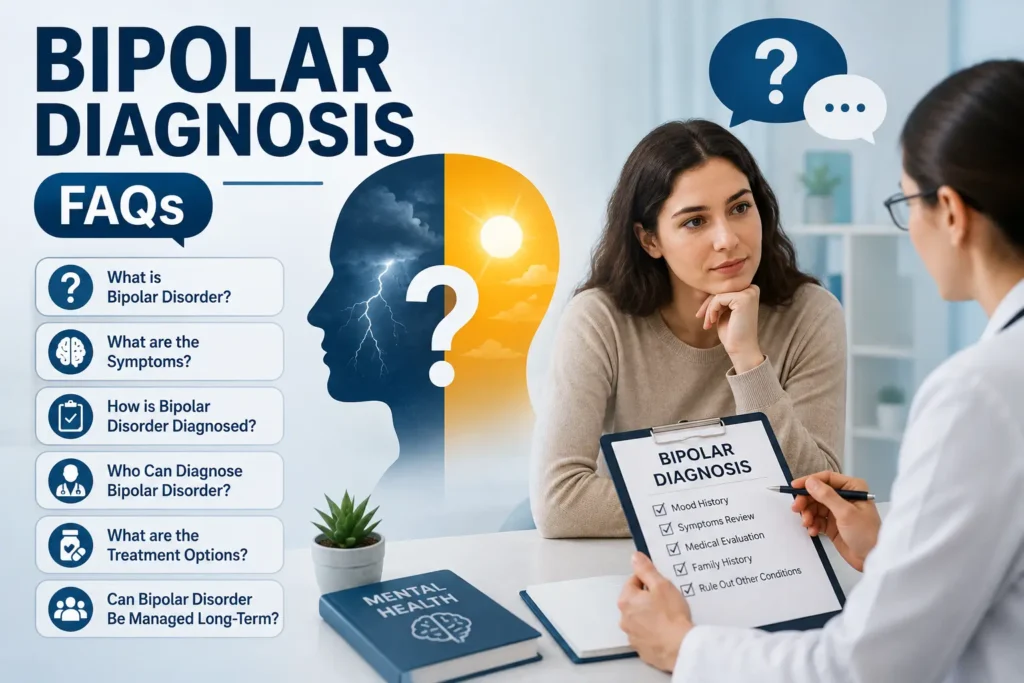
Bipolar Diagnosis FAQs: Bipolar disorder is diagnosed clinically by a psychiatrist or psychologist through structured interviews and DSM-5 criteria—there’s no blood test, brain scan, or single quiz that confirms it. The questions below cover how the process works, who can diagnose it, how testing and screening tools fit in, and what to expect at each stage.
Table of Contents
Key Takeaways
- Diagnosis is based on a documented history of manic, hypomanic, or depressive episodes, not a lab test.
- Online quizzes and screening tools can flag a concern but can never replace a clinical evaluation.
- A licensed psychiatrist or psychologist should make the diagnosis, not a general practitioner alone.
- The diagnostic process often takes multiple appointments, since a genuine pattern needs to be established over time.
- Misdiagnosis is common in both directions — bipolar disorder mistaken for depression or ADHD, and vice versa.
- If you’re in crisis, don’t wait on a diagnosis to get help — crisis resources are always available.
About This FAQ Guide
If you’re researching a possible bipolar disorder diagnosis — for yourself or someone you care about — the questions below are organized by theme, from the basics of how diagnosis works to what happens after you receive one. Each answer is intentionally concise; where a topic deserves a fuller explanation, we link to the dedicated guide covering it in depth.
Diagnosis Basics
What does it actually mean to be “diagnosed” with bipolar disorder? It means a qualified clinician has determined, based on your history and symptoms, that you meet DSM-5 criteria for at least one manic or hypomanic episode (with or without a history of depressive episodes). For the full picture of what the condition involves, see what is bipolar.
Is there a blood test or brain scan for bipolar disorder? No. Bipolar disorder is diagnosed clinically, through interviews and symptom history. Bloodwork or imaging may be ordered to rule out other medical causes of mood symptoms, like thyroid problems, but they can’t confirm bipolar disorder itself.
Can I diagnose myself using an online quiz? No. Self-assessment tools can suggest whether a full evaluation is worth pursuing, but they aren’t diagnostic. Our bipolar test and bipolar quiz explain exactly what these tools can and can’t tell you.
What’s the difference between bipolar disorder and just having mood swings? Ordinary mood swings are usually short-lived and tied to specific events. Bipolar disorder involves distinct episodes — mania, hypomania, or major depression — that last for defined periods (days to weeks) and represent a real shift from a person’s baseline functioning. See bipolar disorder symptoms for the full symptom picture.
How is bipolar disorder officially defined? The DSM-5 defines it as a group of mood disorders involving episodes of mania or hypomania, often alongside episodes of major depression. The exact combination of episodes determines which type is diagnosed — see types of bipolar disorder for the breakdown.
DSM-5 Criteria and Diagnostic Standards
What are the DSM-5 criteria clinicians actually use? Broadly, a manic episode requires at least one week of abnormally elevated, expansive, or irritable mood plus several additional symptoms (like decreased need for sleep, grandiosity, or risky behavior); a hypomanic episode requires the same features for at least four days without severe impairment. Our DSM-5 bipolar disorder guide walks through the full criteria.
How long do symptoms need to last to count as an episode? Mania: at least seven days, or any length if hospitalization is required. Hypomania: at least four days. Major depressive episodes: at least two weeks. Anything shorter typically doesn’t meet the threshold on its own.
Does irritability count as a manic symptom? Yes — DSM-5 recognizes irritable mood as an alternative to euphoric mood for meeting mania or hypomania criteria, though it generally requires more additional symptoms to qualify.
What’s the difference between mania and hypomania in a diagnosis? Mania is more severe, lasts longer, and significantly impairs functioning or requires hospitalization; hypomania is shorter and less disruptive. Which one a person has experienced determines whether they’re diagnosed with bipolar I or bipolar II. See our detailed mania vs. hypomania comparison.
Is there a separate diagnostic standard for cyclothymia? Yes. Cyclothymic disorder involves numerous periods of hypomanic and depressive symptoms that don’t fully meet criteria for a full episode, persisting for at least two years in adults. It’s a distinct diagnosis from bipolar I or II, covered in our bipolar 1 vs 2 vs cyclothymia guide.
The Diagnostic Process and What to Expect
How many appointments does it usually take to get diagnosed? There’s no fixed number, but a reliable diagnosis commonly takes several appointments over weeks or months, since clinicians need to confirm a genuine pattern rather than judge from a single visit. Full details are in how bipolar disorder is diagnosed.
What happens during a typical evaluation? A structured clinical interview covering your mood history, sleep patterns, family history, and functioning — sometimes using a formal tool like the K-SADS or SCID interview — along with, where relevant, input from family members who’ve observed your symptoms.
Do I need to have had a manic episode to get diagnosed? It depends on the diagnosis. Bipolar I requires at least one manic episode. Bipolar II requires at least one hypomanic episode plus at least one major depressive episode, without a full manic episode. See bipolar 1 vs bipolar 2 for the complete distinction.
Will I need to talk to family members as part of the process? Often, yes. Because people don’t always recognize their own manic or hypomanic symptoms clearly, clinicians frequently ask permission to speak with a parent, partner, or close family member who can describe what they’ve observed.
What should I bring to my first appointment? A written timeline of mood episodes, notes on sleep and energy patterns, any family history of mood disorders, and a list of current medications. Being specific — dates, behaviors, durations — speeds up an accurate diagnosis considerably.
Can bipolar disorder be diagnosed in one visit? It’s uncommon and generally not advisable. Most reliable diagnoses follow observation and mood tracking over time, since a single visit rarely provides enough information to confirm a genuine episodic pattern.
Who Can Diagnose Bipolar Disorder
Which type of doctor diagnoses bipolar disorder? Psychiatrists are the primary specialists qualified to diagnose and treat bipolar disorder, since they can also prescribe medication. Clinical psychologists can diagnose through structured assessment but can’t prescribe. Full details are in who can diagnose bipolar disorder.
Can my regular doctor diagnose me? A general practitioner can recognize warning signs and refer you to a specialist, but a confirmed bipolar diagnosis should come from a psychiatrist or psychologist with training in mood disorders.
Can a therapist diagnose bipolar disorder? Licensed therapists with appropriate clinical training sometimes can, depending on their credentials and local regulations, but many refer out to a psychiatrist for a full diagnostic evaluation, particularly if medication may be needed.
Do I need a referral to see a psychiatrist? This depends on your healthcare system and insurance. In many cases, yes — check with your primary care provider or insurance plan about referral requirements before booking.
Testing, Screening, and Self-Assessment
What screening tools do clinicians actually use? Common tools include the Mood Disorder Questionnaire (MDQ), the Young Mania Rating Scale (YMRS), and structured interviews like the K-SADS (for youth) or SCID (for adults). These help guide, but don’t replace, a full clinical evaluation. See bipolar screening for more.
Are online bipolar tests accurate? They can be useful starting points for recognizing patterns worth discussing with a doctor, but they’re not diagnostic instruments and shouldn’t be treated as a final answer either way.
What’s the difference between a screening tool and a diagnostic interview? A screening tool is a short questionnaire that flags whether further evaluation is warranted. A diagnostic interview is a comprehensive, structured clinical assessment conducted by a trained professional that can actually confirm a diagnosis.
How do I know if I should get evaluated? If you’ve noticed distinct periods of unusually high energy, elevated or irritable mood, or decreased need for sleep — especially alongside depressive episodes — that’s a reasonable basis to seek an evaluation. See how to know if you have bipolar for a fuller discussion of the early signs worth acting on.
Diagnosis Across Life Stages
Does bipolar disorder look the same in every age group? No. Presentation shifts across the lifespan — teens often show irritability more than classic euphoria, children’s cases are carefully distinguished from disruptive mood dysregulation disorder, and adult presentations tend to align most closely with the “textbook” picture. See our dedicated guides on bipolar diagnosis in adults, bipolar diagnosis in teenagers, and bipolar diagnosis in children for age-specific detail.
Can bipolar disorder be diagnosed after years of being treated for depression? Yes, and it’s fairly common — bipolar disorder frequently begins with depressive episodes, with the defining manic or hypomanic episode appearing later, sometimes triggered or revealed during antidepressant treatment. Our guide on bipolar diagnosis after depression explains why this happens and what to do about it.
At what age is bipolar disorder most commonly first diagnosed? It’s most often first identified in the late teens through twenties, though symptoms can technically emerge at any age.
Does bipolar disorder present differently in men and women? There are some documented tendencies — for example, differences in episode patterns and co-occurring conditions — though individual presentation varies widely. See bipolar 1 vs 2 in men and women for more.
Misdiagnosis, Missed Diagnosis, and Diagnosis Changes
Why is bipolar disorder so often misdiagnosed? Symptoms overlap significantly with other conditions — depression, ADHD, anxiety, borderline personality disorder, and disruptive mood dysregulation disorder in youth — and hypomanic episodes are often subtle or go unreported. Our bipolar misdiagnosis guide covers this in detail.
Can bipolar disorder be mistaken for ADHD? Yes, particularly because both can involve impulsivity, distractibility, and high energy. The key distinguishing factor is episodicity — ADHD symptoms are chronic and consistent, while bipolar symptoms occur in distinct episodes.
Can someone be misdiagnosed with bipolar disorder when they don’t actually have it? Yes, this happens too — conditions like borderline personality disorder, DMDD, and substance-related mood changes can sometimes be mistaken for bipolar disorder, especially without a thorough history.
Can my diagnosis change over time? Yes. Diagnoses can shift as new symptoms emerge or a clearer pattern develops — for example, from depression to bipolar II after a first hypomanic episode is identified, or from bipolar II to bipolar I if a full manic episode later occurs.
What should I do if I think my current diagnosis is wrong? Raise your concerns directly with your psychiatrist, ideally with specific examples and a symptom timeline. Never stop or adjust medication on your own — work through any diagnostic reassessment with your provider.
After Diagnosis
What happens right after I’m diagnosed? Your clinician will typically discuss treatment options, which usually combine medication and therapy, and explain which type of bipolar disorder you’ve been diagnosed with. See bipolar disorder treatment for what this generally involves.
Will I need medication for life? Many people with bipolar disorder benefit from long-term medication management, though the specifics depend on your diagnosis, symptom severity, and response to treatment — a conversation to have directly with your prescriber.
What’s the long-term outlook after a diagnosis? Outcomes vary widely, but consistent treatment, therapy, and lifestyle management are associated with better long-term stability. Our bipolar disorder prognosis guide covers this in more depth.
What happens if bipolar disorder goes untreated? Untreated bipolar disorder is associated with a higher risk of complications, including relapse, impaired functioning, and increased risk of self-harm. See bipolar disorder complications for the full picture.
Where can I find definitions of the clinical terms I keep hearing? Our bipolar disorder glossary breaks down terms like euthymia, mixed features, and rapid cycling in plain language.
Common Diagnostic Terms, Explained Simply
| Term | Plain-English Meaning |
| Manic episode | A distinct period of unusually high energy, elevated or irritable mood, and reduced need for sleep, lasting at least a week |
| Hypomanic episode | A milder, shorter version of mania (at least four days) that doesn’t severely disrupt daily life |
| Major depressive episode | At least two weeks of low mood or loss of interest, along with other symptoms like fatigue or sleep changes |
| Mixed features | Symptoms of mania and depression occurring at the same time or in rapid alternation |
| Rapid cycling | Four or more distinct mood episodes within a 12-month period |
| Euthymia | A stable, balanced mood state — neither depressed nor manic |
| Differential diagnosis | The process of distinguishing bipolar disorder from other conditions with overlapping symptoms |
Warning Signs That Need Immediate Attention
While working through a diagnosis, certain symptoms require urgent attention rather than waiting for your next scheduled appointment:
- Thoughts of suicide, self-harm, or feeling like a burden to others
- Signs of psychosis, such as hearing voices or holding beliefs that clearly aren’t true
- Extreme agitation or behavior that puts your safety or others’ at risk
- A sudden, dramatic shift in energy, sleep, or judgment
If you or someone you know is in crisis, don’t wait for a diagnosis to get help. In the U.S., call or text 988 to reach the Suicide & Crisis Lifeline, available 24/7, or text HOME to 741741 for the Crisis Text Line. If there’s immediate danger, call 911 or go to the nearest emergency room.
How Common Is Bipolar Disorder, Globally and in the U.S.?
According to the World Health Organization, an estimated 37 million people experienced bipolar disorder worldwide in 2021, including 3.8 million adolescents aged 10 to 19. In the U.S., national survey data places lifetime prevalence at roughly 2.9% among adolescents specifically. For a fuller statistical picture across age groups and bipolar subtypes, see bipolar disorder statistics.
Summary
Getting a bipolar diagnosis right takes time, the right specialist, and an honest, detailed account of your mood history — there’s no shortcut through a blood test or a quick quiz. If you recognized your own situation in several of these questions, the most useful next step is a full evaluation with a psychiatrist or psychologist experienced in mood disorders, not more searching for answers online. The dedicated guides linked throughout this page can help you go deeper on whichever part of the process applies to you.
This article is for educational purposes and isn’t a substitute for a professional psychiatric evaluation. If you’re concerned about your mental health, consult a qualified healthcare provider.