Bipolar diagnosis in children is rare and requires clear evidence of a distinct manic or hypomanic episode — not just chronic irritability or mood swings. Because true mania before puberty is uncommon, child psychiatrists take a cautious, multi-step approach that carefully rules out ADHD, disruptive mood dysregulation disorder (DMDD), and other conditions before confirming a bipolar diagnosis.
Table of Contents
Key Takeaways
- A confirmed bipolar diagnosis in a child under 12 is uncommon; most pre-teen mood and behavior symptoms turn out to have a different explanation.
- Diagnosis requires at least one episode of mania or hypomania with a clear beginning and end — not constant irritability.
- Disruptive mood dysregulation disorder (DMDD) was created specifically to give chronically irritable children a more accurate diagnosis instead of bipolar disorder.
- Diagnosis in children involves a specialist evaluation, structured interviews, and observation over time — never a single office visit.
- Rates of childhood bipolar diagnosis rose sharply in the U.S. in the 1990s and 2000s, prompting ongoing debate among researchers about over-diagnosis.
- A family history of bipolar disorder raises clinical suspicion but is never enough, on its own, to confirm a diagnosis.
Why Bipolar Diagnosis in Children Is One of the Most Debated Topics in Child Psychiatry
If you’ve read conflicting things about whether children can even have bipolar disorder, you’re not imagining it — this is a genuinely contested area of child psychiatry.
Classic bipolar disorder, as first described over a century ago, was understood to emerge in mid-to-late adolescence or adulthood. True mania in a child younger than 10 has historically been considered rare. Then, starting in the 1990s, U.S. clinics saw a dramatic rise in children diagnosed with what researchers called “pediatric bipolar disorder,” often based on chronic irritability and temper outbursts rather than the distinct, episodic mood shifts described in the DSM-5.
That surge concerned researchers enough that the American Psychiatric Association introduced a new diagnosis, disruptive mood dysregulation disorder (DMDD), in DSM-5 specifically to give a more accurate diagnostic home to children with chronic irritability who didn’t actually meet criteria for bipolar disorder. Understanding this history matters for parents, because it explains why a careful child psychiatrist today will move slowly and cautiously before confirming a bipolar diagnosis in a young child — the field has learned, the hard way, what happens when that caution is skipped.
Early Signs Parents Often Notice First
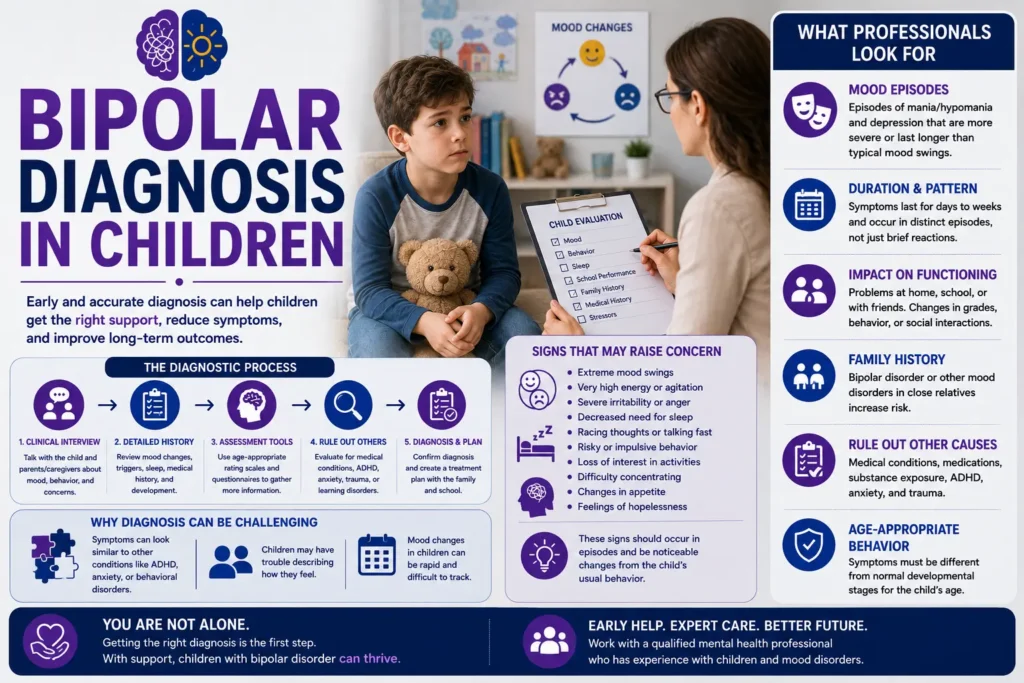
Before any formal process starts, most parents come in because they’ve noticed a pattern that goes well beyond typical childhood behavior. For symptom-specific detail, see our dedicated guide on bipolar symptoms in children. Broadly, the signs that tend to prompt an evaluation include:
- Extreme, prolonged temper outbursts that seem disproportionate to the trigger
- Periods of unusually high energy with little need for sleep
- Rapid, pressured speech or racing, jumbled thoughts
- Grandiose statements — believing they have special powers or abilities
- Hypersexual behavior or comments unusual for the child’s developmental stage
- Distinct stretches of sadness, hopelessness, or loss of interest in favorite activities
- Sharp, uncharacteristic shifts between these states, rather than one constant mood
The key word clinicians keep coming back to is episodic. A child who is irritable most of the time, every day, is describing something different from a child who has a clearly defined week of high energy and grandiosity followed by a clearly defined low period.
Symptoms Clinicians Assess During a Bipolar Evaluation
| Symptom Category | What It Can Look Like in a Child | Why It Matters Diagnostically |
| Elevated or expansive mood | Unusually silly, giddy, or “wired” beyond the situation | A core feature of mania/hypomania, not typical excitement |
| Grandiosity | Insisting they can fly, are smarter than teachers, or don’t need rules | Distinguishes mania from ordinary childhood imagination |
| Decreased need for sleep | Full of energy after very little sleep, not just resisting bedtime | A hallmark sign that separates mania from simple hyperactivity |
| Pressured, rapid speech | Talking so fast it’s hard to follow or interrupt | Reflects racing thought patterns |
| Increased goal-directed activity | Starting elaborate projects, hyperfocused creative bursts | Distinct from general restlessness |
| Risky or impulsive behavior | Dangerous physical stunts, inappropriate sexual comments | Raises concern beyond typical ADHD impulsivity |
| Depressive symptoms | Withdrawal, irritability, appetite or sleep changes, low energy | Needed to confirm bipolar II or mixed presentations |
For the full picture of how these symptoms present across the types of bipolar disorder, see our detailed breakdown.
The DSM-5 Standard: Why Episode Duration Matters So Much in Kids
The DSM-5 doesn’t lower the bar for children — the same criteria used for adults and teens apply. A manic episode still requires a distinct period of abnormally elevated, expansive, or irritable mood lasting at least one week (or any duration if hospitalization is required), plus several additional symptoms like grandiosity, decreased need for sleep, or risky behavior. A hypomanic episode requires at least four days. We cover the complete criteria in our DSM-5 bipolar disorder guide.
What’s different in children isn’t the rulebook — it’s how carefully clinicians have to apply it. A child’s irritability that’s present nearly every day for a year looks nothing like a manic episode on paper, even though it can seem just as severe day to day. This is exactly the distinction that led to the creation of DMDD, and it’s the single most important thing separating an accurate bipolar diagnosis in a child from a misdiagnosis.
How the Diagnostic Process Works for Children
A bipolar diagnosis in a child is built over time, not decided in a single appointment. The general process typically includes:
- Referral. A pediatrician, school psychologist, or therapist notices a pattern serious enough to warrant specialist evaluation.
- Specialist evaluation. A child and adolescent psychiatrist or psychologist conducts a detailed clinical interview, often using the Kiddie Schedule for Affective Disorders and Schizophrenia (K-SADS) to systematically assess for manic, hypomanic, and depressive episodes.
- Parent and caregiver interviews. Because young children often can’t accurately describe their own internal experience, clinicians rely heavily on detailed reports from parents, and sometimes teachers, about specific behaviors and their timing.
- Extended observation and mood tracking. Families are frequently asked to log mood, sleep, and behavior daily over several weeks to establish whether symptoms are genuinely episodic.
- Developmental and medical history review. The clinician considers developmental stage, trauma history, and rules out medical causes like thyroid dysfunction.
- Differential diagnosis. The clinician systematically compares the pattern against DMDD, ADHD, anxiety, autism spectrum-related dysregulation, and other conditions (see table below).
- Diagnosis and family education. If the pattern clearly fits DSM-5 criteria, the clinician explains the diagnosis and next steps, including how it differs from the more common alternative diagnoses considered along the way.
For more on how this compares to evaluation at other ages, see how bipolar disorder is diagnosed and our companion guide to bipolar diagnosis in teenagers.
Who Should Evaluate a Child for Bipolar Disorder?
Given how easily childhood bipolar disorder can be confused with other conditions, the specialist matters. Diagnosis is best made by:
- Child and adolescent psychiatrists, who have specific training in distinguishing pediatric mood disorders and can prescribe medication if needed
- Clinical child psychologists trained in structured diagnostic interviews for mood disorders
- Developmental-behavioral pediatricians, often working alongside a psychiatric specialist for complex cases
A general pediatrician can raise initial concerns and make a referral, but given the diagnostic complexity involved, a general practitioner typically shouldn’t be the one confirming or ruling out bipolar disorder in a child. See who can diagnose bipolar disorder for more on provider qualifications.
Bipolar Disorder vs. Look-Alike Conditions in Children
This comparison is the crux of pediatric mood evaluation. Chronic irritability and temper outbursts show up across several childhood conditions, and distinguishing them is where careful diagnosis really happens.
| Condition | Core Pattern | Key Difference From Bipolar Disorder |
| Disruptive mood dysregulation disorder (DMDD) | Chronic, near-daily irritability with frequent severe temper outbursts | Mood is persistently irritable between outbursts, with no distinct manic/hypomanic episode |
| ADHD | Hyperactivity, impulsivity, distractibility | Symptoms are consistent and chronic, not episodic; no elevated mood, grandiosity, or decreased need for sleep |
| Oppositional defiant disorder (ODD) | Defiance, argumentativeness, anger toward authority | Behavior is reactive to specific demands or rules, not tied to a distinct mood shift |
| Autism spectrum-related dysregulation | Meltdowns, rigidity, emotional overwhelm | Triggered by sensory or routine disruption rather than a spontaneous mood episode |
| Anxiety disorders | Irritability, restlessness, difficulty sleeping | Sleep problems stem from worry, not decreased need for sleep during high energy |
| Trauma-related responses | Mood swings, hypervigilance, emotional reactivity | Symptoms typically connect to identifiable triggers or reminders of trauma |
A careful clinician focuses on whether the high-energy, grandiose, decreased-sleep pattern shows up as a distinct episode that’s different from the child’s usual self — versus irritability and dysregulation that are simply how the child is most of the time. This distinction is exactly why bipolar misdiagnosis is such a well-documented problem in pediatric mental health.
Risk Factors That Raise Clinical Suspicion
No single risk factor confirms a diagnosis, but certain factors make clinicians more likely to pursue a full bipolar workup rather than starting with DMDD or ADHD. Our bipolar disorder causes guide covers this in depth; for children specifically, the most relevant factors include:
- A parent or sibling diagnosed with bipolar disorder
- A strong family history of major mood disorders across multiple relatives
- Documented episodes with a clear onset and end, rather than constant symptoms
- Significant functional impairment during high-energy periods specifically (not just generally difficult behavior)
Screening Tools Used in Pediatric Settings
As with adolescents, screening tools help decide whether a full evaluation is warranted — they don’t diagnose bipolar disorder on their own. Tools commonly used with children include:
- Parent-report General Behavior Inventory (P-GBI) — tracks mood episode patterns over time as reported by a caregiver
- Young Mania Rating Scale (YMRS), adapted for use with parent input for younger children
- K-SADS structured interview — the most rigorous diagnostic tool, typically reserved for specialist evaluations
- Child Behavior Checklist (CBCL) — broader behavioral screener sometimes used to flag a “dysregulation profile” warranting further assessment
A high score on any of these is a reason to pursue a full specialist evaluation, not a diagnosis in itself.
What to Bring to Your Child’s Evaluation: A Checklist for Parents
Organized, specific information speeds up an accurate diagnosis considerably. Consider preparing:
- [ ] A written log of specific episodes, including approximate start and end dates
- [ ] Notes distinguishing “high energy” periods from your child’s usual baseline energy
- [ ] Sleep patterns during both high-energy and low periods
- [ ] Concrete behavior examples rather than general impressions (“stayed up rearranging his room at 2 a.m. for three nights straight”)
- [ ] Family mental health history, including bipolar disorder, depression, or other conditions
- [ ] Any input from teachers, coaches, or other caregivers
- [ ] A list of prior diagnoses, evaluations, or treatments already tried
Myths vs. Facts About Diagnosing Bipolar Disorder in Children
| Myth | Fact |
| Temper tantrums mean a child has bipolar disorder | Frequent tantrums are far more often explained by DMDD, ADHD, or developmental factors than by bipolar disorder |
| Bipolar disorder in children is common | True bipolar disorder before puberty is considered uncommon by most researchers, even though diagnosis rates rose sharply in past decades |
| A hyper, energetic child is showing signs of mania | Mania requires decreased need for sleep, grandiosity, and other specific features — not just high energy |
| One bad week confirms a diagnosis | A pattern of distinct episodes over time is required, not a single difficult stretch |
| Medication is the first step regardless of diagnosis | Treatment should follow an accurate diagnosis; mood stabilizers carry real risks and aren’t appropriate for every irritable child |
| DMDD is just a “softer” version of bipolar disorder | DMDD is a distinct diagnosis with a different course and different treatment approach, not a mild form of bipolar disorder |
For a broader collection of misconceptions across all ages, see bipolar disorder myths.
Warning Signs That Need Immediate Attention
Some behaviors require urgent evaluation rather than a routine appointment. Seek immediate help if a child shows:
- Statements about wanting to die, disappear, or hurt themselves
- Signs of psychosis, such as seeing or hearing things that aren’t there
- Extreme aggression that puts the child or others at risk of injury
- Behavior that suggests a total loss of judgment about safety
If a child appears to be in danger, don’t wait for a scheduled evaluation. In the U.S., call or text 988 to reach the Suicide & Crisis Lifeline, available 24/7. If there is immediate danger, call 911 or go to the nearest emergency room. A pediatrician’s office or urgent psychiatric care line can also help you find the fastest path to an emergency evaluation.
After a Diagnosis: What Families Typically Do Next
Once a diagnosis is confirmed, the focus shifts to building a treatment plan suited to the child’s age and severity. We cover this in detail in our guides to bipolar disorder treatment and bipolar disorder complications that can arise without appropriate management. Many parents also want a realistic sense of what’s ahead — our bipolar disorder prognosis guide explains long-term outlook and the factors that improve it, including how early and accurately the diagnosis was made.
It’s also worth getting familiar with the terms that come up throughout this process. Our bipolar disorder glossary explains clinical language like mania, hypomania, and mixed features in plain terms, and our mania vs. hypomania comparison clears up one of the most common points of confusion for newly diagnosed families.
How Common Is a Confirmed Bipolar Diagnosis in Children?
Reliable prevalence estimates specifically for pre-teen children are harder to come by than for teens or adults, largely because of the diagnostic controversy described earlier in this guide. What researchers do agree on is that diagnosed rates of pediatric bipolar disorder rose sharply in U.S. clinical settings from the 1990s through the 2000s, a trend that prompted significant debate about whether it reflected genuine increased prevalence, improved recognition, or over-application of the diagnosis to children with chronic irritability who didn’t clearly meet DSM criteria. That debate is a major reason DMDD exists today as a separate, more precisely defined diagnosis. For statistics across the broader bipolar spectrum and age ranges, see bipolar disorder statistics.
Frequently Asked Questions
Can a child under 10 actually have bipolar disorder? It’s possible but considered uncommon by most researchers. True manic episodes meeting full DSM-5 criteria are much rarer before puberty than in adolescence, which is why clinicians apply extra caution and thoroughly rule out other explanations first.
What’s the difference between bipolar disorder and DMDD in a child? Bipolar disorder involves distinct, time-limited episodes of mania or hypomania with a clear beginning and end. DMDD involves persistent irritability and frequent temper outbursts that are present almost every day, without a distinct high-energy episode in between.
Can bipolar disorder in children be misdiagnosed as ADHD? Yes, and it happens in both directions. Some children with bipolar disorder are initially diagnosed with ADHD because of overlapping impulsivity and distractibility, while some children with severe ADHD are mistakenly suspected of having bipolar disorder because of intense emotional reactivity.
Does a family history of bipolar disorder mean my child will develop it? No. Family history raises the likelihood and is a meaningful risk factor clinicians weigh carefully, but most children with a bipolar parent or sibling do not go on to develop the disorder themselves.
How long does it take to diagnose bipolar disorder in a child? There’s no fixed timeline, but because a genuine pattern needs to be established, it commonly takes several appointments over weeks or months rather than a single visit.
Is medication used before a diagnosis is confirmed? Generally, no. A confirmed or strongly suspected diagnosis should guide medication decisions, since mood stabilizers and antipsychotics carry real side effects and aren’t appropriate for every child with mood or behavior symptoms.
Can school staff diagnose or rule out bipolar disorder? No. Teachers and school psychologists can flag concerning patterns and provide valuable observational input, but a diagnosis requires a licensed mental health professional trained in psychiatric assessment.
Will my child’s diagnosis change as they get older? It’s possible. Some children initially diagnosed with DMDD or another condition are later found to meet criteria for bipolar disorder as they move through adolescence, and vice versa. This is one reason ongoing reassessment matters, especially around puberty.
Summary
Bipolar diagnosis in children is one of the most carefully scrutinized areas of child psychiatry, precisely because the condition is genuinely uncommon before puberty and easily confused with more common conditions like DMDD, ADHD, and anxiety. A reliable diagnosis depends on identifying a real, distinct episode of mania or hypomania — not just chronic irritability or difficult behavior — through a structured evaluation with a qualified child and adolescent specialist. If you’re concerned about your child, the right first step is a referral to that kind of specialist, not a label applied after a single hard week.
This article is for educational purposes and isn’t a substitute for a professional psychiatric evaluation. If you’re concerned about your child’s mental health, consult a qualified healthcare provider.