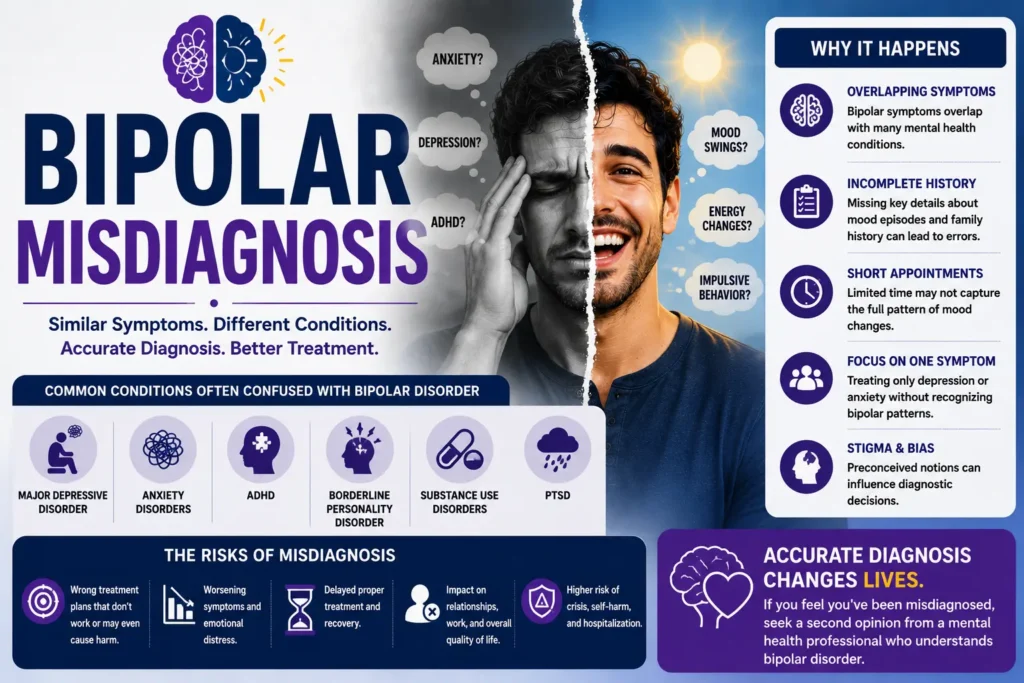
Bipolar disorder is frequently misdiagnosed because its symptoms overlap heavily with other conditions — most often depression, ADHD, anxiety, and borderline personality disorder. Misdiagnosis usually happens because a person seeks help during a depressive episode and doesn’t mention (or doesn’t recognize) a past period of mania or hypomania, so the clinician only sees half the picture. If your symptoms, treatment response, or diagnosis don’t quite add up, a second opinion with a focus on your full mood history is the most reliable way to correct it.
Table of Contents
Key Takeaways
- Bipolar disorder is commonly mistaken for major depression, ADHD, anxiety disorders, and borderline personality disorder.
- The most common driver of misdiagnosis is an incomplete history — hypomanic or manic episodes that were never reported or recognized.
- Antidepressants given for “depression” that’s actually undiagnosed bipolar disorder can sometimes trigger or worsen manic symptoms.
- A misdiagnosis can delay effective treatment for years.
- If something about your current diagnosis or treatment doesn’t fit, a second opinion focused on your complete mood history can help.
Why Bipolar Disorder Is So Often Misdiagnosed
Bipolar disorder doesn’t announce itself clearly. Unlike a broken bone or an infection, it’s identified through a pattern of mood episodes over time — and that pattern is easy to miss, especially if you’ve never been asked the right questions. For a full explanation of what the condition involves, see bipolar disorder and what bipolar disorder is.
Several factors make misdiagnosis particularly common:
- People usually seek help during a low, not a high. Hypomania and mania can feel productive, energizing, or simply like “a good period,” so they’re rarely the reason someone books an appointment.
- Hypomania is subtle. Unlike full mania, hypomania doesn’t always disrupt daily functioning, which makes it easy for both patients and clinicians to overlook. See our full breakdown of mania vs. hypomania.
- Symptom overlap with other conditions is real, not just a documentation problem — several disorders share genuine surface-level similarities with bipolar disorder.
- A single short appointment rarely captures a full mood history. Diagnosis depends on a detailed, honest look back over months or years, which our guide to how bipolar disorder is diagnosed explains in more depth.
The Conditions Bipolar Disorder Is Most Often Mistaken For
Major Depressive Disorder (Unipolar Depression)
This is by far the most common misdiagnosis. If a clinician only sees the depressive side of the pattern, bipolar disorder can look identical to standard depression on the surface. The distinguishing factor is a history of mania or hypomania — without it, a diagnosis of unipolar depression is often the reasonable initial call. Our guide to bipolar depression symptoms explains how this presentation compares to standard depressive episodes.
ADHD (Attention-Deficit/Hyperactivity Disorder)
Distractibility, impulsivity, racing thoughts, and restlessness appear in both conditions, which makes overlap especially common in teenagers and adults with hypomanic symptoms. The key difference is pattern: ADHD symptoms are typically constant and present from childhood, while bipolar symptoms come in distinct episodes with clear starting and ending points.
Borderline Personality Disorder (BPD)
Both conditions involve mood instability, but the timing and triggers differ. BPD mood shifts tend to happen quickly — sometimes within hours — and are usually triggered by interpersonal stress or fear of abandonment. Bipolar mood episodes are typically more sustained, lasting days to weeks, and aren’t always tied to an external trigger.
Anxiety Disorders
Racing thoughts, restlessness, and trouble sleeping can look like generalized anxiety or panic disorder, especially during hypomanic periods. Anxiety disorders, however, don’t typically include the elevated mood, grandiosity, or decreased need for sleep seen in manic or hypomanic episodes.
Substance Use Disorders
Stimulant use, withdrawal, or intoxication can produce symptoms that closely resemble mania or depression, which is why clinicians screen for substance use as part of a full evaluation.
Schizophrenia or Other Psychotic Disorders
When bipolar disorder includes psychotic features during a severe manic or depressive episode, it can be mistaken for a primary psychotic disorder if the mood component isn’t weighted heavily enough in the evaluation.
Comparison: Bipolar Disorder vs. Commonly Confused Conditions
| Condition | Key Overlap | Key Difference |
| Major depression | Low mood, fatigue, hopelessness | No history of mania/hypomania |
| ADHD | Distractibility, impulsivity, restlessness | ADHD is constant/lifelong; bipolar symptoms are episodic |
| Borderline personality disorder | Mood instability, impulsivity | BPD shifts are faster and often trigger-driven; bipolar episodes last longer |
| Anxiety disorders | Racing thoughts, poor sleep, restlessness | Anxiety lacks elevated mood, grandiosity, or reduced need for sleep |
| Substance use disorders | Mood and energy changes | Symptoms tied to use/withdrawal rather than an independent mood pattern |
| Schizophrenia/psychotic disorders | Psychosis during severe episodes | Bipolar psychosis occurs alongside a mood episode, not independently |
Why Misdiagnosis Matters: The Antidepressant Problem
One of the most significant risks of misdiagnosing bipolar disorder as unipolar depression is treatment. Antidepressants prescribed without a mood stabilizer can, in some people with underlying bipolar disorder, trigger a manic or hypomanic episode or contribute to more frequent mood cycling. This doesn’t mean antidepressants are dangerous for everyone — it means getting the underlying diagnosis right changes which medications are appropriate. Full treatment considerations, including how mood stabilizers and antidepressants are used together or avoided, are covered in bipolar disorder treatment.
Signs Your Current Diagnosis Might Be Wrong
Consider raising these points with your provider or seeking a second opinion if:
- You’ve been diagnosed with depression, but antidepressants have made you feel unusually energized, irritable, or “wired” rather than better
- You’ve had periods of elevated mood, reduced need for sleep, or impulsive decisions that were never discussed with your provider
- Your mood symptoms come in distinct episodes rather than being constant
- A close family member has bipolar disorder and your symptoms follow a similar pattern
- Your current diagnosis and treatment plan haven’t meaningfully helped after a reasonable trial period
What to Do If You Suspect a Misdiagnosis
| Step | What It Involves |
| 1. Track your mood | Keep a daily log of mood, sleep, and energy for several weeks — patterns are hard to argue with |
| 2. List every past episode | Include high-energy periods you may have written off as “just a good time” |
| 3. Bring in outside perspective | A family member or close friend can often recall episodes you don’t remember clearly |
| 4. Ask directly about bipolar disorder | Don’t assume your provider has ruled it out — ask explicitly if it was considered |
| 5. Seek a second opinion | A psychiatrist with specific experience in mood disorders can offer a fresh, focused evaluation |
| 6. Don’t stop medication abruptly | Any medication changes should be made with a doctor’s guidance, not on your own |
For a structured way to organize this information before an appointment, tools like the bipolar screening or bipolar quiz can help you prepare, and our guide on how to know if you have bipolar walks through the core symptom pattern in plain language.
Myths vs. Facts About Bipolar Misdiagnosis
| Myth | Fact |
| “If a doctor diagnosed me, it must be right.” | Misdiagnosis is common precisely because bipolar disorder is hard to identify without a full history — second opinions are normal and reasonable. |
| “Misdiagnosis only happens with bad doctors.” | It happens even with skilled, careful clinicians because the information needed often isn’t volunteered by the patient. |
| “If antidepressants aren’t working, just try a higher dose.” | A poor response — or a paradoxical reaction like increased energy or agitation — can be a signal to reconsider the diagnosis, not just the dose. |
| “Bipolar disorder always looks dramatic and obvious.” | Hypomania, in particular, can be subtle and easily missed, even by the person experiencing it. |
| “Getting re-evaluated means starting over.” | A second evaluation builds on your existing history — it isn’t wasted time. |
For more misconceptions about the condition broadly, see bipolar disorder myths.
Warning Signs That Need Prompt Attention
Regardless of your current diagnosis, seek help sooner rather than later if you notice:
- Days without sleep and no sense of being tired
- Impulsive spending, risky sexual behavior, or reckless driving that’s out of character
- Hearing or seeing things others don’t
- Hopelessness lasting more than two weeks
- Any thoughts of self-harm or suicide
Emergency Help
If you or someone you know is having thoughts of suicide or self-harm, treat it as a medical emergency. In the US, call or text 988 (Suicide & Crisis Lifeline). In the UK, call 111 or the Samaritans at 116 123. Elsewhere, contact your local emergency number or nearest emergency department. You don’t need a confirmed diagnosis to reach out for support.
The Long-Term Cost of Getting It Wrong
Research bodies including the World Health Organization (WHO) and the National Institute of Mental Health (NIMH) recognize bipolar disorder as a condition where early, accurate treatment meaningfully improves outcomes. A prolonged misdiagnosis can mean years of ineffective treatment, worsening episodes, and strain on relationships and work. It can also affect complications and long-term prognosis. Correcting a misdiagnosis, even years later, still meaningfully improves the outlook going forward.
Frequently Asked Questions
How common is bipolar misdiagnosis? It’s considered one of the more frequently misdiagnosed major mental health conditions, largely because it’s most often first mistaken for unipolar depression. Exact rates vary between studies and populations, so it’s best to consult sources like the American Psychiatric Association or peer-reviewed research rather than a single statistic.
Can antidepressants make undiagnosed bipolar disorder worse? In some people, yes — antidepressants without a mood stabilizer can trigger or worsen manic or hypomanic symptoms. This is one reason an accurate diagnosis matters before starting treatment.
How is bipolar disorder told apart from ADHD? The main distinction is pattern: ADHD symptoms are usually lifelong and consistent, while bipolar symptoms occur in distinct episodes with a clear before-and-after.
How is bipolar disorder told apart from borderline personality disorder? BPD mood shifts tend to be faster — sometimes within a day — and often triggered by relationship stress. Bipolar episodes usually last days to weeks and aren’t always linked to an external trigger.
Should I get a second opinion if I think I was misdiagnosed? Yes, this is a reasonable and common step. A psychiatrist with specific experience in mood disorders can conduct a focused re-evaluation using your fuller history.
Can bipolar disorder be diagnosed alongside another condition? Yes. Bipolar disorder frequently occurs alongside anxiety disorders, ADHD, or substance use disorders. Having one of these diagnoses doesn’t rule out the other.
What should I bring to a second-opinion appointment? A mood log if you have one, a list of all past diagnoses and medications tried, notes on how you responded to each treatment, and any history of high-energy periods, even brief ones.
Summary
Bipolar disorder is easy to misdiagnose because its symptoms overlap with several other common conditions, and because the episodes most likely to reveal it — mania and hypomania — are the ones people are least likely to bring up on their own. If your diagnosis or treatment hasn’t felt right, that’s a legitimate reason to revisit it, not something to dismiss. Tracking your mood, being thorough about your full history, and seeking a focused second opinion from a psychiatrist experienced in mood disorders are the most effective ways to get an accurate answer and the right treatment plan.