Bipolar screening is a short questionnaire — not a diagnosis — used to flag whether someone’s mood, energy, or behavior patterns look like they could be linked to bipolar disorder. The most widely used tools are the Mood Disorder Questionnaire (MDQ), the Hypomania Checklist (HCL-32), and the Bipolar Spectrum Diagnostic Scale (BSDS). A “positive” screen means it’s worth talking to a doctor or psychiatrist for a full clinical evaluation — it does not confirm you have bipolar disorder.
Table of Contents
Key Takeaways
- Bipolar screening tools are self-report checklists designed to catch signs of past hypomania or mania, which people often overlook or misremember.
- No online quiz or screening tool can diagnose bipolar disorder on its own — that requires a structured clinical interview with a psychiatrist or psychologist.
- The most researched tools (MDQ, HCL-32, BSDS) each have strengths and blind spots; none of them work equally well for bipolar 1 and bipolar 2.
- Screening is especially useful for people being treated for depression, since bipolar disorder symptoms are frequently mistaken for unipolar depression for years before the correct diagnosis is made.
- A positive screen is a starting point for a conversation with a professional, not a label to self-apply.
What Is Bipolar Screening?
Bipolar screening is a brief, structured way of checking whether a person’s history of mood swings, energy changes, sleep patterns, or impulsive behavior fits the pattern seen in bipolar disorder. It usually takes the form of a paper or online questionnaire that a person fills out about themselves, sometimes followed by a clinician reviewing the answers.
Screening tools exist because bipolar disorder is one of the most commonly missed diagnoses in mental health care. People experiencing a manic or hypomanic episode often feel productive, confident, or simply “like themselves, but better” — so they don’t seek help during that phase. It’s usually the depressive episodes that bring someone into a doctor’s office, which means the hypomanic or manic history can get missed entirely unless someone specifically asks about it. A good screening tool asks those specific questions.
It’s worth being clear about what screening is not. It is not the same as bipolar disorder diagnosis, which requires a full clinical interview, a review of symptom timing and duration against DSM-5 criteria, and often input from family members who witnessed the episodes. A screening tool is a filter, not a verdict.
Why Bipolar Screening Matters
The gap between symptom onset and correct diagnosis for bipolar disorder is often measured in years, not months. Multiple studies on delayed diagnosis have found that people with bipolar disorder are frequently treated for depression, anxiety, or personality disorders first — sometimes for a decade or longer — before the bipolar pattern is recognized.
This delay has real consequences. Certain antidepressants, when given without a mood stabilizer, can trigger a manic or hypomanic switch in someone with undiagnosed bipolar disorder. Getting screened isn’t about self-diagnosing — it’s about giving your doctor a clearer, more complete picture of your mood history so treatment decisions are safer and more accurate.
Screening is particularly relevant if you:
- Have been treated for depression that hasn’t responded well to antidepressants
- Have noticed distinct “up” periods — more energy, less need for sleep, racing thoughts, impulsivity — that don’t match how you normally feel
- Have a close biological relative with bipolar disorder, since it runs in families (see bipolar disorder causes)
- Are a clinician trying to rule bipolar disorder in or out before starting antidepressant therapy
How Bipolar Screening Tools Work
Most bipolar screening questionnaires share the same basic structure: a list of statements about energy, mood, sleep, speech, and behavior, each answered “yes” or “no” based on whether you’ve ever experienced that symptom cluster during a distinct period of time. The questionnaire is then scored against a cutoff — hit or exceed that cutoff, and the screen is considered “positive,” meaning further evaluation is recommended.
What separates these tools from a generic personality quiz is that they’re built around the actual symptom criteria for mania and hypomania used in clinical diagnosis, and they’ve been tested against real clinical outcomes to see how well they perform.
The Main Bipolar Screening Tools
| Tool | Best Used For | Format | What It Focuses On |
| Mood Disorder Questionnaire (MDQ) | General bipolar spectrum screening, most widely studied | 13 yes/no items + impact question | Lifetime history of manic/hypomanic symptoms |
| Hypomania Checklist (HCL-32) | Detecting hypomania in people already diagnosed with depression | 32 yes/no items | Milder hypomanic traits, useful for bipolar II |
| Bipolar Spectrum Diagnostic Scale (BSDS) | Capturing “atypical” bipolar presentations | Narrative-style checklist | Broader bipolar spectrum features |
| Rapid Mood Screener (RMS) | Quick primary-care screening | 6 yes/no items | Distinguishing bipolar I from major depression |
Each tool trades off differently between catching true cases (sensitivity) and avoiding false alarms (specificity). Research consistently shows the MDQ has strong specificity — meaning it rarely flags someone who doesn’t have bipolar disorder — but its sensitivity is inconsistent across studies, and it tends to perform better for bipolar I than for bipolar II, where hypomanic episodes are subtler. The HCL-32 tends to be more sensitive to the milder hypomania seen in bipolar II, but that comes at the cost of more false positives, since it can also flag traits linked to other conditions like anxiety or ADHD.
This is exactly why no single questionnaire is treated as definitive on its own. Clinicians often use a combination of tools alongside a full interview.
What a Bipolar Screening Test Actually Asks
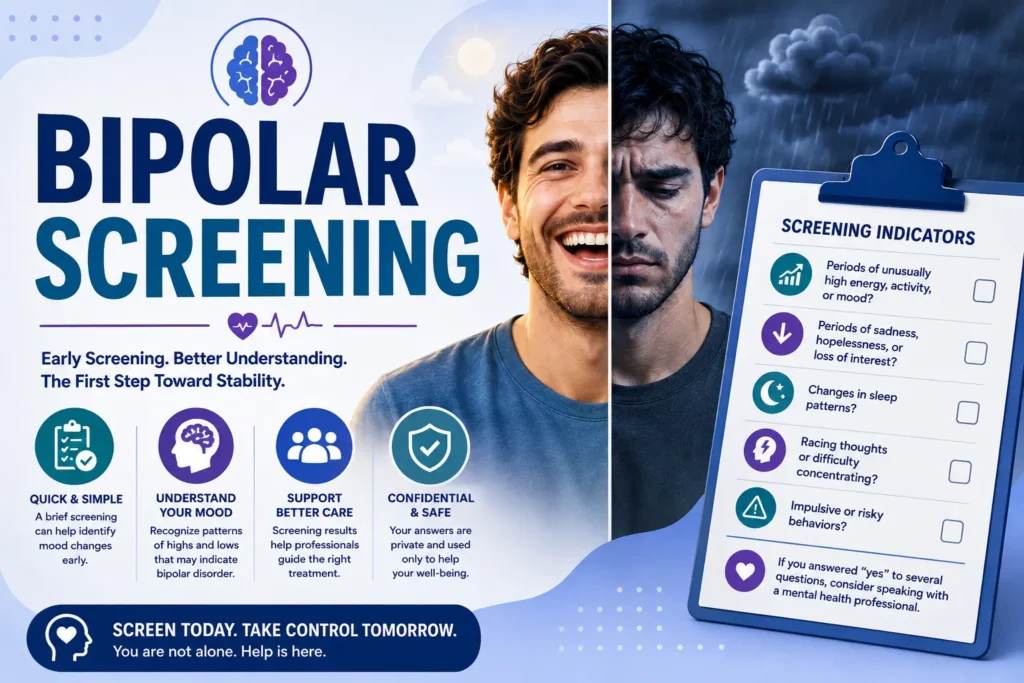
While the exact wording differs between tools, most bipolar screening questionnaires ask about the same core set of experiences, typically framed as “has there ever been a period when…”:
- You felt so good, high, or hyper that other people thought you weren’t your normal self
- You were much more talkative or spoke faster than usual
- Your thoughts raced, or you couldn’t slow your mind down
- You were so easily distracted that you had trouble concentrating
- You had much more energy than usual
- You were more active or did many more things than usual
- You were more social or outgoing than usual
- You were more interested in sex than usual
- You did things that were unusual for you, or that other people might have thought were excessive, foolish, or risky
- Spending money got you into trouble
- You needed less sleep than usual and didn’t miss it
A positive screen typically requires several of these to have happened at the same time, during a distinct period, and to have caused some noticeable disruption — not just occasional good moods. That combination of “clustered symptoms + same time period + real-world impact” is what separates a screening-positive result from ordinary personality traits like being naturally energetic or occasionally impulsive.
Bipolar Screening vs. Bipolar Diagnosis
This is the single most misunderstood part of the process, so it’s worth spelling out clearly.
| Bipolar Screening | Bipolar Diagnosis | |
| Who administers it | Can be self-administered online or on paper | Licensed psychiatrist, psychologist, or trained clinician |
| Time required | 5–10 minutes | One or more clinical sessions |
| What it measures | Whether symptoms resemble the bipolar pattern | Whether symptoms meet DSM-5 diagnostic criteria |
| Includes clinical history | No | Yes — episode timing, duration, family history, medical rule-outs |
| Can rule bipolar in or out | No | Yes |
| Appropriate next step | Discuss results with a doctor | Begin a treatment plan |
If you want to understand exactly how a formal diagnosis is reached, including the DSM-5 episode-duration requirements, the bipolar disorder diagnosis guide covers that process in full. And if you’re trying to understand how bipolar I and bipolar II differ in the first place — which affects how screening results should be interpreted — see bipolar 1 vs bipolar 2.
Who Should Get Screened for Bipolar Disorder
Bipolar screening isn’t only for people who suspect they have the condition. It’s a standard part of good mental health practice in several situations:
- Before starting antidepressant treatment. Many prescribers screen for bipolar disorder first, since antidepressants alone can worsen the course of bipolar illness in some people.
- When depression treatment isn’t working. Treatment-resistant depression is one of the more common reasons bipolar disorder eventually gets identified.
- During postpartum mental health checks. Mood episodes can emerge or intensify around childbirth, and screening is increasingly used in perinatal care.
- When there’s a family history. Because bipolar disorder has a strong genetic component, screening is reasonable for close relatives of someone diagnosed with it.
- When mood swings are affecting relationships, work, or finances. Especially patterns of impulsive spending, conflict, or dramatic shifts in energy and sleep.
How to Take a Bipolar Screening Test
If you’re completing a screening questionnaire — whether it’s handed to you by a clinician or found through a reputable mental health organization online — a few things make the results more useful:
- Answer based on your entire life, not just how you feel today. Most tools ask about lifetime history, not current mood.
- Think in terms of distinct periods, not single days. The symptoms need to have clustered together over days or weeks, not just a single great afternoon.
- Be honest about impact. If people around you noticed a difference, or it caused problems, that matters more than how “fun” the period felt at the time.
- Don’t fill it out during an active mood episode if you can avoid it. Answers given while depressed or manic can skew results in either direction.
- Bring the results to an appointment rather than sitting with them alone. A positive or negative screen both deserve context from a professional.
What a Positive Bipolar Screening Result Means
A positive result means your answers matched a pattern that, statistically, is often associated with bipolar disorder — nothing more, nothing less. It’s a signal to seek a full evaluation, not confirmation of a diagnosis.
It’s also worth knowing that positive screens can happen for reasons other than bipolar disorder. Conditions such as ADHD, borderline personality disorder, anxiety disorders, and even normal temperament variation can produce similar answers on some items, particularly on longer, more sensitive checklists like the HCL-32. This is a known limitation of self-report screening, not a flaw specific to you.
If you screen positive, a reasonable next step looks like this:
- Schedule an appointment with a primary care doctor, psychiatrist, or psychologist
- Bring the completed screening tool with you, or mention that you completed one
- Be prepared to describe specific episodes: how long they lasted, how they affected your sleep, work, spending, or relationships
- If possible, ask a family member who has known you a long time whether they’ve noticed distinct “high” periods — this outside perspective is often more accurate than self-recall
What a Negative Bipolar Screening Result Means
A negative screen lowers the likelihood of bipolar disorder but doesn’t rule it out completely. Some people with bipolar II, in particular, underreport or don’t recognize hypomanic episodes as unusual, since hypomania can feel like simply having a good, productive stretch. If your depressive symptoms continue despite a negative screen — especially if antidepressants alone aren’t helping — it’s still reasonable to raise the possibility of bipolar disorder with your provider.
Common Mistakes When Interpreting Bipolar Screening Results
| Mistake | Why It’s a Problem |
| Treating a positive result as a diagnosis | Screening tools flag patterns; they don’t apply DSM-5 criteria or rule out other conditions |
| Self-diagnosing from an online quiz alone | Many informal online quizzes aren’t validated research instruments |
| Filling out the questionnaire during a mood episode | Current mood state can distort how you recall past patterns |
| Ignoring a positive screen because “it’s just a quiz” | Screening tools are evidence-based and worth discussing with a professional either way |
| Assuming a negative result rules out bipolar II | Milder hypomania is the symptom most often missed by both patients and standard screens |
Bipolar Screening Myths vs. Facts
| Myth | Fact |
| “A positive screening test means I have bipolar disorder.” | It means further evaluation is recommended — diagnosis requires a clinical interview. |
| “Only psychiatrists can use these tools.” | Many are designed to be self-administered, though results should still be reviewed with a professional. |
| “If I don’t screen positive, I definitely don’t have bipolar disorder.” | Screening tools can miss milder hypomanic presentations, especially in bipolar II. |
| “Screening tools are basically internet personality quizzes.” | Validated tools like the MDQ and HCL-32 are built from DSM criteria and tested in clinical research. |
| “One screening tool is enough to be sure either way.” | Clinicians often combine multiple tools and a full interview, since each tool has different blind spots. |
Bipolar Screening in Children and Teens
Screening for bipolar disorder in younger people is more complex, since normal adolescent mood swings, sleep changes, and impulsivity can overlap with early symptoms. Screening tools designed for adults aren’t always appropriate for children without modification, and a family history combined with input from parents or teachers is usually weighted heavily. If you’re concerned about a child or teenager, a child psychiatrist or pediatric mental health specialist is the appropriate starting point rather than a self-report screening tool.
Emergency Warning Signs — When Screening Isn’t Enough
Screening tools are meant for stable reflection on past patterns, not for assessing an active crisis. Seek immediate help — through emergency services, a crisis line, or an emergency room — if you or someone you know is currently experiencing:
- Thoughts of suicide or self-harm
- Severe agitation, confusion, or being unable to stay safe
- Psychotic symptoms such as hallucinations or delusions during a mood episode
- Reckless behavior that puts personal safety at immediate risk
In the United States, you can call or text 988 to reach the Suicide & Crisis Lifeline at any time. If you’re outside the US, contact your local emergency number or a national crisis service.
Frequently Asked Questions
Is there a free bipolar screening test I can take online? Yes. Several reputable mental health organizations offer free, validated screening questionnaires like the MDQ online at no cost. Just remember that the result is a screening flag, not a diagnosis.
How accurate is bipolar screening? Accuracy varies by tool and by population. Widely studied tools like the MDQ tend to be quite good at avoiding false positives but can miss a meaningful number of true bipolar II cases, since hypomania is easy to underreport. No screening tool matches the accuracy of a full clinical evaluation.
Can a screening test tell me if I have bipolar 1 or bipolar 2? Not reliably. Most screening tools flag “bipolar spectrum” risk in general rather than distinguishing between types. That distinction depends on episode severity and duration, which is assessed during a clinical diagnosis. See bipolar 1 vs 2 diagnosis for how that determination is actually made.
How long does a bipolar screening questionnaire take? Most take between five and fifteen minutes to complete, depending on the tool.
Can I screen positive for bipolar disorder and not actually have it? Yes. False positives happen, particularly with more sensitive tools, and can occur with conditions like ADHD, anxiety, or personality disorders that share some overlapping symptoms.
Should I take a bipolar screening test if I’m already diagnosed with depression? It can be a good idea, especially if antidepressants haven’t fully worked. Bipolar disorder is one of the more commonly overlooked explanations for treatment-resistant depression.
Do doctors use the same screening tools as the free online versions? Often, yes. Tools like the MDQ are the same whether completed online through a mental health nonprofit or handed to you on paper in a clinic — what differs is whether a professional reviews and contextualizes the results afterward.
What should I do after a positive bipolar screening result? Book an appointment with a doctor, psychiatrist, or psychologist and bring your results. They’ll typically ask more detailed questions about episode timing, duration, and impact to determine whether a full diagnostic evaluation is warranted.
Summary
Bipolar screening is a fast, evidence-based way to flag whether your mood history looks consistent with bipolar disorder — but it’s a starting point, not an endpoint. Tools like the MDQ, HCL-32, and BSDS each catch different parts of the bipolar spectrum, which is why results are meant to guide a conversation with a professional rather than stand alone. If you screen positive, negative, or somewhere in between, the next right step is the same: bring what you’ve learned to a qualified clinician who can walk through your history and reach an actual diagnosis. For a deeper look at what happens after screening, the bipolar disorder diagnosis and bipolar disorder treatment guides are good next reads.