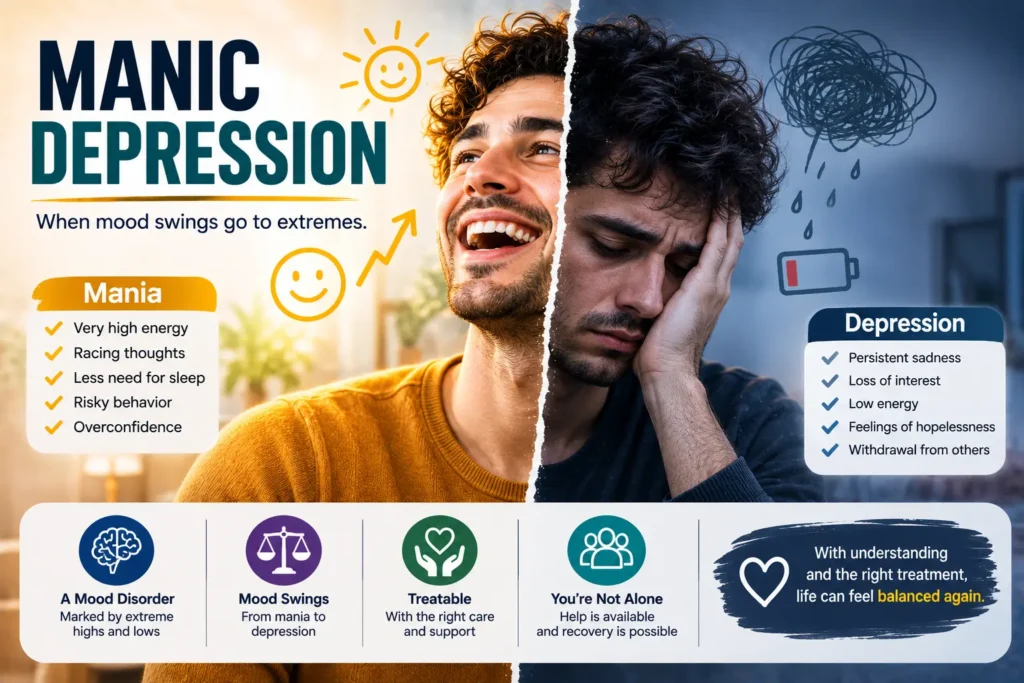
Manic depression is the older, now-outdated term for what’s officially called bipolar disorder today. The name changed because “manic depression” only described two mood extremes — mania and depression — while the modern diagnostic system recognizes a wider spectrum, including hypomania, mixed states, and distinct subtypes like bipolar I and bipolar II. The condition itself hasn’t changed; the terminology and diagnostic understanding around it have.
Table of Contents
Key Takeaways
- “Manic depression” and “manic-depressive illness” were the standard clinical terms before the DSM-5 adopted “bipolar disorder.”
- The name change reflects a more precise diagnostic system, not a different condition.
- The term is still used informally and shows up often in search, but it’s no longer accurate for clinical documentation.
- Bipolar disorder is now divided into distinct subtypes — see types of bipolar disorder for the full breakdown.
- Anyone researching “manic depression” today should look into current bipolar disorder resources for accurate, up-to-date information.
Why the Term “Manic Depression” Exists
The phrase “manic depression” comes from the two mood states it originally described: manic episodes, marked by extreme highs in energy and mood, and depressive episodes, marked by extreme lows. For much of the 20th century, this two-pole framing — sometimes formalized as “manic-depressive illness” or “manic-depressive psychosis” — was the dominant clinical language used by psychiatrists, including in early editions of diagnostic manuals used by the American Psychiatric Association.
It’s a term you’ll still encounter in older medical literature, in general conversation, and sometimes in media portrayals of the condition, even though it’s no longer the clinical standard.
Why the Name Changed to “Bipolar Disorder”
The shift from “manic depression” to “bipolar disorder” happened gradually, largely through revisions to the DSM (Diagnostic and Statistical Manual of Mental Disorders) published by the American Psychiatric Association. A few key reasons drove the change:
It reflects a spectrum, not just two poles. “Bipolar” — meaning “two poles” — was chosen to represent the full range of mood states involved, including hypomania, which is a milder elevated state that doesn’t reach full mania, and mixed states, where manic and depressive symptoms occur together.
It allowed for more precise subtypes. As the diagnostic system evolved, clinicians recognized meaningful differences between people who experience full mania and those who experience only hypomania. This distinction eventually became the basis for separating bipolar I from bipolar II.
It reduced some of the stigma associated with the older term. “Manic depression” was sometimes used loosely or inaccurately in everyday language, contributing to public misunderstanding of the condition. The more clinical, spectrum-based term “bipolar disorder” was intended to support clearer, more accurate communication.
According to resources from the NHS and Cleveland Clinic, “bipolar disorder” is now the standard term used across major health organizations worldwide, including the World Health Organization.
Manic Depression vs. Bipolar Disorder: Is There a Difference?
This is one of the most common points of confusion, so it’s worth stating plainly.
| Question | Answer |
| Are manic depression and bipolar disorder the same condition? | Yes — “manic depression” is simply the older name for what’s now diagnosed as bipolar disorder. |
| Did the symptoms change? | No, the underlying mood episodes (mania, hypomania, depression) are the same; what changed is how they’re categorized and named. |
| Is “manic depression” still used in official diagnosis? | No. Clinicians use “bipolar disorder” along with the specific subtype (bipolar I, bipolar II, cyclothymia) for accurate diagnosis. |
| Why do people still say “manic depression”? | It remains in everyday language and older records, but it doesn’t reflect the more precise modern diagnostic framework. |
| Does using the old term matter for treatment? | Not directly, but understanding the current terminology helps when researching accurate treatment and diagnostic information. |
For the full modern classification system, see types of bipolar disorder and what is bipolar.
How “Manic Depression” Maps to Modern Bipolar Subtypes
Since the older term didn’t distinguish between subtypes, it’s helpful to see how it corresponds to today’s diagnostic categories.
| Older Term | Closest Modern Equivalent |
| Manic depression / manic-depressive illness (with full mania) | Bipolar I disorder |
| Manic depression (with milder elevated episodes) | Bipolar II disorder |
| Chronic, milder mood cycling sometimes grouped under the older term | Cyclothymia |
| “Mixed” manic-depressive states | Mixed features specifier, still recognized in current diagnosis |
This mapping isn’t exact — the older term wasn’t built to capture these distinctions — but it gives useful context for anyone encountering “manic depression” in an older diagnosis, family history, or historical medical record. For a detailed comparison between the two main subtypes, see bipolar 1 vs bipolar 2 and bipolar 1 vs 2 differences.
Symptoms Historically Described as “Manic Depression”
While the terminology has changed, the symptom pattern originally described under “manic depression” is what’s now organized into distinct mood episodes:
| Mood Episode | Key Features |
| Manic episode | Elevated or irritable mood, high energy, reduced need for sleep, impulsivity, sometimes psychosis |
| Hypomanic episode | A milder version of the above, without severe impairment or psychosis |
| Depressive episode | Persistent low mood, fatigue, loss of interest, changes in sleep and appetite |
| Mixed features | Manic and depressive symptoms occurring together or in rapid succession |
For a full breakdown of each, see bipolar disorder symptoms, mania symptoms, and hypomania symptoms.
Causes and Risk Factors
The causes behind what was once called manic depression are the same causes recognized for bipolar disorder today — a combination of genetic vulnerability, brain chemistry differences, and environmental triggers. This hasn’t changed with the terminology shift; only the diagnostic framework around it has become more refined.
For the full picture of contributing factors, see bipolar disorder causes.
Diagnosis Today
If you or a family member were once diagnosed with “manic depression,” it’s worth knowing that a modern evaluation would use the current DSM-5 criteria to determine the specific subtype — bipolar I, bipolar II, or cyclothymia — based on episode severity, duration, and pattern. This distinction matters because treatment approaches can differ between subtypes.
For details on how this evaluation works, see bipolar disorder diagnosis.
Treatment: Then and Now
Treatment approaches have also evolved substantially since the “manic depression” era. Early treatment options were far more limited, while today’s approach typically combines mood-stabilizing medication, psychotherapy, and structured lifestyle management, tailored to the specific bipolar subtype and episode pattern.
For a complete modern treatment overview, see bipolar disorder treatment.
Myths vs. Facts About Manic Depression
| Myth | Fact |
| “Manic depression is a different, more severe condition than bipolar disorder.” | They’re the same condition — “manic depression” is simply the outdated name. |
| “Doctors still diagnose people with manic depression.” | Current clinical diagnosis uses “bipolar disorder” with a specific subtype, not the older term. |
| “The name change means the condition is now less serious.” | The name change reflects better diagnostic precision, not a change in severity. |
| “Manic depression only involves severe mania and severe depression.” | The modern spectrum includes hypomania and mixed states, which the older term didn’t fully capture. |
| “There’s nothing useful in older ‘manic depression’ research.” | Much of the historical research remains relevant; it’s the terminology and categorization that have been refined. |
For broader misconceptions about the condition, see bipolar disorder myths.
Complications and Long-Term Outlook
Whether referred to as manic depression or bipolar disorder, the long-term course and potential complications of untreated mood episodes are the same. Consistent treatment remains the strongest factor in long-term stability and functioning.
For more detail, see bipolar disorder complications and bipolar disorder prognosis.
Warning Signs to Watch For
Regardless of terminology, the warning signs that indicate a mood episode may be developing include:
- A sudden drop in need for sleep without feeling tired
- Rapid speech, racing thoughts, or jumping between ideas
- Increasing impulsivity, spending, or risk-taking
- Persistent low mood, fatigue, or loss of interest lasting more than two weeks
- Any hallucinations or delusions, which indicate a more severe episode
When to Seek Emergency Help
Seek immediate help if you or someone you know shows signs of psychosis, extreme agitation, or any thoughts of self-harm or suicide. In the US, call 988 (Suicide & Crisis Lifeline) or 911 in an emergency. In the UK, contact the Samaritans at 116 123 or call 999. These situations shouldn’t wait for a scheduled appointment.
Frequently Asked Questions
Is manic depression the same as bipolar disorder? Yes. “Manic depression” is the older clinical name for what’s now diagnosed as bipolar disorder.
When did the term change from manic depression to bipolar disorder? The shift happened gradually through revisions to the DSM diagnostic manual, as psychiatry moved toward a more spectrum-based, subtype-specific understanding of the condition.
Why do some people still use the term manic depression? It remains common in everyday language, older medical records, and some media references, even though it’s not the current clinical term.
Is manic depression a more severe form of bipolar disorder? No — it’s not a separate or more severe condition. It’s simply the outdated name for the same underlying diagnosis.
Does manic depression refer to bipolar I or bipolar II? The older term didn’t distinguish between subtypes, so it could historically refer to either, depending on episode severity. Modern diagnosis specifies which subtype applies.
Is “manic-depressive” an offensive term? It’s outdated rather than inherently offensive, but current clinical and public health guidance favors “bipolar disorder” for accuracy and clarity.
Should I use the term manic depression when talking to my doctor? It’s fine to mention if that’s the term you’re familiar with or that appears in older records, but your doctor will use current bipolar disorder terminology for diagnosis and treatment planning.
Summary
Manic depression is the older name for bipolar disorder — the underlying condition hasn’t changed, but the terminology and diagnostic framework around it have become far more precise, distinguishing between bipolar I, bipolar II, and cyclothymia based on the specific pattern of mood episodes involved. If you’re researching a past “manic depression” diagnosis or simply came across the term, the most accurate and up-to-date information will be found under current bipolar disorder resources.
To explore the modern classification and what it means for diagnosis and treatment, see our guides on bipolar disorder, bipolar 1 vs bipolar 2, and bipolar disorder glossary.