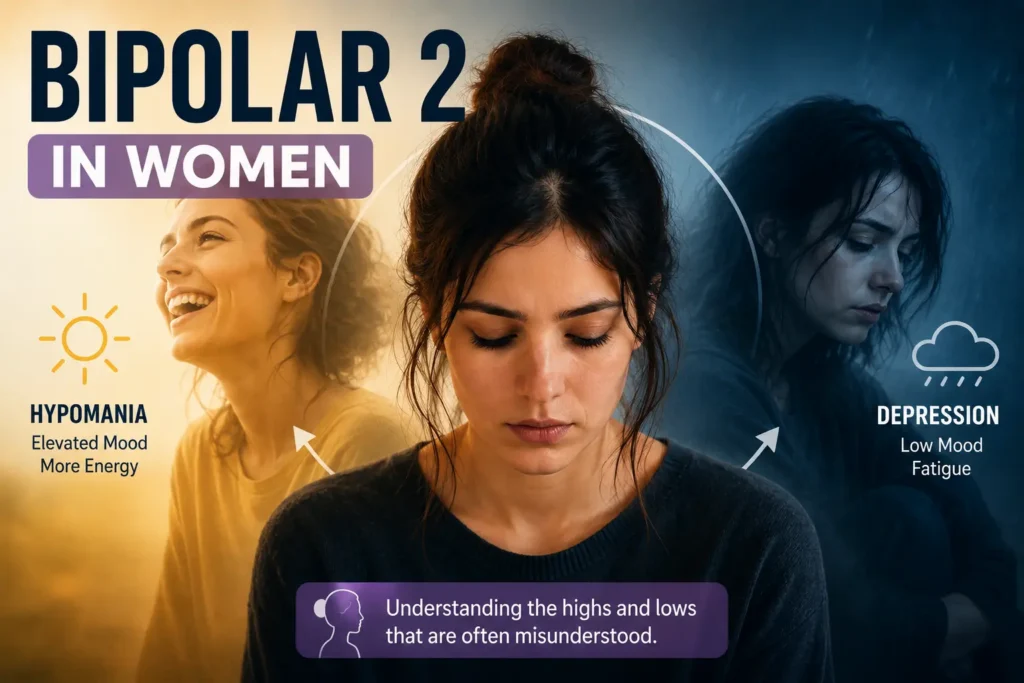
Bipolar 2 disorder affects men and women at broadly similar rates overall, but research suggests women are more often diagnosed specifically with bipolar 2 (rather than bipolar 1), tend to experience more depressive episodes relative to hypomanic ones, and are more likely to have rapid cycling — four or more mood episodes within a year. Reproductive hormonal events — the menstrual cycle, pregnancy, the postpartum period, and perimenopause — can all influence when and how episodes occur. None of this changes the underlying diagnostic criteria, but it does shape how bipolar 2 tends to show up across a woman’s life, and why treatment often needs to account for hormonal timing. For the clinical foundation behind this pattern, see our guide to bipolar 2 disorder.
Table of Contents
Key Takeaways
- Women are more often diagnosed with bipolar 2 specifically, and tend to experience a heavier depressive burden than hypomanic burden over time.
- Rapid cycling and mixed features (hypomanic and depressive symptoms occurring together) are more commonly reported in women.
- Reproductive hormonal events — menstruation, pregnancy, postpartum, and perimenopause — are linked to shifts in mood episode timing and severity.
- Bipolar 2 in women is frequently misdiagnosed as unipolar depression, PMDD, or a personality disorder, which can delay appropriate treatment.
- Treatment planning often needs to account for hormonal timing, medication safety during pregnancy and breastfeeding, and thyroid function.
Does Bipolar 2 Show Up Differently in Women?
The DSM-5 diagnostic criteria for bipolar 2 — at least one hypomanic episode and one major depressive episode, without a history of full mania — are identical regardless of gender. What differs, according to research, is the pattern of how the illness tends to unfold.
Studies on bipolar illness and gender have found that women with bipolar disorder are more likely to be diagnosed with bipolar 2 rather than bipolar 1, more likely to experience depressive episodes overall, and more likely to have rapid cycling and mixed states — periods where hypomanic and depressive symptoms occur at the same time. Much of this research covers bipolar disorder broadly, so it’s worth treating these as general patterns rather than a fixed rule for every woman with the condition. For the foundational picture of the illness itself, our guide to what is bipolar disorder is a useful starting point.
The Depressive Weight of Bipolar 2 in Women
Depressive episodes tend to dominate the course of bipolar 2 for most people, but this pattern appears especially pronounced in women. Research suggests women with bipolar disorder report more depressive episodes and fewer manic or hypomanic ones compared to men, which may partly explain why bipolar 2 — defined by hypomania rather than full mania — is diagnosed more often in women.
This has a practical consequence: because depression is what’s most visible and most disruptive, it’s also what most often gets treated first, sometimes without anyone asking about a history of hypomania. That gap is one of the central reasons bipolar 2 in women gets misdiagnosed as standalone depression. Our dedicated guide to bipolar 2 depression covers this symptom picture in full detail, and our guide to bipolar 2 hypomania explains what the “up” side of the illness looks like when it does appear.
Rapid Cycling and Mixed Features
Two patterns show up more often in research on women with bipolar disorder:
- Rapid cycling — experiencing four or more distinct mood episodes within a single year. This pattern is more frequently reported in women than in men.
- Mixed features — hypomanic symptoms (like racing thoughts, irritability, or restlessness) occurring alongside depressive symptoms at the same time, rather than in clearly separate episodes.
Both patterns can make bipolar 2 harder to recognize and treat, since the mood picture doesn’t always separate neatly into distinct “up” and “down” periods. If you’re trying to understand how these patterns compare across the wider condition, our page on bipolar disorder symptoms is a useful companion.
Hormones and the Female Reproductive Cycle
This is one of the most clinically important — and most under-explained — parts of bipolar 2 in women. Reproductive hormonal events are consistently linked to changes in mood episode timing and severity.
| Reproductive event | What research suggests |
| Menstrual cycle | Some women experience mood worsening in the premenstrual phase; a history of premenstrual mood symptoms is linked to a higher risk of depressive episodes later, including around perimenopause |
| Pregnancy | Hormonal shifts during pregnancy can affect mood stability; treatment planning often requires careful medication review with a psychiatrist and obstetric provider |
| Postpartum period | The postpartum period carries a notably elevated risk of mood episode recurrence, including postpartum depression and, in some cases, postpartum psychosis, which requires urgent medical attention |
| Perimenopause | Research has found a substantial proportion of women with bipolar disorder experience at least one depressive episode during the menopausal transition, with some studies reporting a majority of participants affected |
| Hormonal contraceptives | Starting or stopping hormonal contraceptives has been associated with mood instability in some women with bipolar disorder |
None of this means every woman with bipolar 2 will experience mood changes tied to these events, but the pattern is well-documented enough that it’s worth discussing directly with a psychiatrist, particularly around major reproductive transitions. For the broader causes and contributing factors behind the condition, see our page on bipolar disorder causes.
Thyroid Function and Bipolar 2 in Women
Thyroid conditions are more common in women generally, and there’s a documented relationship between thyroid function and mood stability in bipolar disorder. Some research has found differences in thyroid hormone levels between women with bipolar disorder and those without, and thyroid dysfunction can also be a side effect of certain mood stabilizers, particularly lithium. This is one of the reasons routine thyroid monitoring is often part of ongoing psychiatric care for women on long-term bipolar treatment — not a separate, unrelated health issue.
Why Bipolar 2 in Women Is Often Misdiagnosed
Several factors contribute to delayed or inaccurate diagnosis:
- Depression dominates the visible symptom picture. Since women with bipolar 2 often experience more depressive episodes than hypomanic ones, clinicians may treat the depression without asking about hypomania history.
- Hormonal mood changes get dismissed as “normal.” Premenstrual, postpartum, or perimenopausal mood symptoms are sometimes attributed entirely to hormones rather than explored as part of a broader mood disorder.
- Overlap with other diagnoses. Bipolar 2 in women is sometimes misdiagnosed as premenstrual dysphoric disorder (PMDD), unipolar depression, or a personality disorder, particularly when mood instability and mixed features are present.
- Rapid cycling can look like unpredictable moodiness rather than a pattern with a diagnosable structure, especially without a mood-tracking history to point to.
Our full guide to bipolar disorder diagnosis and bipolar 1 vs 2 diagnosis covers how clinicians distinguish bipolar 2 from these overlapping conditions. If you want a starting point for a conversation with a provider, our bipolar 1 vs 2 test and bipolar 1 vs 2 quiz can help frame that discussion, though neither replaces a full clinical evaluation.
Bipolar 2 in Women vs. Men: A Comparison
| Factor | More commonly reported in women | More commonly reported in men |
| Diagnosis type | Bipolar 2 more often than bipolar 1 | Bipolar 1 or mixed presentations somewhat more often |
| Episode balance | More depressive episodes relative to hypomanic ones | More pronounced hypomanic/manic episodes |
| Cycling pattern | Rapid cycling and mixed features more common | Less frequently reported |
| Hormonal influence | Menstrual cycle, pregnancy, postpartum, and perimenopause linked to episode timing | Not a comparable factor |
| Common misdiagnoses | PMDD, unipolar depression, personality disorders | Substance use disorder, conduct-related conditions |
| Help-seeking | Often earlier than men, though still frequently delayed | Often delayed due to stigma around emotional expression |
For a deeper dive into these differences, our dedicated page on bipolar 1 vs 2 in men and women explores the research further, and our guide to bipolar 2 in men covers the male-specific presentation directly.
Diagnosis: What a Thorough Evaluation Looks Like
- A complete mood history, including how mood has tracked alongside the menstrual cycle, pregnancies, or menopause transition
- Screening for hypomania specifically, since depressive symptoms often dominate the visible picture
- Ruling out overlapping conditions, including PMDD, thyroid dysfunction, and personality disorders that can share surface-level features with bipolar 2
- Thyroid function testing, given the documented relationship between thyroid health and mood stability
- A conversation about reproductive plans, if relevant, since this affects both diagnosis context and future treatment planning
Myths vs. Facts About Bipolar 2 in Women
| Myth | Fact |
| “Mood swings around your period are just PMS, not worth mentioning to a psychiatrist.” | A history of premenstrual mood symptoms is linked to a higher risk of later depressive episodes and is clinically relevant information. |
| “Bipolar 2 in women is basically the same as PMDD.” | The two are distinct diagnoses, though they can overlap or be confused; an accurate evaluation should distinguish between them. |
| “Pregnancy automatically means stopping all psychiatric medication.” | Medication decisions during pregnancy are individualized and should always be made with a psychiatrist and obstetric provider — stopping medication abruptly carries its own risks. |
| “Menopause has nothing to do with mood stability in bipolar 2.” | Research has found a notable increase in depressive episodes during the menopausal transition for many women with bipolar disorder. |
| “Rapid mood changes just mean someone is ‘moody,’ not that it’s a diagnosable pattern.” | Rapid cycling is a recognized clinical pattern in bipolar disorder and is more commonly reported in women. |
For a broader set of misconceptions across the condition, see our page on bipolar disorder myths.
Treatment Considerations for Women
Core treatment for bipolar 2 doesn’t differ by gender in terms of what’s clinically effective, but several factors specific to women often shape how treatment is planned.
| Consideration | Why it matters |
| Medication safety during pregnancy and breastfeeding | Some mood stabilizers carry specific risks during pregnancy and require careful risk-benefit discussion with a psychiatrist |
| Postpartum monitoring | The postpartum period carries elevated relapse risk and warrants close follow-up |
| Thyroid monitoring | Particularly relevant for women on lithium or other medications that can affect thyroid function |
| Hormonal contraceptive changes | Worth discussing with a psychiatrist, since starting or stopping hormonal birth control has been linked to mood shifts in some women |
| Cycle-aware mood tracking | Tracking mood alongside the menstrual cycle can help identify hormonally linked patterns that inform treatment timing |
Our full guide to bipolar 2 treatment and broader bipolar disorder treatment overview cover the standard medication and therapy approaches in more depth. Any medication decisions — especially around pregnancy, breastfeeding, or hormonal contraceptives — should always go through a psychiatrist and, where relevant, an obstetric provider.
Complications If Left Unaddressed
Untreated or misdiagnosed bipolar 2 in women is associated with:
- Prolonged depressive burden if only the depressive episodes are treated without addressing the underlying bipolar pattern
- Increased relapse risk during unmonitored reproductive transitions, particularly postpartum
- Greater difficulty distinguishing hormonal mood symptoms from a treatable mood disorder, delaying appropriate care
- Elevated suicide risk during depressive or mixed episodes
- Strain on parenting, relationships, and daily functioning during unaddressed mood instability
Our page on bipolar disorder complications covers these risks across the broader condition in more depth.
Warning Signs to Watch For
- Persistent low mood or hopelessness lasting two weeks or more
- Sudden bursts of energy, reduced need for sleep, or unusual confidence, even briefly
- Mood symptoms that seem to track closely with the menstrual cycle, pregnancy, or menopause transition
- New or worsening mood symptoms in the weeks after childbirth
- Any thoughts of suicide or self-harm, at any point
When to Seek Emergency Help
Some situations connected to bipolar 2 in women require urgent attention, particularly around the postpartum period. Seek immediate help if you or someone you know experiences:
- Thoughts of suicide or a specific plan to self-harm
- Postpartum symptoms involving confusion, hallucinations, or delusional thinking (possible signs of postpartum psychosis, a medical emergency)
- A sudden, severe worsening of mood or functioning
- Statements suggesting someone no longer wants to be alive
If you or someone else is in crisis, call or text 988 (Suicide & Crisis Lifeline) in the U.S., or contact local emergency services immediately. This is a sensitive topic, and if you’re personally navigating these feelings, reaching out to a mental health professional or crisis line is a strong, reasonable step to take.
Prognosis and Long-Term Outlook
With accurate diagnosis and treatment that accounts for hormonal timing, women with bipolar 2 can achieve the same long-term stability as anyone else with the condition. The pattern of more frequent depressive episodes and rapid cycling means ongoing monitoring is particularly valuable, especially around reproductive transitions. Our page on bipolar disorder prognosis and dedicated bipolar 2 prognosis guide cover the factors that shape long-term outcomes in more depth.
Frequently Asked Questions
Is bipolar 2 more common in women than men? Research suggests bipolar disorder overall affects men and women at broadly similar rates, but bipolar 2 specifically — as opposed to bipolar 1 — is diagnosed more often in women.
Can birth control affect bipolar 2 symptoms? Some women report mood changes when starting or stopping hormonal contraceptives. This is worth discussing directly with a psychiatrist if you notice a pattern.
Does pregnancy make bipolar 2 worse? Effects vary by individual. Pregnancy and the postpartum period are both periods of elevated relapse risk for many women with bipolar disorder, which is why close monitoring during this time is often recommended.
Is postpartum psychosis the same as bipolar 2? No, but postpartum psychosis is closely linked to bipolar disorder and represents a medical emergency requiring immediate treatment, distinct from typical bipolar 2 episodes.
Can menopause trigger a bipolar 2 relapse? Research has found a notable increase in depressive episodes during the perimenopausal transition for many women with bipolar disorder, making this a period worth discussing proactively with a psychiatrist.
How is bipolar 2 different from PMDD? PMDD is a separate diagnosis tied specifically to the premenstrual phase of the menstrual cycle, while bipolar 2 involves distinct hypomanic and depressive episodes that aren’t confined to a hormonal cycle. The two can sometimes be confused or co-occur, which is why a thorough evaluation matters.
Should women with bipolar 2 avoid pregnancy? This is a personal, medical decision that should be made in partnership with a psychiatrist and obstetric provider, who can help weigh treatment options and monitoring plans — not a decision this article can make for you.
Summary
Bipolar 2 in women often carries a heavier depressive weight, a higher chance of rapid cycling, and a meaningful connection to reproductive hormonal events — from the menstrual cycle through perimenopause. None of this changes the underlying diagnosis, but it does shape how the illness tends to unfold and what thoughtful treatment needs to account for. If any of this resonates with your own experience, particularly around hormonal timing or a pattern of depression-dominant episodes, a full evaluation with a psychiatrist familiar with these patterns is the most reliable next step.
This article is for educational purposes and is not a substitute for professional medical advice. If you have concerns about your mental health, please consult a qualified healthcare provider.