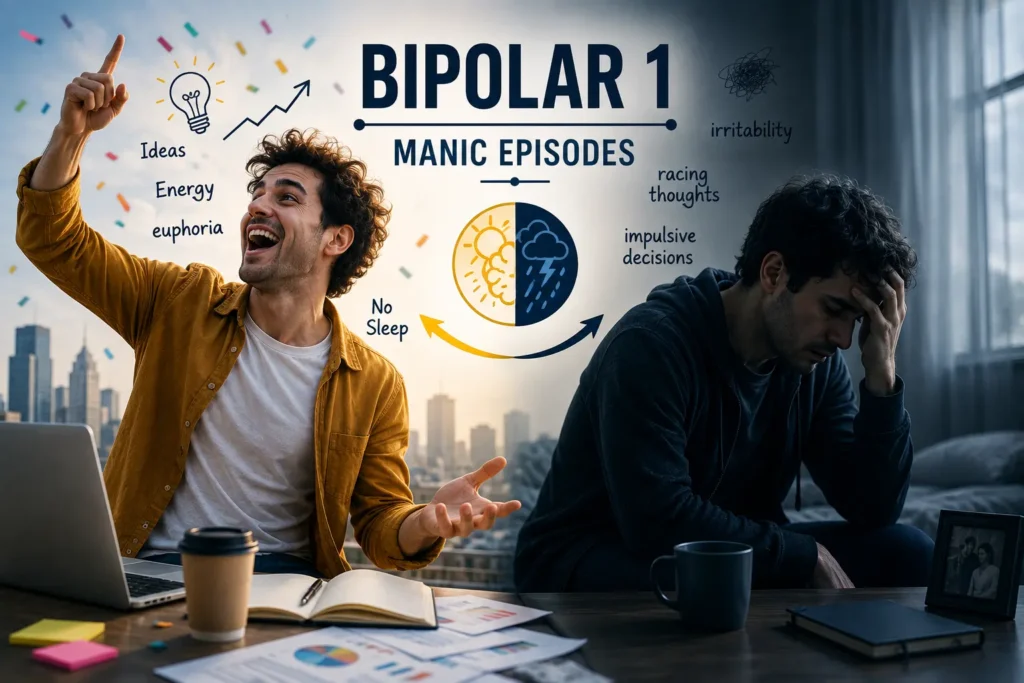
Bipolar 1 Manic Episodes are distinct periods of abnormally elevated, expansive, or irritable mood combined with a surge in energy and activity, lasting at least a week — or any length of time if they lead to hospitalization. They’re more than just “feeling great” or “having a productive week.” Mania affects judgment, sleep, impulse control, and sometimes involves psychosis, and it typically requires medical treatment to resolve safely.
Table of Contents
Introduction
Mania is the feature that defines bipolar 1 disorder. Without at least one manic episode, a bipolar 1 diagnosis isn’t made — which is why understanding exactly what mania looks like matters so much, whether you’re trying to recognize it in yourself or support someone going through it.
The tricky part is that mania rarely announces itself as a problem. It often feels like confidence, energy, and clarity — right up until it doesn’t. This guide breaks down what a manic episode actually looks like day by day, how it differs from simply feeling upbeat, and what to do if you or someone you love is in the middle of one.
If you haven’t yet reviewed the basics of the condition, our guide on what bipolar disorder is is a useful starting point, and our bipolar 1 vs bipolar 2 guide explains how the severity of manic episodes is what separates the two diagnoses.
Key Takeaways
- A manic episode involves elevated mood, high energy, and behavioral changes lasting at least one week, or any duration if hospitalization is needed.
- Mania is diagnosed clinically, using DSM-5 criteria — our bipolar 1 diagnosis guide covers this process in full.
- Severe mania can include psychosis, meaning a break from reality through hallucinations or delusions.
- Manic episodes are a medical situation, and prompt treatment reduces both severity and risk.
- A depressive “crash” often follows a manic episode, which is part of the overall bipolar 1 pattern.
What Is a Manic Episode, Exactly?
A manic episode is a sustained, biologically driven shift in mood and energy — not simply a good mood or a burst of motivation. It affects thinking, sleep, judgment, and behavior all at once, and it’s intense enough to disrupt work, relationships, or safety.
The full diagnostic definition comes from the DSM-5, and it requires the mood disturbance to last at least one week (or any length if hospitalization becomes necessary), along with several specific symptoms occurring alongside it. For the complete clinical criteria and how professionals confirm a diagnosis, see our bipolar 1 diagnosis guide. This article focuses on what mania actually looks and feels like in real life.
The Core Signs of a Manic Episode
Manic episodes typically involve a combination of the following, representing a clear change from someone’s usual behavior:
| Sign | What It Looks Like in Practice |
| Elevated or irritable mood | Euphoria, unusual optimism, or sudden short temper and agitation |
| Decreased need for sleep | Feeling fully rested after two or three hours of sleep |
| Rapid or pressured speech | Talking quickly, loudly, or jumping between topics |
| Racing thoughts | Ideas moving faster than they can be expressed or organized |
| Inflated self-esteem | Grandiose plans, unrealistic confidence, believing in special abilities |
| Increased goal-directed activity | Starting multiple projects at once, working through the night |
| Distractibility | Attention jumping rapidly from one thing to another |
| Risky behavior | Impulsive spending, risky driving, reckless decisions, hypersexuality |
Not everyone experiences every symptom, and the specific combination varies from person to person. What matters clinically is that several of these appear together, persist for a sustained period, and represent a real departure from that person’s baseline. For a broader look at how these symptoms fit into the wider condition, see our bipolar disorder symptoms guide.
The Stages of a Manic Episode
Mania rarely appears out of nowhere. It typically develops in a recognizable pattern.
| Stage | What Happens |
| Prodrome (early warning) | Subtle sleep changes, rising energy, mild irritability or optimism |
| Acute mania | Full symptoms present — elevated mood, racing thoughts, risky behavior, little need for sleep |
| Peak severity | In severe cases, psychosis may emerge — hallucinations, delusions, or disorganized thinking |
| Resolution | Symptoms ease, often with treatment, though this can take days to weeks |
| Post-episode crash | Many people experience a depressive episode or significant exhaustion afterward |
Recognizing the prodrome stage — the earliest, subtlest signs — is one of the most valuable skills someone with bipolar 1 or their support system can develop, since intervention at this point can sometimes prevent a full episode.
Mania vs. Hypomania vs. Normal Excitement
People often confuse genuine mania with simply being in an unusually good mood, or with hypomania, the milder pattern seen in bipolar 2 disorder. The distinctions matter for both diagnosis and safety.
| Feature | Normal Excitement | Hypomania | Mania (Bipolar 1) |
| Duration | Hours to a few days | At least 4 days | At least 1 week, or any length if hospitalized |
| Impact on functioning | None | Noticeable, but manageable | Significant disruption to work, relationships, or safety |
| Sleep | Normal | Reduced, but functional | Little to no need for sleep |
| Judgment | Intact | Slightly impaired | Often severely impaired |
| Psychosis | Never | Never | Possible in severe cases |
| Hospitalization | Never needed | Rarely needed | Sometimes required |
A full breakdown of how bipolar 1 and bipolar 2 differ overall — not just in mania — is available in our bipolar 1 vs 2 symptoms and bipolar 1 vs 2 chart guides.
What Causes a Manic Episode to Start
Manic episodes typically emerge from a combination of underlying biological vulnerability and specific triggers. Common triggers include major stress, significant sleep loss, substance use, and, in some cases, certain medications or medical conditions. Our bipolar 1 causes guide explains this process in depth, including the genetic and environmental factors that make someone susceptible to mania in the first place.
When Mania Involves Psychosis
In severe cases, mania can include psychotic features — a break from shared reality. This might look like:
- Believing in special powers, missions, or identities that aren’t real (grandiose delusions)
- Hearing voices or seeing things that aren’t there (hallucinations)
- Paranoid or suspicious beliefs without basis
- Disorganized, difficult-to-follow speech or thinking
Psychotic mania is considered a psychiatric emergency. It requires prompt medical attention, often including hospitalization, both for safety and to begin effective treatment. Psychotic features don’t mean someone has a different or worse diagnosis — they’re a recognized, treatable feature of severe bipolar 1 mania.
How Long Do Manic Episodes Last?
By definition, a manic episode lasts at least one week unless hospitalization shortens that timeline by intervening early. Without treatment, mania can persist for weeks or, in some cases, longer, gradually escalating in severity. With prompt treatment — typically involving medication and sometimes hospitalization — the acute phase often begins to ease within days, though full resolution and return to baseline mood can take longer. Every case is different, and the guide to bipolar 1 treatment explains what that intervention process generally involves.
The Crash After Mania
It’s common for a manic episode to be followed by a depressive episode, sometimes called a “crash.” This isn’t a separate problem — it’s part of the natural cycling pattern in bipolar 1. The shift from extreme energy and confidence to fatigue, low mood, or hopelessness can feel disorienting, and it’s one of the reasons ongoing treatment focuses on stability rather than just resolving a single episode. Our bipolar 1 vs 2 depression guide explains how depressive episodes differ across bipolar types.
How to Recognize Mania in Someone Else
Because mania often doesn’t feel like a problem to the person experiencing it, loved ones are frequently the first to notice something is off. Signs to watch for include:
- Sudden, uncharacteristic bursts of energy or ambition
- Talking noticeably faster or more than usual
- Sleeping very little without seeming tired
- Making big decisions impulsively — spending, relationships, work
- Increasing irritability when questioned or slowed down
- Starting to seem disconnected from reality (in severe cases)
If you notice these signs, gently expressing concern and encouraging a medical evaluation is usually more effective than confrontation, which can increase agitation.
A Quick Checklist: Could This Be a Manic Episode?
- Has the person’s mood or energy changed noticeably for a week or more?
- Are they sleeping far less than usual, without feeling tired?
- Have they made unusually risky or impulsive decisions recently?
- Is their speech faster, louder, or harder to follow?
- Has their behavior caused problems at work, in relationships, or with safety?
- Are there any signs of confusion, paranoia, or beliefs that seem disconnected from reality?
Answering “yes” to several of these is a strong signal that a medical evaluation is warranted — this checklist is a starting point for a conversation with a professional, not a diagnostic tool. Full diagnostic criteria are covered in our bipolar 1 diagnosis guide.
Myths vs. Facts About Manic Episodes
| Myth | Fact |
| “Mania just means being really happy.” | Mania involves impaired judgment, disrupted sleep, and often serious consequences — it’s a medical episode, not simply happiness. |
| “People in mania know something is wrong.” | Insight is often limited during mania; the episode frequently feels positive to the person experiencing it. |
| “Mania always includes psychosis.” | Psychosis occurs in some, but not all, manic episodes. |
| “Once mania ends, everything goes back to normal immediately.” | A depressive episode or exhaustion phase often follows, and recovery can take time. |
| “Someone in mania can just calm down if they try.” | Mania is a biologically driven episode, not something resolved through willpower alone. |
See our full bipolar disorder myths guide for more misconceptions about the condition overall.
What Helps During a Manic Episode
| Helpful | Unhelpful |
| Encouraging contact with a psychiatrist promptly | Waiting to see if it resolves on its own |
| Staying calm and speaking gently | Arguing, confronting, or lecturing |
| Reducing stimulation (noise, crowds, decisions) | Adding pressure or big decisions during the episode |
| Supporting sleep and rest where possible | Enabling further sleep loss or excessive stimulation |
| Involving trusted family or a care team | Managing the situation entirely alone |
Professional treatment is the most effective way to resolve a manic episode safely. Our bipolar 1 treatment guide covers the medications and approaches typically used, both during an acute episode and for long-term prevention.
Complications of Untreated or Repeated Manic Episodes
Manic episodes that go untreated, or that recur frequently, are associated with a higher risk of complications, including relationship and financial difficulties, job loss, legal issues from impulsive decisions, and an increased likelihood of future episodes. Our bipolar disorder complications guide covers this in more depth, including why early, consistent treatment matters for long-term outcomes.
When to Seek Emergency Help
Certain signs during a manic episode call for immediate medical attention rather than a scheduled appointment:
- Signs of psychosis, such as hallucinations or delusional beliefs
- Extremely risky behavior that puts the person or others in danger
- Any expression of thoughts of self-harm or suicide
- Severe agitation or aggression
In these situations, contact emergency services or go to the nearest emergency department immediately. Mania with psychotic or safety-related features is a medical emergency, not something to manage by waiting it out.
Frequently Asked Questions
How long does a bipolar 1 manic episode usually last? By clinical definition, at least one week, though hospitalization can shorten this by intervening early. Without treatment, episodes can persist significantly longer.
Can a manic episode happen without any warning? It’s uncommon for mania to appear with zero warning. Most episodes have a prodrome phase with subtler signs — like reduced need for sleep or rising energy — that build before full symptoms emerge.
Is it possible to have mania without psychosis? Yes. Most manic episodes don’t involve psychosis. Psychotic features occur in a subset of severe cases and represent one possible feature of mania, not a requirement.
What’s the difference between mania and hypomania? Mania is more severe, lasts longer (at least a week versus at least four days), and causes significant impairment or requires hospitalization. Hypomania, seen in bipolar 2, is milder and typically doesn’t disrupt functioning as severely.
Can stress alone trigger a manic episode? Stress is a well-documented trigger in people who already have an underlying vulnerability to bipolar 1, but it’s rarely considered a standalone cause. Our bipolar 1 causes guide explains this relationship further.
Does everyone with bipolar 1 experience psychosis during mania? No. Psychosis occurs in some cases of severe mania but is not present in every manic episode or every person with bipolar 1.
What typically happens after a manic episode ends? Many people experience a depressive episode or a period of exhaustion following mania, which is part of the broader mood cycling pattern in bipolar 1.
Should someone in a manic episode go to the hospital? It depends on severity. Episodes involving psychosis, danger to self or others, or a total inability to function safely typically require hospitalization. Milder episodes may be managed with close outpatient psychiatric care instead.
Summary
A manic episode is the defining feature of bipolar 1 disorder — a sustained period of elevated mood, high energy, and behavioral change that goes well beyond simply feeling good. It follows a recognizable pattern, from early warning signs through acute symptoms to, eventually, resolution and often a depressive aftermath.
Recognizing mania early, understanding its stages, and knowing when to seek help are some of the most valuable tools for managing bipolar 1 long-term. If you’re navigating a recent episode or supporting someone through one, the next helpful steps are understanding the diagnosis process and exploring treatment options that can reduce how often these episodes occur and how severe they become.