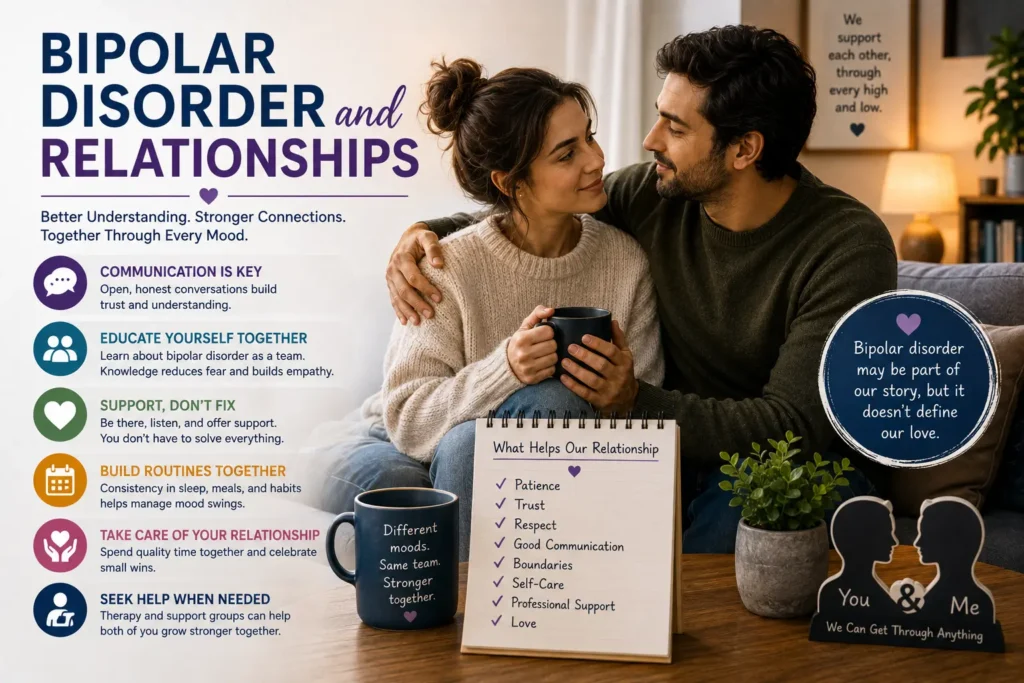
Bipolar Disorder and Relationships can strain relationships through mood-driven conflict, unpredictability, and communication breakdowns during episodes — but it doesn’t have to define or damage a relationship long-term. Couples who do well typically combine consistent treatment, honest communication about warning signs, clear boundaries, and outside support like therapy. Dating and partnership with bipolar disorder are absolutely possible; they just require more intentional structure than relationships without a chronic mood condition in the mix.
Table of Contents
Introduction
If you’re in a relationship with someone who has bipolar disorder — or you have bipolar disorder yourself and you’re wondering how it will affect your love life — you’re asking a fair question. Mood episodes don’t just affect the person experiencing them. They ripple out to partners, and over time, those ripples can either erode a relationship or, handled well, actually strengthen it.
This isn’t a topic most articles cover honestly. Either they downplay the real challenges, or they paint a picture so bleak it scares people away from relationships they could otherwise thrive in. Neither extreme is useful.
This guide focuses on what actually happens in relationships affected by bipolar disorder, and what tends to help. If you’re newer to the diagnosis itself, it’s worth first understanding what bipolar disorder is and reviewing the core symptoms, since how each mood state shows up directly shapes what a partner experiences.
Key Takeaways
- Manic, hypomanic, and depressive episodes each create different relationship challenges — not just “mood swings.”
- Communication about early warning signs prevents most relationship blowups from escalating.
- Bipolar disorder affects both partners; caregiver burnout in partners is real and needs attention too.
- Couples therapy alongside individual treatment improves outcomes more than either alone.
- Dating with bipolar disorder works best with honest, well-timed disclosure — not necessarily immediate disclosure.
- A relationship struggling isn’t proof the relationship is doomed; it’s often a sign the treatment plan needs adjusting.
How Each Mood State Affects a Relationship
Bipolar disorder isn’t one consistent mood — it cycles between distinct states, and each one creates a different relationship dynamic. Understanding the different types of bipolar disorder helps explain why one couple’s experience can look completely different from another’s.
| Mood State | Common Relationship Impact |
| Mania | Impulsive decisions (spending, infidelity risk, sudden plans), irritability, reduced insight into how behavior affects the partner |
| Hypomania | Increased charm and energy that can feel exciting at first, but often paired with reduced patience and poor follow-through |
| Depression | Withdrawal, low libido, irritability, difficulty engaging in shared activities, partner feeling shut out |
| Mixed episodes | Unpredictable combination of high energy and low mood — often the hardest state for partners to anticipate or respond to |
| Euthymia (stable mood) | The baseline most relationships function well in — communication and connection are typically much easier here |
Mania in particular carries relationship risks that depression doesn’t — including impulsive financial decisions and behavior partners describe as “not like them at all.” If you want the fuller clinical picture, our guide to mania and hypomania explains how the two differ, and our page on mania vs. hypomania breaks down the practical distinctions partners often ask about.
Dating With Bipolar Disorder
When and How to Disclose
There’s no universal rule for when to tell someone you’re dating that you have bipolar disorder. Disclosing too early, before trust is built, can feel like oversharing to both people. Waiting too long can feel like a betrayal of trust once the relationship is more serious.
A reasonable approach many clinicians suggest: disclose once the relationship is heading toward exclusivity or long-term commitment, not on a first date, but before major life decisions are made together. Frame it factually — what the diagnosis means for you specifically, what your treatment plan looks like, and what you’d want them to know about your patterns — rather than either minimizing it or over-explaining.
What Healthy Dating Looks Like
- Being honest about your treatment adherence, not just the diagnosis itself
- Giving a new partner a realistic (not catastrophized) picture of what an episode might look like
- Not using bipolar disorder as a blanket explanation for every conflict
- Recognizing when hypomanic energy might be influencing decisions in a new relationship, like moving too fast
Common Relationship Challenges
Communication Breakdown During Episodes
During mania or depression, communication patterns shift. Someone in a depressive episode may seem distant or uninterested, when they’re actually struggling with low energy and hopelessness rather than losing feelings for their partner. Someone in mania may talk over their partner, become defensive quickly, or make promises they can’t keep in the moment.
Trust and Unpredictability
Repeated cycles of instability can wear down trust — not because the person with bipolar disorder is untrustworthy, but because partners struggle to predict which version of a conversation they’ll get. This is where consistent treatment matters most for the relationship, not just the individual.
Intimacy Changes
Libido and emotional availability often shift significantly between mood states — reduced during depression, sometimes increased and less inhibited during mania or hypomania. Partners benefit from understanding this is symptom-driven rather than a reflection of attraction or commitment.
Financial Strain
Impulsive spending during manic or hypomanic episodes is one of the most commonly reported relationship stressors. Couples often benefit from proactive financial safeguards — shared visibility into accounts, agreed-upon spending limits during high-risk periods — set up during stable periods, not mid-conflict.
Caregiver Burnout
Partners who take on a caretaking role during episodes are at real risk of burnout, resentment, and their own mental health decline. A relationship works best when the partner without bipolar disorder also has their own support system and isn’t solely responsible for managing the other person’s stability.
Warning Signs a Relationship Needs More Support
| Sign | What It Often Means |
| Repeated cycles of crisis followed by “everything’s fine” | Underlying treatment or relapse-prevention plan likely needs adjusting |
| One partner consistently walking on eggshells | Communication patterns need structural change, often with a therapist’s help |
| Financial or safety incidents recurring during episodes | Concrete safeguards and a written crisis plan are overdue |
| Partner feeling solely responsible for the other’s stability | Caregiver burnout risk — outside support is needed for both people |
| Avoidance of the topic entirely | A sign to open direct, low-conflict conversation about the diagnosis’s role in the relationship |
If episodes are escalating or safety becomes a concern, review the warning signs that indicate a mood episode may be building, and don’t wait to involve a treatment provider.
What Actually Helps: Building a Stronger Relationship
Treat It as a Shared Project, Not One Person’s Problem
Relationships tend to do best when both partners understand the condition, not just the person diagnosed. Learning the causes of bipolar disorder and typical treatment approaches together can shift the dynamic from “your illness” to “something we manage together.”
Build a Joint Warning-Sign Plan
Sit down during a stable period and write out, together, what early warning signs look like for mania and for depression. Agree in advance on what the partner should say or do when they notice these signs — and agree the person with bipolar disorder won’t take it as an accusation when they do.
Use Couples or Family Therapy
Family-focused therapy has research support specifically for bipolar disorder, not just general couples counseling. It’s built around communication skills, relapse recognition, and reducing the high-stress interactions that can actually trigger episodes. This pairs well with the individual therapy approaches — like cognitive behavioral therapy — used for the diagnosis itself.
Separate the Person From the Episode
This is one of the hardest but most protective mindset shifts for partners: an irritable comment during hypomania or a withdrawn week during depression is a symptom, not necessarily a reflection of how your partner feels about you or the relationship. This doesn’t mean excusing harmful behavior — it means responding to patterns with a treatment lens rather than a purely personal one.
Protect Routine as a Couple
Since sleep and routine disruption are known triggers, couples who build predictable shared routines — consistent bedtimes, regular check-ins, planned downtime — often see fewer destabilizing episodes than couples with chaotic, unpredictable schedules.
Myths vs. Facts
| Myth | Fact |
| “A relationship with someone bipolar is always chaotic.” | With consistent treatment, many relationships involving bipolar disorder are stable and healthy long-term. |
| “You should avoid dating someone with bipolar disorder.” | The diagnosis alone doesn’t predict relationship success — treatment adherence and communication do. |
| “Mania makes someone a different, more genuine person.” | Mania involves altered judgment and brain chemistry; it isn’t a truer version of someone’s personality. |
| “If they loved me enough, they’d never have another episode.” | Bipolar disorder is a biological condition; episodes reflect illness activity, not depth of feeling. |
For a broader look at misconceptions beyond relationships, see our full bipolar disorder myths page.
When to Seek Professional Help
Consider bringing in a couples therapist or contacting a treatment provider if:
- Conflict during episodes is escalating rather than resolving
- One partner feels consistently unsafe, physically or emotionally
- Communication has broken down to the point of frequent shutdowns or explosive arguments
- The partner with bipolar disorder is not engaging with their own treatment plan
- The non-diagnosed partner is showing signs of burnout, anxiety, or depression themselves
If there are ever signs of self-harm, suicidal thoughts, or safety concerns during an episode, this becomes urgent rather than something to work through gradually. In the U.S., the 988 Suicide & Crisis Lifeline is available by call or text at any time, and emergency services should be contacted if there’s immediate danger.
Frequently Asked Questions
Can a person with bipolar disorder have a healthy, long-term relationship? Yes. Treatment adherence, communication, and mutual understanding are far stronger predictors of relationship success than the diagnosis itself.
Should I tell someone I’m dating that I have bipolar disorder? Most clinicians recommend disclosing once a relationship is becoming serious, framed factually around your treatment and patterns rather than as a dramatic confession.
Does bipolar disorder cause cheating or impulsive behavior in relationships? Manic episodes can involve impulsivity and poor judgment that sometimes includes infidelity risk, but this reflects symptom-driven behavior during an active episode, not a fixed trait of everyone with the diagnosis.
How do I support a partner during a depressive episode without enabling withdrawal? Stay engaged with low-pressure check-ins, encourage treatment adherence, and avoid interpreting withdrawal as rejection — while also gently maintaining connection rather than fully backing away.
Is it normal to feel exhausted as the partner of someone with bipolar disorder? Yes, and it’s worth taking seriously. Caregiver burnout is common and manageable with your own support system, not something to push through silently.
Can couples therapy help with bipolar-related relationship issues? Yes — family-focused and couples therapy have research support for improving communication and reducing relapse-related conflict in relationships affected by bipolar disorder.
Summary
Bipolar disorder changes the shape of a relationship, but it doesn’t have to define its quality. The relationships that do best treat the condition as something both partners understand and manage together — built on early warning-sign communication, consistent treatment, realistic expectations during dating, and outside support like therapy when things get hard. If you’re navigating this now, the goal isn’t a relationship without conflict. It’s a relationship with the tools to handle conflict well.
This article is for educational purposes and isn’t a substitute for personalized medical or relationship counseling advice. If you or your partner are experiencing symptoms of bipolar disorder or relationship distress, consider speaking with a licensed healthcare professional or therapist.