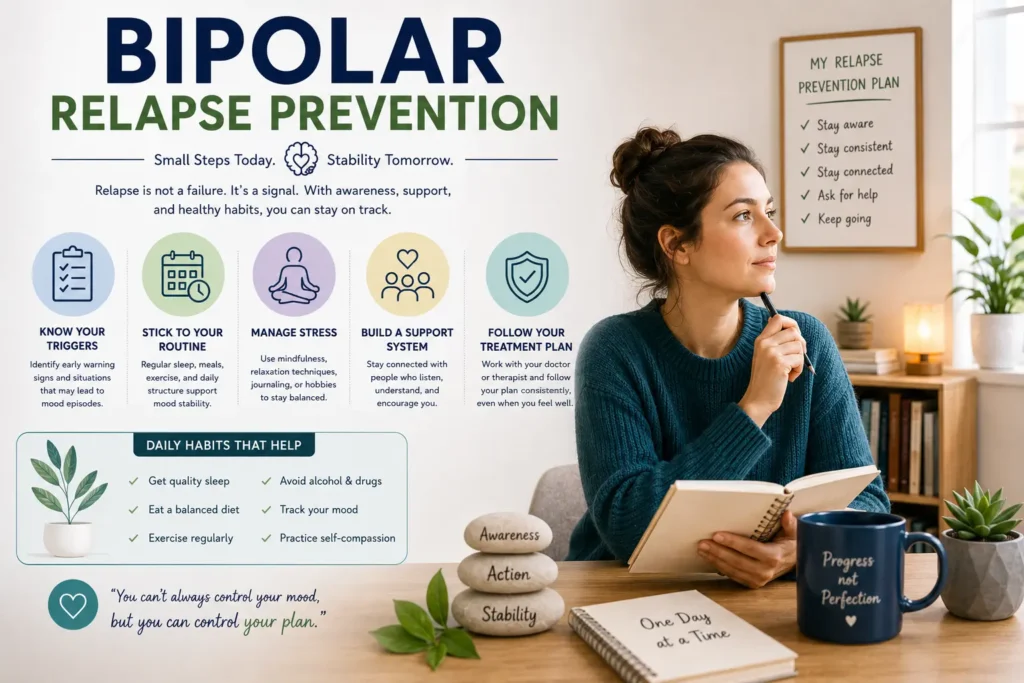
Bipolar relapse prevention means learning to recognize your personal early warning signs — often called a “relapse signature” — before a full manic or depressive episode develops, and having a clear plan for what to do when they appear. Research shows most people with bipolar disorder can identify their own prodromal symptoms, sometimes weeks in advance, which creates a real window to intervene before things escalate. Prevention works best as a combination of consistent medication, ongoing therapy, self-monitoring, and support from people who know your patterns. For a broader look at day-to-day strategies, see our guide on how to manage bipolar disorder.
Table of Contents
Key Takeaways
- Relapse is common in bipolar disorder — research suggests most people will experience more than one episode over their lifetime, which is why prevention planning matters.
- Warning signs typically appear during a period called the prodrome, which can start weeks before a full episode.
- Most people can learn to recognize their own “relapse signature” — the specific pattern of symptoms that tends to appear before their episodes.
- Medication adherence, consistent sleep, and stress management are among the most consistently supported relapse prevention strategies.
- A relapse prevention plan works best when it’s written down in advance and shared with your treatment team and a trusted support person.
- Warning signs differ for mania and depression, and they can look different from person to person, so a personalized plan matters more than a generic checklist.
What Does “Relapse” Actually Mean in Bipolar Disorder?
Relapse refers to the return of manic, hypomanic, mixed, or depressive symptoms after a period of relative stability. It’s different from ongoing symptoms that never fully resolved — relapse implies you had some meaningful stretch of stability before symptoms came back.
Bipolar disorder is a recurring condition for most people. Research reviewing the natural course of the illness has found that a large majority of people with bipolar disorder — <cite index=”19-1″>between 70% and 90%</cite> — will experience more than one episode over time, and naturalistic studies have found that <cite index=”19-1″>around half of people relapse within a year, and roughly two-thirds within two years</cite>. That doesn’t mean relapse is inevitable for everyone or that treatment doesn’t work — it means relapse prevention is a genuinely important, ongoing part of managing the condition rather than a one-time concern.
Why Relapse Prevention Deserves Its Own Plan
It’s tempting to think of relapse prevention as just “staying on treatment.” That’s part of it, but not the whole picture.
The research base for relapse prevention specifically focuses on the window of time before a full episode develops — the prodrome — because that’s when intervention has the best chance of working. Waiting until a manic or depressive episode is already in full swing usually means treatment is playing catch-up rather than getting ahead of it.
This is also why relapse prevention differs somewhat from general symptom management. It’s less about treating an active episode and more about catching the signals that one is building, then acting on them quickly.
Understanding the Prodrome: Your Early Warning Window
The prodrome is the period between feeling stable and a full mood episode. Clinical literature typically breaks it into two phases:
| Phase | Timing | What It Looks Like |
| Early prodrome | Up to several weeks before an episode | Mild, sometimes subtle changes in sleep, mood, or energy |
| Late prodrome | Days to hours before an episode | More noticeable, escalating symptoms |
Research on this topic has consistently found that <cite index=”27-1″>identifiable early symptoms tend to appear two to four weeks before a full manic or depressive recurrence</cite> in most people with bipolar disorder, and importantly, those symptoms tend to be <cite index=”27-1″>consistent for a given individual, even though they vary widely between different people</cite>.
That consistency is what makes relapse prevention possible. If your early signs are always the same — say, sleeping less and feeling unusually talkative — you can learn to recognize that specific pattern rather than having to watch for every possible bipolar symptom in general.
Your “Relapse Signature”: What It Is and Why It Matters
Clinicians sometimes use the term “relapse signature” to describe the specific combination of early warning symptoms that tends to precede an individual’s episodes. It’s essentially your personal early-warning fingerprint.
Building your relapse signature usually involves looking back at your past episodes and asking:
- What was different about your sleep in the weeks before?
- Did your energy, talkativeness, or spending habits shift?
- Were you more irritable, withdrawn, or tearful than usual?
- Did people around you notice something before you did?
- Were there specific stressors or life events involved?
A therapist or psychiatrist can help you work through this systematically, but many people find they can identify meaningful patterns on their own once they start paying attention. Research suggests this is realistic — a notable proportion of people with bipolar disorder, even after only one prior episode, are able to <cite index=”19-1″>reliably identify their own prodromal symptoms for both mania and depression</cite>.
Early Warning Signs of Manic or Hypomanic Relapse
Manic and hypomanic prodromes tend to be somewhat easier for people to recognize than depressive ones, though they can still be missed — especially because they can feel good at first.
Common early signs include:
- Needing less sleep without feeling tired
- Increased talkativeness or racing thoughts
- Rising irritability or impatience
- Increased energy or restlessness
- Starting more projects than usual
- Impulsive spending or decision-making
- Feeling unusually confident or “on top of the world”
For a full breakdown of manic symptoms themselves, see our dedicated guide on mania symptoms. If you’re trying to distinguish early hypomania from full mania, our guide on mania vs hypomania can help clarify the difference.
Early Warning Signs of Depressive Relapse
Depressive prodromes are often subtler and can be mistaken for ordinary low moods or fatigue, which is part of why they can be harder to catch early.
Common early signs include:
- Increasing fatigue or low energy
- Sleeping more than usual, or trouble falling asleep
- Withdrawing from friends, family, or activities
- Loss of interest in things you normally enjoy
- Increased self-criticism or hopeless thinking
- Difficulty concentrating
- Changes in appetite
If you want a fuller picture of what depressive episodes look like in bipolar disorder specifically, our guide on bipolar depression symptoms covers this in more depth.
Comparing Manic vs. Depressive Warning Signs
| Category | Manic/Hypomanic Warning Signs | Depressive Warning Signs |
| Sleep | Needing less sleep, not feeling tired | Sleeping more, or difficulty falling asleep |
| Energy | Increased, restless | Decreased, fatigued |
| Mood | Elevated, irritable | Low, hopeless, tearful |
| Social behavior | More talkative, socially active | Withdrawn, isolating |
| Thinking | Racing thoughts, grandiosity | Self-critical, difficulty concentrating |
| Behavior | Impulsive spending, risk-taking | Reduced activity, loss of interest |
What Triggers a Relapse
Relapse doesn’t happen at random. Certain factors consistently raise the risk, and research reviewing multiple studies on bipolar relapse prevention has identified a few standout patterns.
| Risk Factor | Why It Matters |
| Stopping or changing medication without medical guidance | One of the most common and preventable relapse triggers |
| Disrupted sleep | Sleep loss is strongly linked to manic relapse in particular |
| High stress or major life events | Stressful events were identified as a primary trigger in relapse research |
| Substance use | Alcohol and drugs can both trigger episodes and interfere with treatment |
| Residual symptoms | People with lingering symptoms despite treatment face a higher relapse risk |
| Past relapse frequency | A history of frequent relapses, especially with short gaps between them, raises future risk |
A review of relapse prevention research found that the highest relapse risk was seen in people who had <cite index=”21-1″>lingering symptoms despite treatment, a history of frequent past relapses, and short intervals between previous relapses</cite>, with stressful life events standing out as a primary trigger. The same review found that <cite index=”21-1″>consistent medication use, ongoing talk therapy, and a strong support system were among the most effective ways to reduce relapse risk</cite>.
To understand your own risk factors in more depth, our guide on bipolar disorder causes explains the underlying biological and environmental factors involved.
Building a Personal Relapse Prevention Plan
A relapse prevention plan turns everything above into something concrete and actionable. Most effective plans include the following elements:
1. Your Relapse Signature
A written list of your specific early warning signs for both mania and depression, based on what’s happened before past episodes.
2. Your Personal Triggers
Situations, stressors, or life events that have preceded past episodes for you specifically.
3. A Response Plan by Severity
| Stage | Example Action |
| Early warning signs noticed | Increase self-monitoring, reduce stressors, prioritize sleep, contact therapist |
| Warning signs escalating | Contact psychiatrist, consider medication review, lean on support system |
| Signs of full episode | Follow emergency plan, involve support person directly, seek urgent psychiatric care |
4. A Support Contact List
Names and numbers for your psychiatrist, therapist, and a trusted family member or friend who knows your warning signs and has permission to speak up if they notice something.
5. A “What Helped Before” Log
Notes on what worked during past episodes or near-misses, so you’re not starting from scratch each time.
Writing this plan down while you’re stable — not during a crisis — makes it far more useful. Many people keep a copy with their psychiatrist and share it with at least one support person in advance.
The Role of Self-Monitoring
Ongoing self-monitoring is one of the most practical, low-cost tools in relapse prevention. This can be as simple as a daily mood and sleep log, or as structured as a mood-tracking app.
What’s worth tracking:
- Daily mood rating
- Sleep duration and quality
- Energy levels
- Irritability
- Major stressors
- Medication adherence
The goal isn’t to obsess over every fluctuation — it’s to notice a pattern building over several days that matches your known relapse signature. For more on building sustainable tracking habits, see our guide on how to manage bipolar disorder.
Why Medication Adherence Is Central to Relapse Prevention
Medication remains one of the most well-supported tools for reducing relapse risk in bipolar disorder. Stopping medication abruptly — even when feeling stable — is one of the most common and preventable causes of relapse.
If you’re considering a medication change for any reason, that conversation should happen with your prescribing psychiatrist, not on your own. Sudden discontinuation can trigger rebound symptoms that are more severe than what the medication was originally managing. Our guide on bipolar disorder treatment covers how medications fit into an overall treatment plan.
The Role of Therapy in Relapse Prevention
Several therapy approaches are specifically designed to reduce relapse risk by helping people recognize and respond to early warning signs:
- Psychoeducation helps people understand their illness, treatment, and personal warning signs — and has been associated with reduced hospitalization and relapse in research on early warning sign interventions.
- Cognitive behavioral therapy (CBT) helps identify and interrupt unhelpful thought patterns that can worsen a developing episode. See our guide on cognitive behavioral therapy for bipolar disorder.
- Dialectical behavior therapy (DBT) builds distress tolerance and emotion regulation skills that can help during the early stages of an episode. See our guide on dialectical behavior therapy for bipolar disorder.
- Family-focused approaches involve loved ones directly in recognizing warning signs, since they often notice changes before the person experiencing them does.
Involving Family and Friends in Relapse Prevention
Support people play a genuinely important role in relapse prevention — not because you can’t manage on your own, but because bipolar disorder, especially mania, can distort a person’s own read on their mood in the moment.
Practical ways to involve trusted people:
- Share your written relapse signature with them in advance
- Agree on how you’d like them to raise concerns if they notice warning signs
- Decide together what steps they should take if you’re not receptive in the moment
- Revisit and update the plan together periodically, especially after any new episode
This works best as a two-way conversation during a stable period, not something decided unilaterally by either side.
Dos and Don’ts of Relapse Prevention
| Do | Don’t |
| Track mood, sleep, and energy consistently | Wait until symptoms are severe to reach out for help |
| Write down your relapse signature while stable | Rely on memory alone during a crisis |
| Contact your psychiatrist at the first sign of a pattern | Stop or change medication without medical guidance |
| Involve a trusted support person in your plan | Isolate when you notice early warning signs |
| Revisit your plan after each episode | Assume last time’s plan still fits without review |
When Warning Signs Escalate: What to Do
If early signs are building despite your usual coping strategies, it’s time to move faster:
- Contact your psychiatrist or therapist as soon as possible — don’t wait for a scheduled appointment
- Let a trusted support person know what’s happening
- Reduce stressors and non-essential commitments where you can
- Prioritize sleep and avoid alcohol or recreational substances
- Avoid major financial or life decisions until things stabilize
- Follow the response plan you built in advance, if you have one
Emergency Warning Signs
Some signs mean it’s time to seek urgent or emergency care rather than working through your usual relapse plan:
- Thoughts of suicide or self-harm
- Severe mania with dangerous, reckless, or risky behavior
- Psychotic symptoms, such as hallucinations or delusions
- Inability to sleep for multiple consecutive nights
- Inability to care for basic needs
If you or someone you know is experiencing any of these, contact a psychiatrist, crisis line, or emergency services immediately. Relapse prevention planning is meant to catch problems early — it isn’t a substitute for emergency care once a crisis is underway.
Frequently Asked Questions
How early can you tell a bipolar relapse is starting? Research suggests early warning signs commonly appear two to four weeks before a full episode, though timing varies by person and by whether the episode is manic or depressive. Manic prodromes are often noticed somewhat earlier than depressive ones.
Can bipolar relapse be prevented completely? Not entirely — bipolar disorder is a recurring condition for most people, and no prevention plan eliminates risk completely. But consistent treatment, self-monitoring, and an early response plan meaningfully reduce both the frequency and severity of relapses for many people.
What’s the difference between a relapse and a mood swing? Everyday mood swings are brief and don’t meet the intensity or duration needed for a diagnosable episode. A relapse involves a return of manic, hypomanic, mixed, or depressive symptoms that meet diagnostic criteria, following a period of relative stability. If you’re unsure how to tell the difference, our guide on bipolar disorder symptoms can help.
Why do I sometimes not notice my own warning signs? This is common, especially with mania, which can feel good in its early stages. It’s part of why involving a trusted support person — who can often spot changes before you do — is such a consistent recommendation in relapse prevention research.
Does stopping medication always cause a relapse? Not always, but stopping or changing medication without medical supervision is one of the most well-documented and preventable relapse triggers. Any medication changes should be discussed with a psychiatrist first.
Is relapse more likely with bipolar 1 or bipolar 2? Relapse risk exists across all types of bipolar disorder, though the pattern of episodes differs. Our guide comparing bipolar 1 vs bipolar 2 explains how episode patterns tend to differ between the two.
Should I make a relapse prevention plan even if I feel stable right now? Yes — a plan is far more useful when it’s written during a stable period, while you can think clearly, rather than improvised during a crisis. Many clinicians recommend creating or updating this plan as part of ongoing care, not just after a relapse.
Summary
Relapse is a common part of the long-term course of bipolar disorder, but it isn’t unpredictable. Most people can learn to recognize their own early warning signs weeks before a full episode develops, and having a clear, written plan — built around your personal relapse signature, your known triggers, and a support network who knows what to watch for — gives you a real chance to intervene early. Prevention works best as an ongoing collaboration with your psychiatrist and therapist, not something managed alone. If you haven’t built a relapse prevention plan yet, that conversation is worth having at your next appointment, while you’re stable enough to think it through clearly.
This article is for educational purposes and is not a substitute for professional medical advice. If you are having thoughts of suicide or self-harm, please contact a crisis line or emergency services in your area immediately.