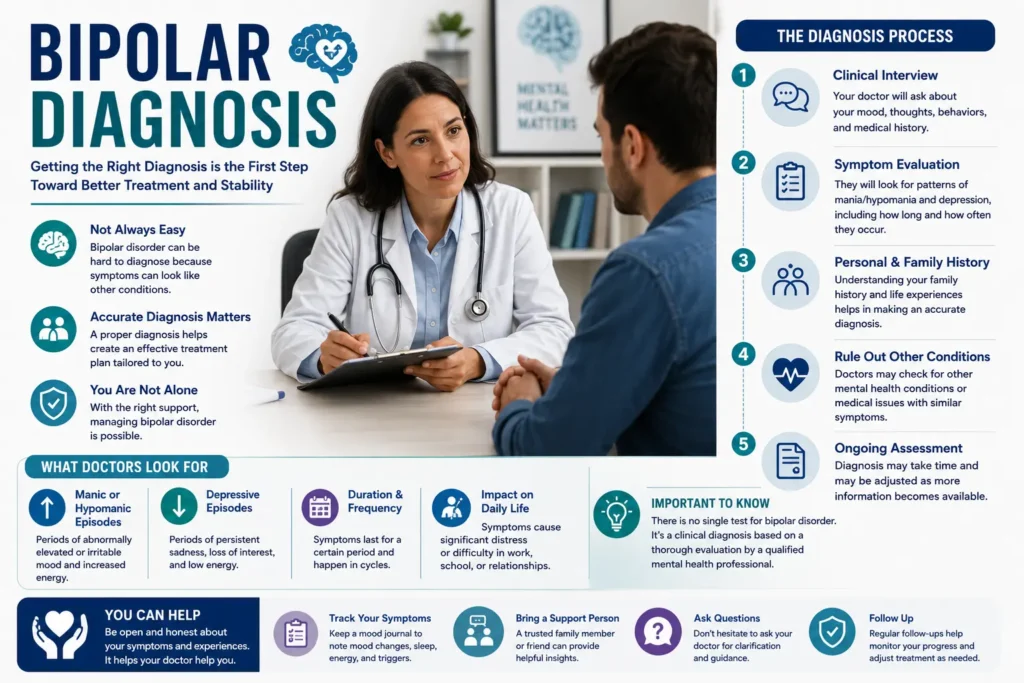
There’s no blood test for bipolar disorder. No scan lights up and confirms it. That surprises a lot of people, especially when so many other health conditions are confirmed with a single lab result. Instead, a bipolar diagnosis is built carefully, over time, through conversation, history, and pattern recognition.
This guide walks through exactly how that process works: who’s qualified to diagnose bipolar disorder, what a clinical evaluation actually involves, which criteria doctors use, why the process sometimes takes years, and what to expect if you’re heading into an evaluation yourself. For background on the condition itself, our guides to bipolar disorder and what is bipolar are useful starting points.
Table of Contents
Key Takeaways
- Bipolar disorder is diagnosed clinically, through a detailed history and interview, not through blood tests or brain imaging.
- Diagnosis relies on the criteria set out in the DSM-5, the diagnostic manual published by the American Psychiatric Association.
- Physical exams and lab tests are still commonly used, but to rule out other medical causes of mood symptoms, not to confirm bipolar disorder itself.
- Misdiagnosis is common, particularly mistaking bipolar disorder for major depressive disorder, since depressive episodes often bring someone to treatment before a manic or hypomanic episode is ever mentioned.
- A single conversation isn’t usually enough. Diagnosis often involves multiple visits, mood tracking, and sometimes input from family members.
A bipolar diagnosis is made through a clinical evaluation that includes a detailed interview about mood history, a physical exam and lab tests to rule out other medical causes, and comparison of symptoms against DSM-5 diagnostic criteria for manic, hypomanic, and depressive episodes. There is no blood test or brain scan that can confirm bipolar disorder on its own. A psychiatrist, psychologist, or other qualified mental health professional typically makes the diagnosis after gathering a full picture of a person’s mood patterns over time.
Who Diagnoses Bipolar Disorder?
Bipolar disorder is typically diagnosed by a psychiatrist, though psychologists and other licensed mental health professionals can also be involved in the evaluation process. A primary care doctor may be the first point of contact and can refer someone for a specialized psychiatric evaluation, especially since ruling out other medical causes is often the first step.
Because bipolar disorder shares symptoms with several other conditions, a specialist with experience in mood disorders is often best positioned to make an accurate diagnosis, particularly in more complex or ambiguous cases.
Why Bipolar Disorder Doesn’t Have a Simple Test
Unlike conditions such as diabetes or thyroid disease, bipolar disorder doesn’t have a biomarker, a specific substance or measurable indicator in the blood or body, that confirms its presence. According to Mayo Clinic Proceedings, no laboratory test currently has sufficient accuracy to diagnose bipolar disorder on its own, which is why the condition remains a clinical diagnosis based on patterns of symptoms over time.
This doesn’t mean tests aren’t used at all. Blood tests, thyroid panels, and sometimes brain imaging are ordered, but for a different reason: to rule out other conditions that can mimic bipolar symptoms, such as an overactive thyroid, certain neurological conditions, or substance-related effects.
The Bipolar Diagnosis Process, Step by Step
While every clinician’s approach varies slightly, a bipolar evaluation generally follows a similar sequence.
Step 1: Initial Conversation and Symptom History
The clinician will ask detailed questions about current symptoms, including their intensity, how long they’ve lasted, and how they’ve affected daily functioning. This isn’t a quick checklist. Expect the conversation to go far beyond “are you sad” or “are you happy,” and instead dig into sleep patterns, energy levels, impulsivity, and changes from your typical baseline behavior.
Step 2: Personal and Family Mental Health History
Since bipolar disorder has a genetic component, clinicians typically ask about family history of bipolar disorder, depression, or other mental health conditions. A close relative with bipolar disorder is considered a relevant risk factor worth discussing during evaluation. For a broader look at contributing factors, see our guide to bipolar disorder causes.
Step 3: Physical Examination and Lab Tests
A physical exam and basic blood work are common early steps, mainly to rule out medical conditions that can produce similar symptoms. Thyroid problems, for example, can cause mood swings, fatigue, and irritability that resemble bipolar symptoms. This step protects against misdiagnosing a treatable medical condition as a psychiatric one.
Step 4: Mood Charting
Clinicians may ask patients to track their mood, sleep, and energy levels daily over a period of time, sometimes called mood charting. This ongoing record can reveal patterns that are hard to recall accurately in a single conversation, especially since people often remember depressive episodes more clearly than manic or hypomanic ones.
Step 5: Comparing Symptoms Against DSM-5 Criteria
The clinician evaluates whether reported symptoms meet the formal criteria for a manic, hypomanic, or major depressive episode, as defined in the DSM-5. This includes checking symptom duration, severity, and whether they represent a clear change from the person’s usual functioning.
Step 6: Ruling Out Other Conditions
Because bipolar disorder overlaps with several other conditions, the clinician works to rule out alternative explanations, including major depressive disorder, ADHD, borderline personality disorder, and substance-induced mood changes, before finalizing a diagnosis.
Step 7: Ongoing Follow-Up
In some cases, especially when the picture isn’t fully clear at first, diagnosis isn’t finalized in one visit. Follow-up appointments allow clinicians to observe patterns over time and adjust the diagnosis if new information or episodes emerge.
DSM-5 Diagnostic Criteria at a Glance
The table below summarizes the core duration and symptom requirements used to diagnose the major forms of bipolar disorder under the DSM-5.
| Diagnosis | Core Requirement | Minimum Duration |
| Bipolar I disorder | At least one manic episode (may also include hypomanic or depressive episodes) | Manic episode: 1 week, or any length if hospitalized |
| Bipolar II disorder | At least one hypomanic episode and one major depressive episode, without a full manic episode | Hypomanic episode: 4 days; depressive episode: 2 weeks |
| Cyclothymic disorder | Numerous periods of hypomanic and depressive symptoms that don’t meet full episode criteria | 2 years (1 year in children/teens), with no symptom-free gap longer than 2 months |
A manic episode also requires at least three additional symptoms (four if the mood is only irritable), such as inflated self-esteem, decreased need for sleep, or increased goal-directed activity, present most of the day, nearly every day. For the full breakdown of what each of these episode types looks like day to day, see our guides to bipolar disorder symptoms, mania symptoms, and bipolar depression symptoms.
For a full comparison between bipolar I and bipolar II specifically, including how their diagnostic paths differ, see our dedicated guide to bipolar 1 vs bipolar 2. If you’re wondering how the full spectrum of related conditions fits together, our guide to types of bipolar disorder lays that out clearly.
Why Misdiagnosis Is So Common
One of the most well-documented challenges in bipolar diagnosis is timing. Research published in Mayo Clinic Proceedings notes that for many patients, the time between symptom onset and an accurate bipolar diagnosis can exceed ten years. A major reason: depressive episodes are far more likely to bring someone into treatment than hypomanic or manic ones, since hypomania in particular can feel productive or pleasant rather than distressing.
This means many people are initially diagnosed with major depressive disorder and prescribed antidepressants alone. Without a mood stabilizer, antidepressants can potentially trigger a switch into mania or destabilize mood in someone who actually has bipolar disorder, which is one reason accurate diagnosis matters so much before treatment begins. Our guide to bipolar disorder treatment explains how treatment approaches differ once a correct diagnosis is established.
Conditions Commonly Mistaken for Bipolar Disorder
| Condition | Overlapping Symptoms | Key Distinguishing Factor |
| Major depressive disorder | Low mood, fatigue, hopelessness | No history of manic or hypomanic episodes |
| ADHD | Impulsivity, distractibility, restlessness | Symptoms are typically chronic rather than occurring in distinct mood episodes |
| Borderline personality disorder | Mood instability, impulsivity | Mood shifts tend to be triggered by interpersonal stress and are shorter in duration than bipolar episodes |
| Anxiety disorders | Agitation, racing thoughts, sleep disruption | Anxiety symptoms aren’t tied to distinct periods of elevated mood or energy |
A thorough evaluation is designed specifically to sort through this overlap, which is a major reason self-diagnosis based on online symptom lists isn’t reliable. Our guide to bipolar disorder myths addresses several common misconceptions related to this exact issue.
Can You Diagnose Yourself With an Online Bipolar Test?
Online screening tools and quizzes can be a helpful starting point for organizing your thoughts before an appointment, but they are not diagnostic. A positive result on a screening questionnaire simply means it may be worth discussing bipolar disorder with a professional, not that a diagnosis is confirmed. Studies on structured screening tools have found that a meaningful percentage of people who screen positive are not ultimately diagnosed with bipolar disorder by a clinician, and some who screen negative are.
If you’re curious about self-assessment tools specifically related to bipolar I vs. bipolar II, our guides on the bipolar 1 vs 2 test and bipolar 1 vs 2 quiz explain what these tools can and can’t tell you.
What to Expect at a Bipolar Diagnosis Appointment
Knowing what’s coming can make the process feel less intimidating. Here’s a general checklist of what’s commonly involved:
- A detailed conversation about your current symptoms and how long they’ve lasted
- Questions about past mood episodes, even ones that happened years ago
- Questions about family history of mental illness
- A physical exam and possibly blood tests to rule out other causes
- Discussion of sleep patterns, energy levels, and any changes in behavior
- Possibly, a request to keep a mood journal or chart before a follow-up visit
- Questions about substance use, since this can influence mood and complicate diagnosis
Being as detailed and honest as possible, including about symptoms that might feel embarrassing, like impulsive spending or risky behavior during high-energy periods, helps clinicians reach an accurate diagnosis more efficiently.
Tips for Preparing for a Bipolar Evaluation
- Track your mood before the appointment. Even a simple daily log of mood, sleep, and energy for a few weeks can provide useful information.
- Talk to family members if possible. They may remember episodes or patterns you don’t recall clearly, especially from periods of hypomania or mania.
- Write down your history of mood episodes, even ones you didn’t think were connected to a mental health condition at the time.
- Be specific about how symptoms affect daily life, not just how you feel internally.
- Mention any family history of bipolar disorder, depression, or other mental health conditions.
Common Mistakes People Make During the Diagnosis Process
- Only mentioning depressive symptoms and leaving out high-energy or elevated-mood periods, since those can feel less like a “problem” at the time.
- Assuming a single evaluation will always be enough for a complex diagnosis.
- Avoiding mention of past risky or impulsive behavior out of embarrassment, when it may be clinically relevant.
- Relying on an online quiz result as a substitute for a professional evaluation.
Warning Signs That Need Immediate Attention
While diagnosis is generally not an emergency process, certain symptoms during an evaluation period do require urgent care rather than waiting for a scheduled appointment:
- Thoughts of suicide or self-harm
- Signs of psychosis, such as hallucinations or delusions
- Severe agitation combined with hopelessness
- Behavior that puts personal safety or others’ safety at risk
If you or someone you know is in crisis, contact the 988 Suicide & Crisis Lifeline (call or text 988 in the US) or local emergency services immediately. Our guide to psychotic symptoms in bipolar disorder explains this specific warning sign in more depth.
After Diagnosis: What Comes Next
Receiving a bipolar diagnosis is the start of a treatment plan, not the end of the process. Most treatment plans combine medication, typically a mood stabilizer, with psychotherapy and lifestyle strategies like consistent sleep habits. Our full guide to bipolar disorder treatment covers these options in depth.
It’s also worth understanding what living with a confirmed diagnosis tends to look like long-term. Our guide to bipolar disorder prognosis covers realistic expectations, while our guide to bipolar disorder complications explains what can happen if the condition goes unmanaged. If unfamiliar clinical terms come up during this process, our bipolar disorder glossary is a useful reference, and our bipolar disorder statistics page offers additional context on how common the condition is.
Frequently Asked Questions
How is bipolar disorder diagnosed? Bipolar disorder is diagnosed through a clinical evaluation that includes a detailed symptom history, physical exam and lab tests to rule out other causes, and comparison of symptoms against DSM-5 diagnostic criteria, typically conducted by a psychiatrist or other qualified mental health professional.
Is there a blood test for bipolar disorder? No. There is currently no blood test or biomarker that can confirm a bipolar diagnosis on its own. Blood tests are used to rule out other medical conditions, like thyroid problems, that can cause similar symptoms.
How long does it take to get diagnosed with bipolar disorder? It varies significantly. Some people are diagnosed relatively quickly, while others go years without an accurate diagnosis, often because depressive symptoms are reported more readily than manic or hypomanic ones.
Can a regular doctor diagnose bipolar disorder, or do I need a psychiatrist? A primary care doctor can conduct an initial evaluation and rule out other medical causes, but a psychiatrist or other mental health specialist typically provides the full diagnostic evaluation, especially for complex or unclear cases.
What’s the difference between a bipolar diagnosis and just having mood swings? A diagnosis requires symptoms that meet specific duration and severity criteria under the DSM-5, representing a clear, sustained change from a person’s usual mood and behavior, not everyday emotional ups and downs.
Can bipolar disorder be misdiagnosed as depression? Yes, this is one of the most common misdiagnoses, since people often seek help during a depressive episode without mentioning past manic or hypomanic periods, which can lead to an initial diagnosis of major depressive disorder alone.
Do online bipolar tests count as a real diagnosis? No. Online screening tools can help organize symptoms before an appointment, but they cannot replace a full clinical evaluation by a qualified professional.
What should I bring to a bipolar diagnosis appointment? A mood journal or chart, a list of past symptoms and episodes, information about family mental health history, and a willingness to discuss both depressive and high-energy periods honestly.
Summary
A bipolar diagnosis isn’t based on a single test or a quick conversation. It’s built through a careful clinical process: a detailed symptom history, a physical exam to rule out other causes, comparison against DSM-5 criteria, and often, ongoing follow-up over time. Understanding this process can make it feel less overwhelming, whether you’re preparing for your own evaluation or trying to understand a loved one’s diagnosis.
If what you’ve read here sounds familiar, the most reliable next step is a conversation with a qualified psychiatrist or mental health professional, alongside exploring our broader library of guides on bipolar symptoms, treatment, and long-term outlook.