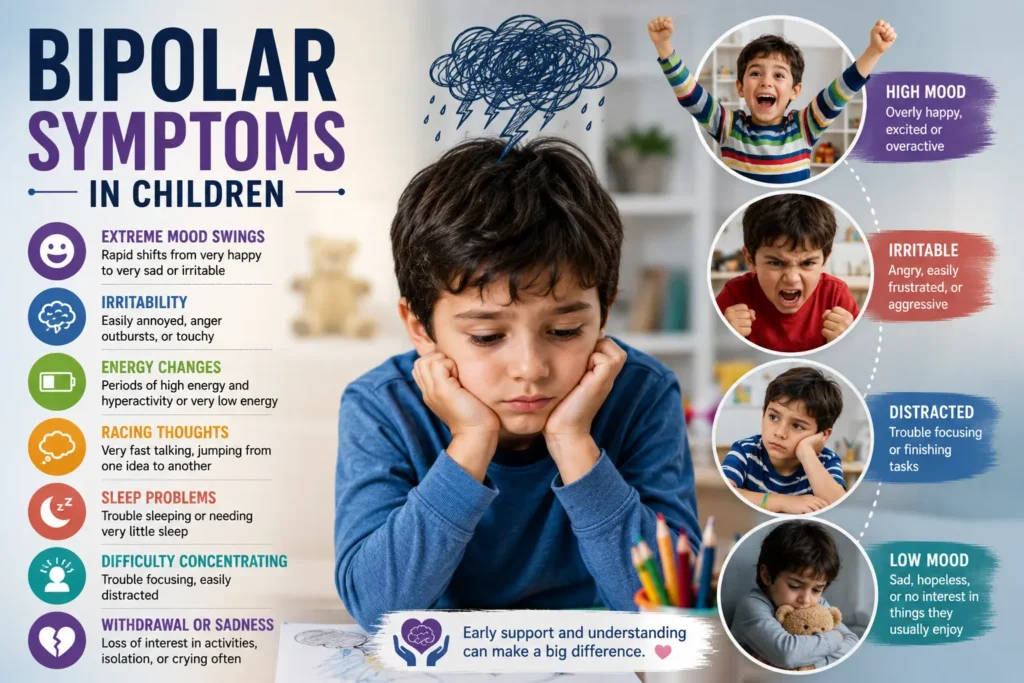
Bipolar symptoms in children involve distinct episodes of elevated, irritable, or depressed mood, along with related changes in energy, sleep, and behavior, that clearly stand out from a child’s usual personality and disrupt daily life at home or school. Pediatric bipolar disorder is less common and more difficult to diagnose than the adult or teen form, partly because normal childhood behavior — tantrums, high energy, mood shifts — can overlap with early symptoms. According to the National Institute of Mental Health, bipolar disorder can occur in children, though careful evaluation by a child psychiatrist is essential given how often other conditions mimic the same signs. For the general symptom picture across all ages, see our guide to bipolar disorder symptoms.
Table of Contents
Introduction
Parents searching for information on childhood bipolar disorder are usually doing so out of real concern — a child whose moods seem to swing further and faster than other kids’, whose behavior at home doesn’t match reports from school, or whose emotional intensity feels different from typical childhood ups and downs.
This is genuinely one of the more complicated corners of child mental health. Bipolar disorder in children is uncommon compared to conditions like ADHD or anxiety, and it’s also one of the more frequently over-suspected diagnoses in this age group, because so many childhood behaviors can look similar on the surface. Getting it right matters, since the right diagnosis shapes the right treatment — and the wrong one can mean years of treatment aimed at the wrong problem.
This guide walks through what bipolar symptoms in children actually look like, how they differ from ordinary childhood behavior, and why this particular diagnosis calls for extra caution and expertise. For background on the condition itself, see bipolar disorder and what bipolar disorder is.
Key Takeaways
- Bipolar disorder can occur in children, but it’s uncommon and requires careful, specialist evaluation.
- The defining feature is distinct episodes — sustained shifts in mood, energy, and sleep — not everyday tantrums or mood swings.
- Irritability and severe outbursts are often more prominent than euphoria in younger children.
- Many childhood behaviors overlap with bipolar symptoms, including ADHD, anxiety, and disruptive mood dysregulation disorder (DMDD).
- DMDD was specifically introduced to reduce overdiagnosis of bipolar disorder in children with chronic irritability rather than episodic mood shifts.
- Family involvement, school coordination, and specialist care are central to accurate diagnosis and treatment.
- Warning signs like self-harm or suicidal statements in a child require immediate professional attention.
Why Diagnosing Bipolar Disorder in Children Is So Complex
A few things make childhood bipolar disorder one of the more debated diagnoses in child psychiatry.
First, young children naturally have limited ability to regulate emotions, so intense reactions, meltdowns, and rapid mood shifts are part of typical development, especially in early childhood. Second, several other conditions — ADHD, anxiety disorders, and DMDD in particular — share overlapping features like irritability, high energy, and emotional volatility. Third, children can’t always describe their internal experience the way an adult or even a teenager can, so diagnosis relies heavily on behavioral observation from parents, teachers, and clinicians.
Because of this complexity, mental health organizations, including guidance reflected by the American Psychiatric Association’s DSM-5, emphasize careful, longitudinal evaluation rather than a single office visit or a symptom checklist. This is one reason a child and adolescent psychiatrist — not a general practitioner alone — is best positioned to make this diagnosis.
What Manic or Hypomanic Symptoms Can Look Like in Children
When mania or hypomania does occur in a child, it tends to look different from the adult picture. Features can include:
- A clearly elevated, silly, or euphoric mood that goes well beyond normal excitement, and stands out from the child’s usual personality
- Severe irritability with intense, prolonged outbursts triggered by seemingly minor frustrations
- Decreased need for sleep — waking up energetic after very little rest, not just difficulty falling asleep
- Grandiosity that goes beyond typical childhood imagination, such as a firm belief in special powers or abilities inconsistent with reality
- Rapid, pressured talking or racing from topic to topic
- Hypersexual behavior or language that is developmentally inappropriate for the child’s age (this specific symptom always warrants prompt professional evaluation, since it can also signal other serious concerns that need to be ruled out)
- Highly impulsive or dangerous behavior beyond the child’s usual risk-taking
The clinical criteria mirror those used for manic episodes and hypomania in general, but the key difference in young children is how much irritability, rather than euphoria, tends to dominate the picture, and how much these features must clearly exceed the child’s developmental baseline to be meaningful.
What Depressive Symptoms Can Look Like in Children
Depressive episodes in children with bipolar disorder can include:
- Persistent sadness, or in younger children, an unusually flat or irritable mood instead of visible sadness
- Loss of interest in play, friends, or activities the child previously enjoyed
- Physical complaints like stomachaches or headaches without a clear medical cause
- Changes in sleep or appetite
- Academic decline or difficulty concentrating at school
- Social withdrawal
- In severe cases, statements about death, self-harm, or not wanting to be alive
Any statement from a child about wanting to die, hurting themselves, or not wanting to exist should always be taken seriously and discussed with a pediatrician or mental health professional promptly, regardless of the child’s age. For the full clinical breakdown of depressive symptoms across ages, see bipolar disorder symptoms.
Comparison Table: Typical Childhood Behavior vs Possible Bipolar Episode
| Feature | Typical Childhood Behavior | Possible Bipolar Episode |
| Duration | Minutes to a few hours | Days to weeks, sustained |
| Trigger | Usually tied to a specific frustration | Often occurs without an obvious cause |
| Sleep | Generally age-appropriate, occasional resistance to bedtime | Days of clearly reduced sleep without tiredness |
| Mood between episodes | Returns to baseline personality | Marked shift from the child’s usual self, sustained |
| Functioning | Manages school and friendships most of the time | Noticeable, sustained disruption at school or home |
| Pattern | Everyday variability | Distinct episodes, sometimes recurring |
This table is a general reference, not a diagnostic tool. If several “possible bipolar episode” features apply consistently over time, it’s worth raising with your child’s pediatrician.
Conditions Frequently Confused With Pediatric Bipolar Disorder
Because so many childhood behaviors overlap, several conditions are commonly mistaken for — or mistakenly ruled into — a bipolar diagnosis:
ADHD. Hyperactivity, impulsivity, and distractibility overlap significantly with manic symptoms. The key distinguishing factor is pattern: ADHD symptoms are typically persistent and consistent, while bipolar symptoms occur in distinct episodes involving mood and sleep changes on top of the behavioral ones.
Disruptive mood dysregulation disorder (DMDD). This diagnosis, introduced in the DSM-5, was created specifically to describe children with chronic, severe irritability and frequent temper outbursts occurring most days — without the episodic mood shifts that define bipolar disorder. Many children previously diagnosed with pediatric bipolar disorder are now more accurately understood as having DMDD.
Anxiety disorders. Anxiety in children can present as irritability, meltdowns, or resistance to change, which can resemble mood episode symptoms without an underlying bipolar pattern.
Autism spectrum characteristics. Meltdowns and sensory-related distress can sometimes be misread as mood episodes, particularly in children with limited verbal communication.
Trauma-related responses. A history of stressful or traumatic experiences can produce mood and behavioral symptoms that overlap with, but aren’t the same as, bipolar disorder.
Because of this overlap, an accurate diagnosis depends on ruling out — or identifying alongside — these other explanations, which is exactly why specialist evaluation matters so much in this age group.
Myths vs Facts About Bipolar Disorder in Children
| Myth | Fact |
| “Bipolar disorder in children is common.” | It’s far less common than conditions like ADHD or anxiety, and diagnosis requires careful evaluation. |
| “Any child with big tantrums has bipolar disorder.” | Chronic irritability with frequent outbursts is more often consistent with DMDD or another condition than bipolar disorder. |
| “Children can’t really have bipolar disorder — it’s an adult illness.” | Bipolar disorder can occur in children, though it looks different and is diagnosed more cautiously than in adults. |
| “A single meltdown or good day confirms or rules out the diagnosis.” | Diagnosis depends on sustained patterns over time, not isolated incidents. |
For a broader look at misconceptions, see bipolar disorder myths.
Risk Factors in Children
Risk factors mirror those seen in bipolar disorder generally, per the National Institute of Mental Health, with a few considerations specific to childhood:
- A parent or sibling with bipolar disorder or another mood disorder
- Exposure to significant early-life stress or instability
- Co-occurring conditions such as anxiety, which can complicate the overall picture
- A family history of mood disorders emerging at an unusually young age
For a fuller discussion of causes, see bipolar disorder causes and causes of mania.
Warning Signs That Need Immediate Attention
Certain signs in a child require immediate professional attention rather than waiting for a scheduled appointment:
- Any statement about wanting to die, disappear, or hurt themselves
- Signs of psychosis — describing things that aren’t there or firmly held unusual beliefs
- Extremely dangerous behavior that puts the child’s safety at risk
- Developmentally inappropriate sexual behavior or language
- Sudden, severe withdrawal from family, friends, and usual activities
If your child talks about suicide or self-harm, or you’re concerned about their immediate safety, contact the 988 Suicide & Crisis Lifeline (call or text 988 in the US) or your local emergency number right away. A pediatrician or your child’s school counselor can also help connect you with urgent support if you’re unsure where to start.
How Diagnosis Works for Children
Diagnosing bipolar disorder in a child is a careful, multi-step process, typically involving a child and adolescent psychiatrist. It generally includes:
- A detailed developmental and behavioral history from parents or caregivers
- Direct observation and interviews with the child, adapted to their developmental level
- Input from teachers or school staff, since behavior at school and home can differ
- Screening for overlapping conditions like ADHD, anxiety, DMDD, and trauma-related symptoms
- Observation over time, since a single visit rarely provides enough information for this particular diagnosis
For the full diagnostic approach used across bipolar disorder generally, see bipolar disorder diagnosis.
Treatment Approaches for Children
Treatment for a child diagnosed with bipolar disorder is typically managed by a child and adolescent psychiatrist and may include:
- Medication, when appropriate, prescribed and monitored with particular care given the child’s age and development
- Family-focused therapy and parent training, since consistent routines and parenting strategies play a significant role in managing symptoms at this age
- Individual therapy adapted to the child’s developmental level
- School coordination, including behavioral support plans or accommodations where needed
For the broader treatment picture used across bipolar disorder generally, see bipolar disorder treatment.
Guidance for Parents and Caregivers
- Keep a simple daily log. Note mood, sleep, and any major outbursts. Patterns are far easier to spot in writing than in memory.
- Loop in the school. Teachers often see a different side of your child, and their input is valuable for diagnosis and ongoing support.
- Get a second opinion if something feels off. Given how complex this diagnosis is, a second specialist opinion is reasonable and common practice.
- Focus on consistency at home. Predictable routines, especially around sleep, can meaningfully support mood stability in children with or at risk for mood disorders.
- Take care of your own wellbeing. Parenting a child through evaluation and treatment for a mood disorder is demanding; your own support matters too.
Complications of Untreated Symptoms
Untreated mood symptoms in children are associated with academic difficulties, strained family relationships, and a higher likelihood of more severe episodes as the child grows older. Accurate, early intervention is associated with better long-term outcomes. For more detail, see bipolar disorder complications and bipolar disorder prognosis.
Checklist: Should Your Child Be Evaluated?
- [ ] Distinct periods of elevated or euphoric mood clearly beyond normal excitement
- [ ] Severe irritability with intense, prolonged outbursts, sustained over days
- [ ] Decreased need for sleep with continued high energy, not just bedtime resistance
- [ ] Grandiosity or beliefs beyond typical childhood imagination
- [ ] Periods of persistent sadness, withdrawal, or physical complaints without medical cause
- [ ] A noticeable, sustained change from your child’s usual personality
- [ ] A family history of bipolar disorder or other mood disorders
- [ ] These patterns clearly disrupting school or home life over time
If several of these apply consistently, it’s worth discussing with your child’s pediatrician, who can refer you to a child and adolescent mental health specialist if needed.
Frequently Asked Questions
Can a young child really have bipolar disorder? It’s possible, though uncommon, and diagnosis requires careful, specialist evaluation given how much overlap exists with normal childhood behavior and other conditions.
What’s the difference between DMDD and bipolar disorder in children? DMDD involves chronic, persistent irritability and frequent outbursts occurring most days, without the distinct episodic mood shifts — including changes in sleep, energy, and grandiosity — that define bipolar disorder.
Is it common for bipolar disorder to be misdiagnosed in children? Yes, misdiagnosis in either direction is a known challenge in this age group, which is why organizations like the American Psychiatric Association emphasize careful, longitudinal evaluation rather than a quick assessment.
Can ADHD medication trigger bipolar symptoms in a child? This is a question worth raising directly with your child’s prescribing doctor, since medication responses vary by individual and by underlying diagnosis. It shouldn’t be assumed without professional guidance.
What should I do if my child talks about wanting to die? Take it seriously every time, regardless of your child’s age or how the statement was said, and contact a mental health professional, pediatrician, or crisis line promptly.
Does bipolar disorder in childhood mean it will definitely continue into adulthood? Bipolar disorder is generally considered a lifelong condition once diagnosed, though with appropriate treatment, many children go on to manage it effectively as they grow.
Should I request an IEP or 504 plan if my child is diagnosed? If symptoms affect your child’s school performance, it’s reasonable to discuss school-based support options with your child’s treatment team and school, since accommodations can help reduce academic strain during treatment.
Summary
Bipolar disorder in children is real but uncommon, and it’s also one of the more frequently over-suspected diagnoses in child mental health because so many typical childhood behaviors — big emotions, high energy, resistance to routine — can look similar on the surface. The clearest signal is a sustained pattern that clearly departs from your child’s usual personality: distinct episodes involving mood, sleep, and energy changes that disrupt daily life, not everyday tantrums. Given how many other conditions overlap, this diagnosis calls for careful, specialist evaluation rather than a quick read at home.
For related reading, see our bipolar disorder statistics, bipolar disorder glossary, or our guide to bipolar symptoms in teenagers if you’re navigating this with an older child or adolescent.
This article is for educational purposes and is not a substitute for a professional diagnosis. If your child is experiencing thoughts of suicide or self-harm, please contact the 988 Suicide & Crisis Lifeline (call or text 988) or your local emergency services immediately.