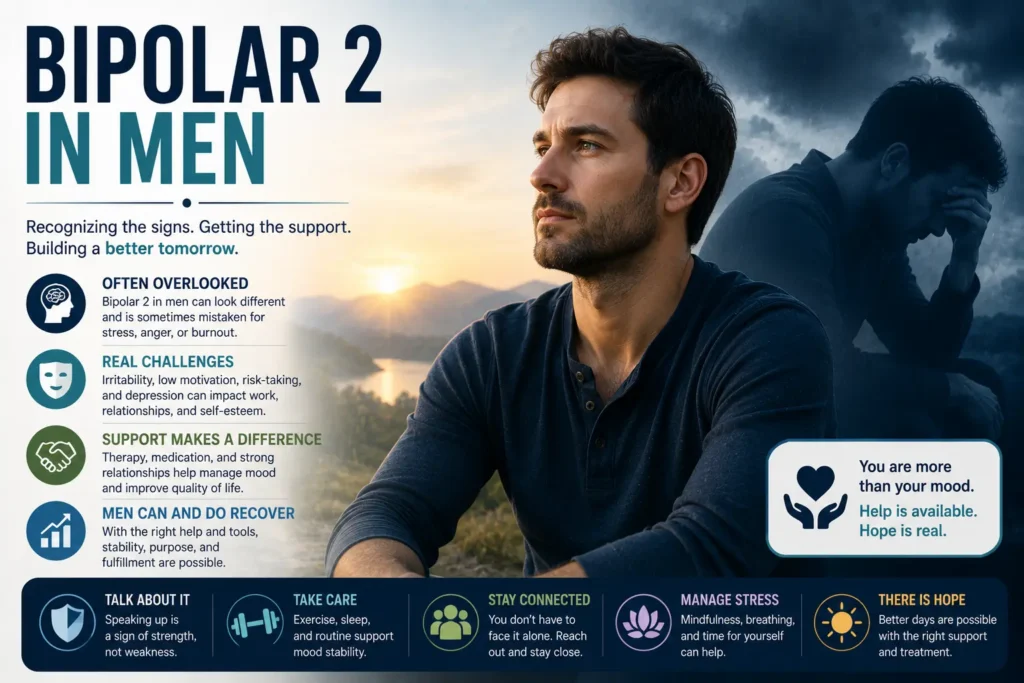
Bipolar 2 disorder affects men and women at broadly similar rates, but research suggests it often shows up, and gets diagnosed, differently in men. Men with bipolar 2 are more likely to present with irritability, anger, or risk-taking rather than visible sadness during depressive episodes, and are more likely to have a co-occurring substance use issue that complicates diagnosis. Cultural expectations around toughness and self-reliance also tend to delay men from seeking help in the first place. None of this changes the underlying condition — bipolar 2 is still defined by episodes of hypomania and depression — but recognizing how it tends to present in men can shorten the road to an accurate diagnosis. For the clinical basics behind this pattern, see our guide to bipolar 2 disorder.
Table of Contents
Key Takeaways
- Bipolar 2 in men often presents with irritability, anger, or withdrawal rather than obvious sadness during depressive episodes.
- Substance use is more common among men with bipolar disorder, and can both mask symptoms and delay diagnosis.
- Cultural stigma around emotional vulnerability contributes to men seeking help later than women, on average.
- The diagnostic criteria for bipolar 2 are identical regardless of gender — what differs is how symptoms tend to be expressed and recognized.
- Once diagnosed, men respond to the same evidence-based treatments as anyone else: mood stabilizers, targeted therapy, and consistent routines.
Does Bipolar 2 Affect Men and Women Differently?
The DSM-5 diagnostic criteria for bipolar 2 disorder — at least one hypomanic episode and one major depressive episode, with no history of full mania — don’t vary by gender. But how those episodes actually look, and how quickly they get recognized, often does differ.
Research on bipolar disorder more broadly has found that men tend to externalize symptoms more than women — expressing distress through irritability, aggression, or risk-taking rather than the more commonly recognized signs of low mood. Much of this research covers bipolar disorder as a whole rather than isolating bipolar 2 specifically, so it’s worth treating these as general patterns rather than fixed rules for every man with the condition. If you want the foundational picture of the illness itself before diving into these differences, our guide to what is bipolar disorder is a good starting point.
How Hypomania Can Look in Men
Hypomania in bipolar 2 disorder involves several days of unusually elevated, expansive, or irritable mood alongside increased energy — but the specific flavor of that presentation can differ.
| Common presentation | How it may show up more often in men |
| Inflated confidence | Overconfidence in business, financial, or physical risk-taking |
| Decreased need for sleep | Staying up late working, socializing, or pursuing new projects |
| Increased goal-directed activity | Overcommitting to work projects, sudden intensity in hobbies or fitness |
| Risky behavior | Reckless driving, impulsive spending, or increased alcohol use |
| Irritability | More pronounced irritability or a short fuse, sometimes mistaken for “just stress” |
Because hypomania often looks like heightened productivity or confidence, and because those traits are sometimes culturally read as normal or even admirable in men, it can be especially easy to overlook until a pattern becomes clear. For the full clinical picture of hypomania, our dedicated guide to bipolar 2 hypomania covers the diagnostic details in depth.
How Depression Can Look in Men
This is where the gender gap in recognition tends to be most significant. Standard descriptions of depression emphasize sadness, tearfulness, and low mood — but research suggests men more often express depressive episodes through:
| Common presentation | How it may show up more often in men |
| Low mood | Irritability, anger, or a short temper rather than visible sadness |
| Loss of interest | Withdrawing from relationships or hobbies without explaining why |
| Fatigue | Framed as “burnout” or physical exhaustion rather than emotional depletion |
| Difficulty concentrating | Attributed to work stress rather than a mood symptom |
| Worthlessness or guilt | Expressed as self-criticism about performance or provider role rather than direct statements of low self-worth |
| Risk-taking or recklessness | Increased substance use, reckless driving, or impulsive decisions used to cope |
None of this means every man experiences depression this way, or that women never do. But this pattern is common enough that it’s a recognized factor in why bipolar depression in men sometimes gets missed, misattributed to stress or personality, or misdiagnosed as a purely externalizing problem rather than a mood disorder. Our full breakdown of the depressive side of the condition is in our guide to bipolar 2 depression.
Why Bipolar 2 Often Goes Undiagnosed Longer in Men
Several factors combine to delay diagnosis for many men:
- Symptoms get externalized. Anger, substance use, and risk-taking are less likely to be read as mood symptoms compared to sadness or withdrawal.
- Stigma discourages help-seeking. Cultural expectations around self-reliance and emotional stoicism can make it harder for men to bring up mood symptoms with a doctor, or to seek help at all until things become severe.
- Substance use complicates the picture. Since substance use is more common among men with bipolar disorder, clinicians sometimes address the substance use first without recognizing the underlying mood disorder driving it.
- Hypomania can look like a strength. Confidence, high energy, and ambition are often read as positive traits rather than symptoms, especially in professional or social contexts.
- Standard depression screenings emphasize traditionally “female-coded” symptoms. Tools built around sadness and tearfulness may miss the irritability-and-withdrawal pattern more common in men.
Our guide to bipolar disorder diagnosis covers the full evaluation process clinicians use, and our page on bipolar 1 vs 2 diagnosis explains how a full mood history — not just current symptoms — factors into an accurate diagnosis.
Bipolar 2 in Men vs. Women: A Comparison
| Factor | More commonly reported in men | More commonly reported in women |
| Depressive symptom style | Irritability, anger, withdrawal | Sadness, tearfulness, guilt |
| Substance use | Higher rates of co-occurring substance use | Lower rates, though still significant |
| Help-seeking | Often delayed due to stigma | Often earlier, though still frequently delayed |
| Hypomanic presentation | Confidence, risk-taking, overcommitment | Similar core symptoms, sometimes framed differently |
| Diagnostic delay | Frequently longer before accurate diagnosis | Also common, but patterns differ |
These are population-level patterns from research, not fixed rules — plenty of men experience textbook sadness during depressive episodes, and plenty of women experience irritability-dominant episodes. If you want a deeper look at these differences specifically, our dedicated comparison of bipolar 1 vs 2 in men and women goes further into the research.
Risk Factors Worth Knowing
| Risk factor | Relevance for men with bipolar 2 |
| Family history | A first-degree relative with bipolar disorder remains one of the strongest known risk factors, regardless of gender |
| Substance use | Higher co-occurrence in men; can both trigger episodes and mask underlying symptoms |
| Occupational stress | High-pressure work environments can act as a trigger, particularly when sleep is sacrificed |
| Delayed treatment-seeking | Longer time to diagnosis is associated with a more difficult overall course |
| Social isolation | Withdrawal during depressive episodes can reduce access to the support that helps manage the condition |
For the broader research behind these risk factors, our page on bipolar disorder causes covers the genetic and environmental contributors in more depth.
Diagnosis: What to Expect
Diagnosis follows the same process for men as anyone else, though a thorough clinician will specifically probe for the patterns more common in male presentation:
- A full mood history, asking directly about irritability, anger, and risk-taking, not just sadness
- Screening for substance use, since it’s common enough to warrant direct questions rather than assumptions
- Input from a partner or close family member, when appropriate, since hypomania can be hard to self-recognize when it’s read as “just being productive”
- Ruling out other explanations, including burnout, occupational stress, or a primary substance use disorder without an underlying mood condition
Our page on bipolar 1 vs 2 test and bipolar 1 vs 2 quiz can help frame a conversation with a clinician, though neither substitutes for a full evaluation.
Myths vs. Facts About Bipolar 2 in Men
| Myth | Fact |
| “Bipolar 2 in men mostly looks like sadness, same as everyone else.” | Depressive episodes in men more often present as irritability, anger, or withdrawal than visible sadness. |
| “If a man is high-functioning and confident, it can’t be hypomania.” | Hypomania frequently looks like confidence and productivity, which is exactly why it’s often missed. |
| “Substance use is a separate problem from bipolar 2.” | In many men, substance use and bipolar 2 co-occur and interact, sometimes masking the underlying mood disorder. |
| “Men don’t need therapy for bipolar 2 — medication is enough.” | Structured therapy alongside medication is part of standard, evidence-based care regardless of gender. |
| “Seeking help is a sign of weakness.” | Seeking treatment is one of the strongest predictors of long-term stability and better outcomes. |
For a broader set of misconceptions about the condition, see our page on bipolar disorder myths.
Treatment for Bipolar 2 in Men
Treatment doesn’t differ by gender in terms of what’s clinically effective — the same evidence-based approaches apply. What sometimes differs is what gets in the way of starting or sticking with treatment.
Medication and Therapy
| Approach | Role in treatment |
| Mood stabilizers | Often foundational for reducing recurrence of both hypomanic and depressive episodes |
| Atypical antipsychotics | Several are specifically approved for bipolar depression |
| Antidepressants | Used cautiously, typically alongside a mood stabilizer |
| Cognitive behavioral therapy (CBT) | Addresses depressive thought patterns and unhelpful coping behaviors |
| Substance use treatment | Often integrated alongside mood disorder treatment when both are present |
| Interpersonal and social rhythm therapy (IPSRT) | Supports routine and sleep stability, both closely tied to mood |
Our full guide to bipolar 2 treatment and broader bipolar disorder treatment overview cover these approaches in more detail.
Addressing the Barriers Specific to Men
- Normalizing the conversation. Framing bipolar 2 as a medical condition, not a character flaw, can lower the barrier to seeking help.
- Addressing substance use directly, rather than treating it as separate from the mood disorder, since the two often need to be managed together.
- Building a support system, even when withdrawal feels like the instinct — isolation tends to make both depressive and hypomanic episodes harder to manage.
- Recognizing irritability as a symptom, not just a personality trait, both for the person experiencing it and for people close to them.
Complications If Left Unaddressed
Untreated or delayed-diagnosis bipolar 2 in men is associated with:
- Higher rates of co-occurring substance use disorders
- Greater relationship and family strain, often tied to irritability, withdrawal, or impulsivity
- Increased risk of job or financial instability during hypomanic episodes
- Elevated suicide risk, particularly during depressive or mixed episodes
- A longer, more difficult path to diagnosis and stabilization
Our page on bipolar disorder complications covers these risks across the broader condition in more depth.
Warning Signs to Watch For
- Increasing irritability, anger, or short temper that feels out of character
- Withdrawing from relationships, work, or activities without a clear explanation
- Escalating alcohol or substance use, especially as a way to manage mood
- Sudden bursts of overconfidence, sleeplessness, or overcommitment to new plans
- Any thoughts of suicide or self-harm, even ones that seem passing
When to Seek Emergency Help
Men with bipolar disorder face a meaningfully elevated suicide risk compared to the general population, particularly during depressive or mixed episodes. Seek immediate help if you or someone you know experiences:
- Thoughts of suicide or a specific plan to self-harm
- A sudden, severe worsening of mood or functioning
- Statements suggesting someone no longer wants to be alive
- Escalating substance use combined with hopelessness or despair
If you or someone else is in crisis, call or text 988 (Suicide & Crisis Lifeline) in the U.S., or contact local emergency services immediately. If you’re personally struggling with these thoughts, reaching out to a mental health professional or crisis line is a strong, reasonable step — not a sign of weakness.
Prognosis and Long-Term Outlook
With accurate diagnosis and consistent treatment, men with bipolar 2 disorder can achieve the same long-term stability as anyone else with the condition. The main factor that tends to affect outcomes isn’t gender itself — it’s how quickly someone gets an accurate diagnosis and stays engaged with treatment. Our page on bipolar disorder prognosis and dedicated bipolar 2 prognosis guide cover the factors that shape long-term outcomes in more depth.
Frequently Asked Questions
Is bipolar 2 more common in men or women? Research generally suggests bipolar disorder affects men and women at broadly similar rates, though presentation and diagnosis timing often differ.
Why do men get diagnosed with bipolar 2 later than women, on average? A combination of factors — externalized symptoms, stigma around help-seeking, and co-occurring substance use — tends to delay diagnosis in men, though individual experiences vary widely.
Can irritability alone be a sign of bipolar 2 in men? Irritability can be a symptom of both hypomanic and depressive episodes, but it’s not exclusive to bipolar 2 and doesn’t confirm a diagnosis on its own. A full clinical evaluation is needed.
Does substance use cause bipolar 2, or does bipolar 2 cause substance use? The relationship can go both ways — some men use substances to cope with undiagnosed mood symptoms, while substance use itself can also trigger or worsen mood episodes. This is why integrated treatment matters when both are present.
Do men respond differently to bipolar medication than women? Core medication effectiveness generally doesn’t differ by gender, though individual response varies and medication decisions should always be made with a psychiatrist.
How does bipolar 2 in men compare to bipolar 1 in men? Bipolar 1 involves full manic episodes and a higher risk of psychosis or hospitalization, while bipolar 2 involves hypomania and typically a heavier depressive burden. Our page on bipolar 1 in men covers that presentation specifically.
Is therapy really necessary if medication is working? Yes, for most people. Structured therapy supports relapse prevention and addresses patterns — like substance use or withdrawal — that medication alone doesn’t resolve.
Summary
Bipolar 2 in men often hides behind irritability, overconfidence, withdrawal, or substance use rather than the more commonly recognized signs of mood disorder — which is exactly why it tends to take longer to diagnose. The underlying condition and its treatment don’t differ by gender, but recognizing these patterns, in yourself or someone you care about, can meaningfully shorten the path to getting help. If any of this sounds familiar, a full evaluation with a psychiatrist — one that asks directly about irritability, substance use, and past hypomanic periods — is the most reliable next step.
This article is for educational purposes and is not a substitute for professional medical advice. If you have concerns about your mental health, please consult a qualified healthcare provider.