
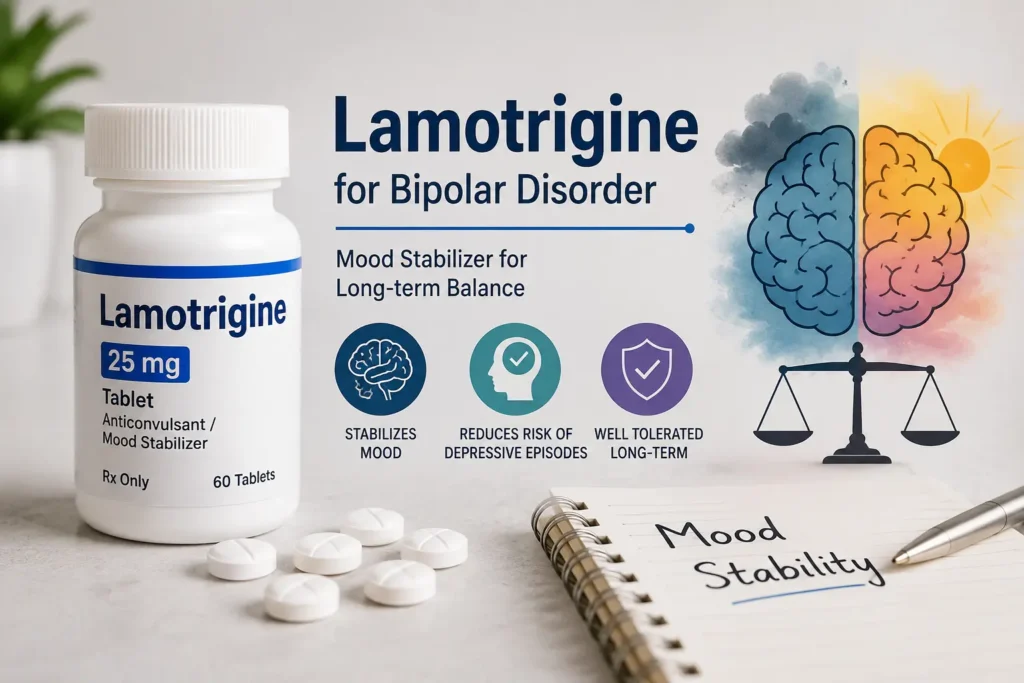
Lamotrigine for Bipolar Disorder: Lamotrigine (brand name Lamictal) is a mood-stabilizing medication approved by the FDA for the long-term maintenance treatment of bipolar I disorder in adults. It doesn’t treat active mania, but it’s especially good at preventing depressive episodes from coming back. Doctors also prescribe it off-label for bipolar depression itself, including in bipolar II disorder. Because it carries a rare but serious rash risk, it has to be started at a very low dose and increased slowly over several weeks.
If that’s all you needed, you have it. Everything below explains the details: how lamotrigine actually works, who it’s for, how it compares with other bipolar medications, the dosing schedule, side effects, and the warning signs that mean you should call your doctor right away.
Table of Contents
Introduction
Bipolar disorder is a lifelong condition, and finding a medication that keeps mood episodes from returning is often more important than finding one that works fast. That’s the gap lamotrigine fills. Unlike medications built to pull someone out of a manic episode within days, lamotrigine is a long game — it’s taken daily to stretch out the time between episodes, particularly depressive ones.
This guide walks through what the research actually shows about lamotrigine in bipolar disorder: what it’s approved for, what it’s used for off-label, how the dosing works, what side effects to watch for, and how it stacks up against other options like lithium and valproate. If you’re newer to the diagnosis itself, it’s worth starting with our overview of what bipolar disorder is and how bipolar disorder is diagnosed before diving into medication specifics.
Key Takeaways
- Lamotrigine is FDA-approved as a maintenance treatment for bipolar I disorder — it delays or reduces future mood episodes, especially depressive ones.
- It has not been shown to treat acute mania or hypomania, and it isn’t approved for acute bipolar depression either, though doctors often prescribe it off-label for that purpose.
- Dosing starts very low (25 mg/day) and increases slowly over about six weeks to reduce the risk of a serious rash.
- Any new rash while starting lamotrigine needs to be reported to a doctor immediately.
- It’s generally weight-neutral and doesn’t require routine blood monitoring, which sets it apart from lithium and valproate.
- It works best for people whose bipolar disorder is more depression-heavy than mania-heavy.
What Is Lamotrigine?
Lamotrigine is an anticonvulsant medication — originally developed to treat epilepsy — that was later found to stabilize mood in people with bipolar disorder. It’s sold under the brand name Lamictal, as well as in generic form, and comes as regular tablets, chewable dispersible tablets, orally disintegrating tablets, and an extended-release version.
It belongs to a category of psychiatric medications often called mood stabilizers, alongside drugs like lithium and other mood stabilizers. Scientists believe it works partly by calming overactive electrical signaling in the brain — specifically by blocking sodium channels on neurons — which is thought to reduce the release of glutamate, a brain chemical linked to mood instability. The exact mechanism behind its effect on mood, though, isn’t fully understood.
Is Lamotrigine FDA-Approved for Bipolar Disorder?
Yes, with an important caveat. Lamotrigine is FDA-approved specifically for the maintenance treatment of bipolar I disorder in adults — meaning it’s used once someone is stable, to delay the return of mood episodes, not to treat one that’s already happening.
Two large 18-month clinical trials supported this approval. In those studies, lamotrigine didn’t outperform placebo at preventing manic episodes, but it clearly outperformed placebo at preventing depressive episodes, without increasing the risk of mania itself. That distinction shapes almost everything about how psychiatrists use this drug today.
For acute bipolar depression — an active depressive episode happening right now — lamotrigine is not FDA-approved, but it’s widely prescribed off-label because meta-analyses of multiple trials have found it modestly effective, particularly in more severe depressive episodes. It’s also commonly used off-label in bipolar II disorder, where depressive episodes tend to dominate the illness more than hypomania does. If you’re trying to understand how bipolar I and bipolar II differ in the first place, our guide on bipolar 1 vs bipolar 2 breaks that down in detail.
Who Is Lamotrigine Typically Prescribed For?
Lamotrigine tends to be a good fit for people whose bipolar disorder is:
- Depression-dominant, meaning depressive episodes happen more often or hit harder than manic or hypomanic ones
- Already stabilized after an acute episode, and now looking for something to prevent relapse
- Not currently in an active manic or mixed episode (since lamotrigine won’t treat that on its own)
- Sensitive to weight gain or metabolic side effects from other mood stabilizers
It’s less often a first choice for people whose main problem is frequent or severe manic episodes, since it simply doesn’t cover that side of the illness. In those cases, doctors typically add or substitute a medication with proven anti-manic effects, such as lithium or an antipsychotic.
How Lamotrigine Compares to Other Bipolar Medications
| Medication | FDA-Approved For | Effective Against Mania? | Effective Against Depression? | Blood Monitoring Needed? | Common Side Effect Concerns |
| Lamotrigine (Lamictal) | Bipolar I maintenance | No | Yes | No | Rash, headache, dizziness |
| Lithium | Acute mania & maintenance | Yes | Yes (moderate) | Yes, regularly | Tremor, thyroid/kidney effects, thirst |
| Valproate (Depakote) | Acute mania | Yes | Limited | Yes, regularly | Weight gain, liver effects, tremor |
| Quetiapine | Acute mania, depression, maintenance | Yes | Yes | No (metabolic checks recommended) | Sedation, weight gain, metabolic changes |
| Lurasidone (Latuda) | Bipolar depression | No | Yes | No | Nausea, restlessness (akathisia) |
This is a simplified snapshot, not a substitute for a full bipolar disorder treatment plan built with your prescriber. Many people end up on a combination — lamotrigine for long-term depression prevention alongside a medication that covers mania — rather than a single drug doing everything.
Lamotrigine Dosing: Why It’s Slow, and What the Schedule Looks Like
The single most important thing to understand about starting lamotrigine is that the dose has to go up gradually. Increasing it too fast dramatically raises the risk of a serious rash, so psychiatrists follow a fixed titration schedule rather than adjusting based on how someone feels.
Standard Adult Titration Schedule (Monotherapy)
| Weeks | Typical Daily Dose |
| Weeks 1–2 | 25 mg once daily |
| Weeks 3–4 | 50 mg once daily |
| Week 5 | 100 mg once daily |
| Week 6 onward | 200 mg once daily (target maintenance dose) |
This schedule shifts if lamotrigine is combined with valproate (doses go lower and slower) or with medications that speed up how the liver clears lamotrigine, such as certain other anticonvulsants (doses may need to go higher). This is exactly why lamotrigine should only be dosed by a prescriber who knows your full medication list — never adjusted on your own.
If a dose is missed for more than about five days in a row, most guidelines call for restarting from the very beginning of the titration schedule, not simply resuming at the last dose. This restart rule surprises a lot of people, so it’s worth writing down or setting a reminder for.
Side Effects of Lamotrigine
Most people tolerate lamotrigine reasonably well compared with other mood stabilizers, and it’s generally considered weight-neutral, which is one reason it’s often preferred by people who’ve struggled with weight gain on other medications.
| Side Effect Category | Examples | Typical Timing |
| Common, usually mild | Headache, nausea, dizziness, drowsiness or trouble sleeping, mild non-serious rash | First few weeks |
| Less common | Blurred or double vision, tremor, dry mouth, back pain | Ongoing, dose-related |
| Rare but serious | Stevens-Johnson syndrome, toxic epidermal necrolysis, DRESS syndrome, aseptic meningitis, blood cell abnormalities | Usually within 2–8 weeks of starting or increasing the dose |
The benign, non-dangerous rash is fairly common — reported in roughly 8–10% of people who start lamotrigine. It usually looks like small, mild red bumps and resolves on its own or after stopping the drug. The problem is that, in the first several weeks of treatment, there’s no reliable way to tell a benign rash apart from the early stage of a dangerous one just by looking at it. That’s why the rule is: any new rash, call your doctor the same day.
Serious Rash Risk: What You Need to Know
This is the warning that shapes how lamotrigine is prescribed. In rare cases, lamotrigine can trigger Stevens-Johnson syndrome (SJS) or toxic epidermal necrolysis (TEN) — severe, potentially life-threatening skin reactions that can require hospitalization. The risk is highest in the first two months of treatment and rises sharply with faster-than-recommended dose increases, higher-than-recommended starting doses, and combination with valproate.
With careful, guideline-based titration, the risk of a serious rash drops to somewhere around 1 in 1,000 to 1 in 3,000, compared with roughly 1 in 100 when dosing guidelines aren’t followed. Children and adolescents are at higher risk than adults, which is part of why lamotrigine’s bipolar indication is limited to adults.
Emergency Warning Signs — Seek Medical Care Immediately
Contact a doctor or go to an emergency room right away if a rash appears alongside any of the following:
- Fever
- Swollen glands
- Sores or blistering in the mouth, eyes, or genitals
- Facial or tongue swelling
- Peeling or blistering skin
- A rash that is spreading rapidly or covers a large area of the body
- Swollen, red, or purplish eyes
Don’t wait to see if it gets worse, and don’t try to manage it yourself with antihistamines while waiting it out. This single precaution — stopping the medication and getting evaluated promptly at the first sign of a concerning rash — is the main reason serious outcomes from lamotrigine are so rare today.
Does Lamotrigine Cause Mania or Hypomania?
Research consistently shows that lamotrigine does not increase the risk of triggering mania or hypomania compared with placebo, which is part of why it earned FDA approval for maintenance use in the first place. That said, because it has essentially no anti-manic effect, some people relying on it alone may still experience a manic or hypomanic episode simply because nothing in their regimen is actively preventing one. Rare individual case reports of a manic switch on lamotrigine exist, but they’re the exception rather than the rule.
If you notice symptoms of an emerging manic or hypomanic episode — racing thoughts, decreased need for sleep, unusual energy — while on lamotrigine, that’s a conversation for your prescriber, not a sign the medication itself is causing it.
Lamotrigine and Pregnancy
Lamotrigine is one of the psychiatric medications with more reassuring safety data during pregnancy compared with some other mood stabilizers, and it’s sometimes preferred for people who are pregnant or planning to become pregnant, particularly since medications like valproate carry known risks to a developing fetus. That said, pregnancy planning with bipolar disorder always requires an individualized conversation with both a psychiatrist and an obstetric provider, since hormonal changes during pregnancy can also affect how the body clears lamotrigine, sometimes requiring dose adjustments.
Myths vs. Facts About Lamotrigine and Bipolar Disorder
| Myth | Fact |
| “Lamotrigine will stop a manic episode.” | It has no proven effect on acute mania. It’s used for depression prevention and maintenance. |
| “Any rash means Stevens-Johnson syndrome.” | Most rashes on lamotrigine are mild and benign, but they can’t be told apart from a dangerous one early on, so all rashes need medical evaluation. |
| “You can speed up the dose if you’re feeling worse.” | Faster titration significantly raises rash risk. Dose changes should only happen under medical guidance. |
| “Lamotrigine causes major weight gain.” | It’s generally considered weight-neutral, unlike lithium or valproate for some patients. |
| “Missing a few doses doesn’t matter.” | Missing more than about five days can require restarting the entire titration schedule from the beginning. |
What to Expect When Starting Lamotrigine
Realistic expectations help a lot here. Because of the mandatory slow titration, lamotrigine typically takes six to eight weeks to reach a full therapeutic dose, and its mood-stabilizing benefits — particularly for depression prevention — often build gradually over that same period rather than showing up immediately. It’s not the medication a doctor reaches for when someone needs rapid stabilization during a crisis; for that, other options with faster onset are used first, with lamotrigine potentially added afterward for the long term.
Regular follow-up appointments during titration allow your prescriber to check in on side effects, especially any skin changes, and confirm the dose increases are on schedule.
Checklist: Starting Lamotrigine Safely
- ✅ Confirm your full titration schedule with your prescriber, in writing if possible
- ✅ Tell your doctor about every other medication and supplement you take, especially valproate or hormonal birth control
- ✅ Set a plan for what to do if you miss a dose for several days
- ✅ Know the emergency warning signs for a serious rash before you start
- ✅ Avoid starting lamotrigine within two weeks of a vaccination, viral illness, or other rash-triggering event, if it can be scheduled around
- ✅ Keep all follow-up appointments during the titration period
- ✅ Track your mood alongside side effects, so patterns are easier to discuss with your doctor
Frequently Asked Questions
Is lamotrigine a mood stabilizer or an antidepressant? It’s classified as a mood stabilizer. It’s not an antidepressant, even though its main strength in bipolar disorder is preventing depressive episodes.
How long does it take for lamotrigine to work for bipolar disorder? Because of the required slow titration, it usually takes six to eight weeks to reach a full maintenance dose, and mood-stabilizing benefits typically build gradually over that period rather than appearing right away.
Can lamotrigine be used for bipolar II disorder? It’s not FDA-approved specifically for bipolar II, but it’s commonly prescribed off-label, especially since bipolar II tends to involve more frequent depressive episodes, which is exactly where lamotrigine performs best.
What happens if I forget a dose? A single missed dose usually isn’t a major issue — take it as soon as you remember unless it’s close to the next dose. But missing roughly five or more consecutive days typically means restarting the titration schedule from the beginning, so contact your prescriber.
Does lamotrigine interact with birth control? Yes. Estrogen-containing hormonal contraceptives can lower lamotrigine blood levels, and starting or stopping hormonal birth control while on lamotrigine may require a dose adjustment. This needs to be discussed directly with your prescriber.
Can lamotrigine be combined with other bipolar medications? Yes, it’s often combined with medications like lithium or an antipsychotic, especially for people who need coverage for both manic and depressive episodes. Combining it with valproate requires a slower, lower-dose titration due to increased rash risk.
Is lamotrigine addictive? No. It’s not associated with dependence or withdrawal in the way substances of abuse are, though stopping any mood stabilizer abruptly can affect mood stability and should be done under medical supervision.
What should I do if I notice a new rash? Contact your prescriber the same day, even if the rash seems mild. Don’t wait for it to worsen, and don’t stop or continue the medication on your own without medical guidance — your doctor needs to assess it.
When to Get Emergency Help
Go to an emergency room or call emergency services if you or someone taking lamotrigine develops a rash accompanied by fever, mouth or eye sores, facial swelling, blistering skin, or a rapidly spreading rash. These can be early signs of a rare but life-threatening reaction and need same-day medical evaluation, not a wait-and-see approach.
Separately, if you or someone you know is experiencing a mental health crisis, having thoughts of suicide, or is in immediate danger, contact 911 (US) or your local emergency number, or reach the 988 Suicide & Crisis Lifeline by calling or texting 988.
Summary
Lamotrigine has carved out a specific, well-supported role in bipolar disorder: it’s not a fast-acting rescue medication, and it doesn’t touch mania, but as a long-term maintenance treatment for preventing depressive relapse, it has solid evidence behind it and a side-effect profile many people find easier to live with than older mood stabilizers. The tradeoff is a slow, non-negotiable dosing schedule and a small but serious rash risk that requires real vigilance in the first couple of months.
None of this replaces an individual conversation with a psychiatrist. If you’re weighing lamotrigine against other options, it helps to first get a clear picture of your own bipolar disorder symptoms and episode pattern, since that’s what actually determines whether lamotrigine — or a different medication entirely — is the better fit. For a broader look at how medications fit into a full care plan, our guide to bipolar disorder treatment covers therapy, lifestyle strategies, and medication together.
This article is for educational purposes only and is not a substitute for professional medical advice. Always talk to a qualified healthcare provider, such as a psychiatrist or your prescribing doctor, before starting, stopping, or adjusting any bipolar medication.
Sources referenced for accuracy include the FDA prescribing information for Lamictal, peer-reviewed clinical trial data on lamotrigine in bipolar maintenance treatment, NHS medicines guidance, and clinical reviews published in Psychiatric Times.