
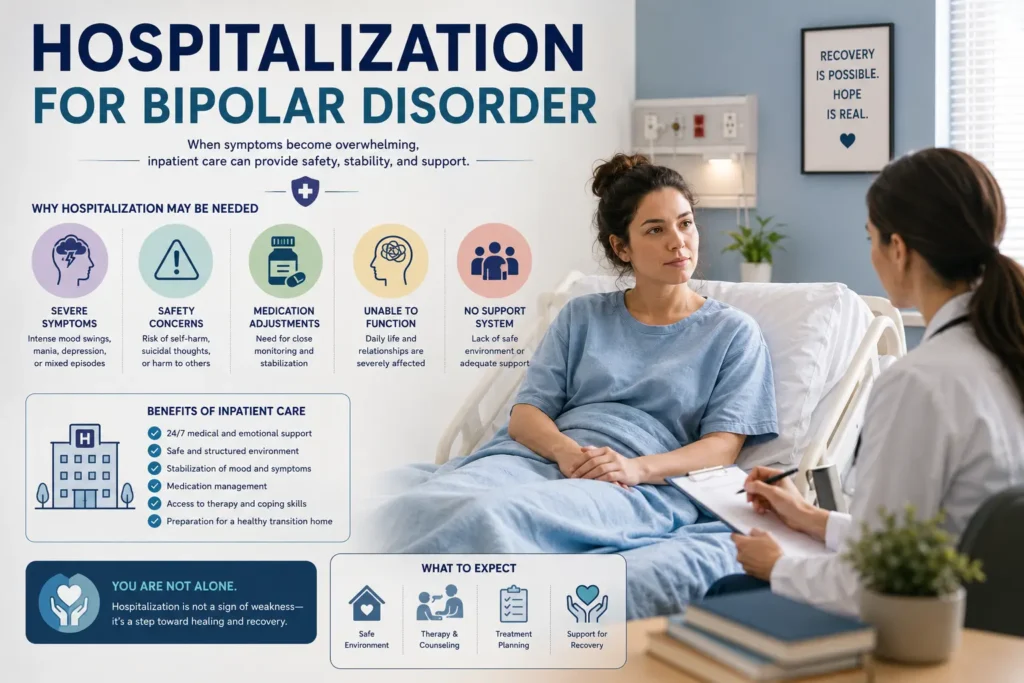
Hospitalization for bipolar disorder is typically needed when someone is at risk of harming themselves or others, experiencing severe mania or psychosis, or unable to safely care for their basic needs. It’s a short-term, stabilizing level of care — most stays run from a few days to a few weeks — used to get someone safe before returning to outpatient treatment. Hospitalization can be voluntary or, in some situations, involuntary under state mental health laws. It’s one part of the broader picture of bipolar disorder treatment, not a separate track of care.
Table of Contents
Key Takeaways
- Hospitalization is generally reserved for safety-related crises, not routine symptom management.
- Common reasons include suicidal thoughts or attempts, severe manic episodes, psychosis, and inability to meet basic needs.
- Admission can be voluntary, where you choose to seek inpatient care, or involuntary, where legal criteria allow hospitalization without consent.
- A typical psychiatric hospital stay for bipolar disorder lasts anywhere from a few days to a couple of weeks, depending on how quickly symptoms stabilize.
- Discharge planning — medication, follow-up appointments, and support — is a critical part of hospitalization, not an afterthought.
- Hospitalization is a stabilizing intervention, not a cure; ongoing outpatient treatment after discharge is essential for maintaining stability.
Why Hospitalization Is Sometimes Necessary
Bipolar disorder is usually managed on an outpatient basis — through medication, therapy, and the kind of day-to-day strategies covered in our guide on how to manage bipolar disorder. But there are moments when symptoms become severe enough that outpatient care isn’t safe or sufficient on its own.
Hospitalization exists for exactly those moments. It provides round-the-clock monitoring, rapid medication adjustment, and a controlled environment when someone’s safety — or someone else’s — is at risk. As one psychiatric expert has put it, the core question isn’t simply how severe someone’s mood symptoms are, but whether those symptoms have crossed into <cite index=”37-1″>being so impairing that the person is at risk of hurting themselves or someone else, or is too disorganized, confused, lethargic, or unable to eat or care for themselves</cite>.
It’s worth being clear from the outset: needing hospitalization at some point doesn’t mean treatment has failed, and it doesn’t reflect on your prognosis long-term. Bipolar disorder is an episodic illness, and even with consistent treatment, a subset of people will experience an episode severe enough to require inpatient stabilization. Our guide on bipolar disorder prognosis covers what long-term outlook typically looks like.
When Hospitalization Becomes Necessary
There’s no single symptom checklist that automatically means “go to the hospital.” Clinicians weigh a combination of safety, functioning, and severity. That said, certain situations consistently point toward inpatient care.
| Situation | Why It May Require Hospitalization |
| Suicidal thoughts, plans, or attempts | Immediate safety risk that outpatient care can’t reliably manage |
| Severe mania with dangerous or reckless behavior | Risk of serious harm from impulsive decisions, including financial, physical, or legal consequences |
| Psychotic symptoms (hallucinations, delusions) | Impaired reality testing that compromises safety and judgment |
| Inability to meet basic needs (eating, sleeping, hygiene, safety) | Sometimes described clinically as being “gravely disabled” |
| Aggressive or threatening behavior toward others | Safety risk to people around the person |
| Severe depression with self-neglect | Risk of medical complications alongside psychiatric ones |
| Medication crisis requiring rapid adjustment under supervision | Some medication changes are safer to manage with close monitoring |
If you’re trying to understand whether what you or a loved one is experiencing fits the profile of a manic episode, our guide on mania symptoms can help you compare. For psychosis specifically within bipolar disorder, see our guide on psychosis in mania.
Voluntary vs. Involuntary Hospitalization
Understanding the difference between these two pathways matters, because they involve different processes, rights, and levels of choice.
| Type | How It Works | Who Decides |
| Voluntary admission | You recognize you need help and agree to be admitted | You, in consultation with a provider |
| Involuntary admission (civil commitment) | Admission occurs without your consent when legal criteria are met | A qualified professional, sometimes with court involvement |
Voluntary Admission
Voluntary hospitalization happens when someone recognizes their symptoms have become unsafe or unmanageable and agrees to inpatient care. This is generally the preferred path, both because it respects a person’s autonomy and because people who enter treatment willingly often engage more readily with the care they receive.
To be admitted voluntarily, a person generally needs to be experiencing severe symptoms affecting daily functioning — <cite index=”29-1″>such as psychosis, mania, substance misuse, or suicidal thoughts or behaviors</cite> — and to be able to show that the level of care needed can’t reasonably be provided outside a hospital setting.
Involuntary Admission
Involuntary hospitalization, sometimes called civil commitment, happens when someone meets specific legal criteria but doesn’t consent to treatment, or isn’t in a state to make that decision safely. Criteria vary by location, but they typically center on three questions: <cite index=”30-1″>is the person a danger to themselves, a danger to others, or so impaired that they can’t provide for their own basic needs</cite>, a state sometimes referred to as being “gravely disabled.”
The process usually starts with an evaluation by a qualified mental health professional. If someone meets criteria, an initial hold typically follows — often lasting somewhere <cite index=”30-1″>between roughly 48 hours and several weeks depending on the jurisdiction</cite> — during which the treatment team assesses whether continued hospitalization is necessary. If longer commitment is recommended, it usually requires a formal hearing, and the person retains the right to legal representation throughout the process.
These holds go by different names depending on location — for example, a short involuntary hold is <cite index=”31-1″>commonly called a “5150” in California, referencing the state code that allows a hold of up to 72 hours, while a similar hold is informally known as being “Baker Acted” in Florida</cite>. Regardless of the specific term, the underlying purpose is the same: a short, legally bounded period to evaluate and stabilize someone who may be in danger.
Research also indicates that certain groups face a higher likelihood of involuntary rather than voluntary hospitalization. A review of risk factors found that <cite index=”34-1″>people with a history of involuntary treatment, those with psychotic or bipolar disorder diagnoses, and those facing socioeconomic disadvantages were more likely to experience involuntary hospitalization</cite> than voluntary admission — a pattern worth knowing about, since it points to broader systemic factors beyond a person’s individual symptoms.
What Happens During Admission
Walking into a psychiatric hospital, especially during a crisis, can feel disorienting. Knowing the general shape of the process in advance can make it feel more predictable.
- Initial safety assessment. This usually happens in an emergency room or dedicated psychiatric admissions area, focused on immediate safety.
- Clinical evaluation. A psychiatrist or attending physician conducts a more complete assessment of symptoms, history, and risk.
- Medical evaluation. A physical health check helps rule out any medical issues contributing to or complicating the psychiatric presentation.
- Level-of-care decision. Based on the evaluations, the team determines whether inpatient admission is appropriate, or whether a less restrictive option would be sufficient.
- Unit placement. Once admitted, you’re assigned to a unit suited to your needs, and orientated to the unit’s routines and expectations.
The full process can take several hours from arrival to unit placement, which can feel slow during a moment of crisis — but each step exists to make sure the level of care actually matches what’s needed.
What Inpatient Treatment Actually Involves
Inpatient psychiatric care for bipolar disorder generally focuses on rapid stabilization rather than long-term therapy work. A typical stay includes:
- Medication management. Psychiatrists can adjust medications more quickly and closely monitor response than is usually possible in an outpatient setting.
- Daily psychiatric check-ins. Regular contact with the treatment team to track progress and safety.
- Structured milieu therapy. A predictable daily schedule, often including groups, that provides stability during an unstable period.
- Safety planning. Especially relevant if suicidal thoughts or self-harm were part of what led to admission.
- Discharge planning. Arranging follow-up care, medication continuity, and support before you leave.
It’s not designed to replace ongoing outpatient therapy — including approaches like cognitive behavioral therapy for bipolar disorder or dialectical behavior therapy for bipolar disorder — but rather to stabilize someone enough to safely return to that kind of ongoing care.
How Long Does Hospitalization Usually Last?
There’s no fixed length of stay for bipolar disorder hospitalization. Most stays range <cite index=”31-1″>from a few days to a few weeks</cite>, depending on factors such as:
| Factor | How It Affects Length of Stay |
| Severity of the episode | More severe presentations generally require longer stabilization |
| Response to medication changes | Faster symptom improvement can shorten the stay |
| Safety concerns | Ongoing risk of self-harm or harm to others may extend the stay |
| Availability of a safe discharge plan | Stay may extend until safe housing, support, and follow-up care are arranged |
| Insurance and facility factors | Coverage and bed availability can also influence timing in practice |
Length of stay decisions are made collaboratively by the treatment team, and — where possible — with input from the patient, focused on the question of whether it’s safe to continue care at a less intensive level.
What to Expect Emotionally
A hospital stay can bring up complicated feelings, even when it’s clearly the right decision. It’s common to feel scared, embarrassed, relieved, or some mix of all three. Research reviewing patient experiences of inpatient psychiatric care has found that many people <cite index=”31-1″>find it genuinely difficult to be away from their usual environment and routines</cite> during a stay, even when the care itself is helpful.
Knowing this in advance doesn’t eliminate the difficulty, but it can help normalize it — the emotional weight of a hospital stay is a common experience, not a sign that something is going wrong or that you’re handling it badly.
Supporting a Loved One Through Hospitalization
If someone you care about needs hospitalization, there are a few concrete ways to help:
- Help with the evaluation process. Family members can often provide helpful context to the evaluating clinician about recent changes in behavior.
- Understand the legal options where you live. In many places, you can <cite index=”31-1″>complete a signed and notarized statement expressing concerns about a loved one’s behavior, or in some states, petition a court for an involuntary hold</cite> if you believe they’re in danger and unwilling to seek help voluntarily.
- Stay involved during the stay. Visiting (where permitted), maintaining contact, and participating in family sessions if offered can support recovery.
- Prepare for discharge together. Understanding the discharge plan — medications, appointments, warning signs to watch for — helps continuity of care after your loved one returns home.
If you’re trying to recognize the warning signs that might precede a crisis like this in the future, our guide on bipolar relapse prevention covers how to build an early-warning plan.
After Discharge: What Comes Next
Hospitalization stabilizes an acute crisis — it doesn’t replace ongoing treatment. What happens after discharge matters just as much as the hospital stay itself.
A solid discharge plan typically includes:
- A follow-up psychiatry appointment scheduled within days, not weeks, of discharge
- Clear instructions on any medication changes made during the stay
- A referral to ongoing therapy if not already in place
- A written safety plan, including warning signs and who to contact if symptoms return
- Involvement of a support person who knows the plan
The period immediately after discharge is a higher-risk window for relapse, which is part of why fast follow-up care matters so much. For guidance on building a longer-term plan to reduce the chances of another hospitalization, see our guide on bipolar relapse prevention and our broader guide to bipolar disorder treatment.
Myths vs. Facts About Bipolar Hospitalization
| Myth | Fact |
| Hospitalization means treatment has failed | It’s a stabilizing step within an episodic illness, not a sign of treatment failure |
| Everyone who’s hospitalized is committed involuntarily | Most psychiatric admissions are voluntary |
| A psychiatric hospital stay lasts months | Most stays for bipolar disorder last days to a few weeks |
| Hospitalization replaces therapy and medication management | It’s meant to stabilize a crisis before returning to ongoing outpatient care |
| Once discharged, the risk period is over | The weeks right after discharge are a known higher-risk period for relapse |
Warning Signs That Hospitalization May Be Needed
If you or someone you know is showing any of the following, it’s time to seek an urgent evaluation:
- Suicidal thoughts, a plan, or any suicide attempt
- Severe mania with dangerous, reckless, or out-of-control behavior
- Hallucinations, delusions, or other signs of psychosis
- Inability to sleep for multiple consecutive nights
- Inability to eat, care for hygiene, or maintain basic safety
- Threats or aggressive behavior toward others
Emergency Help
If you or someone you know is in immediate danger, call your local emergency number or go to the nearest emergency room right away. In the United States, you can also call or text 988 to reach the Suicide & Crisis Lifeline, available 24/7. Don’t wait to see if symptoms improve on their own — early intervention often leads to a shorter, less severe crisis.
Frequently Asked Questions
When should someone with bipolar disorder go to the hospital? Generally when there’s a risk of harm to themselves or others, signs of psychosis, or an inability to safely meet basic needs like eating or sleeping. If you’re unsure, a psychiatric evaluation — through an emergency room, crisis line, or urgent psychiatric appointment — can help determine the right level of care.
Can you be hospitalized against your will for bipolar disorder? Yes, in situations where someone meets legal criteria for involuntary commitment, typically involving danger to self, danger to others, or an inability to meet basic needs. The specific process and hold length vary by location.
How long do bipolar hospital stays usually last? Most stays range from a few days to a few weeks, depending on how quickly symptoms stabilize and whether a safe discharge plan can be arranged.
Does hospitalization mean someone will need to be hospitalized again? Not necessarily. Many people are hospitalized once during a severe episode and go on to manage the condition long-term with outpatient care. Our guide on bipolar relapse prevention covers strategies to reduce the chances of a future crisis.
What’s the difference between a psychiatric hospital and a regular hospital’s mental health unit? Both provide inpatient psychiatric care, but a dedicated psychiatric hospital focuses exclusively on mental health treatment, while a psychiatric unit within a general hospital shares a facility with medical and surgical care. Both can appropriately treat a bipolar disorder crisis.
Will hospitalization show up on my medical record permanently? Psychiatric hospitalization becomes part of your medical history, but records are protected by the same confidentiality laws that apply to other medical care. It’s worth discussing specific concerns about privacy and disclosure with your treatment team.
What should I bring if I’m admitted to a psychiatric hospital? Policies vary by facility, but most allow comfortable clothing without strings or drawstrings, toiletries without alcohol content, a list of current medications, and contact information for support people. Hospitals typically provide a specific list upon admission.
Summary
Hospitalization for bipolar disorder is a short-term, safety-focused intervention used when symptoms become severe enough to put someone’s wellbeing at risk — not a sign that treatment has failed or a permanent state. Whether the path in is voluntary or involuntary, the goal is the same: stabilize the crisis, then return to ongoing outpatient care with a clear plan in place. If you’re worried about your own safety or a loved one’s, don’t wait for things to get worse before reaching out — an evaluation is the first step toward getting the right level of care.
This article is for educational purposes and is not a substitute for professional medical advice. If you are having thoughts of suicide or self-harm, please contact a crisis line or emergency services in your area immediately.