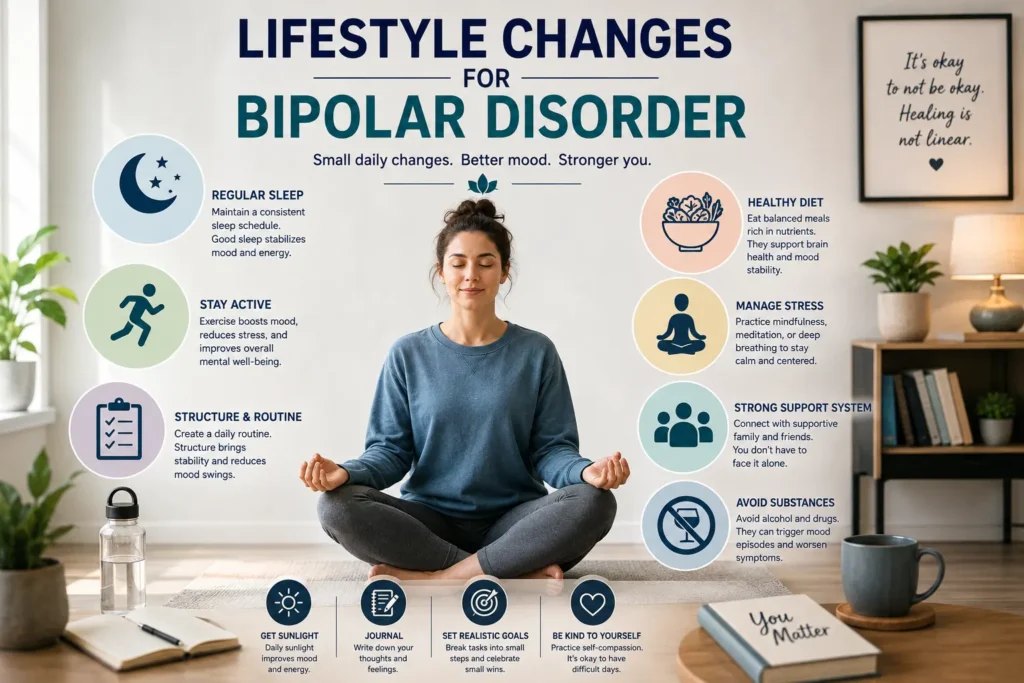
Lifestyle Changes for Bipolar Disorder: Lifestyle changes won’t replace medication or therapy, but they can meaningfully reduce how often mood episodes happen and how severe they get.
The habits with the strongest track record are a consistent sleep-wake schedule, a predictable daily routine, limiting alcohol and stimulants, regular moderate exercise, stress management, and staying closely connected to a treatment team and support system. None of these work in isolation — they work because they protect the biological rhythms that bipolar disorder disrupts.
Table of Contents
Introduction
If you or someone you love has bipolar disorder, you’ve probably already heard the standard advice: “get more sleep,” “reduce stress,” “exercise more.” It’s not wrong, but it’s usually said without any explanation of why it matters or how to actually do it when your mood, energy, and motivation are the very things bipolar disorder destabilizes.
This guide is different. It walks through the specific lifestyle changes that have a real, biological connection to mood stability in bipolar disorder — not generic wellness tips borrowed from a general health blog. You’ll find out why sleep timing matters more than sleep duration, how to build a routine that survives a bad week, which substances are worth cutting entirely, and how to build an early warning system for your own warning signs.
Lifestyle change is not a treatment on its own. It’s a foundation that makes medication and therapy work better. Think of it as reducing the number of ways your daily life can accidentally destabilize your mood.
Key Takeaways
- Sleep and routine stability are the two highest-leverage lifestyle changes for bipolar disorder.
- Alcohol, recreational drugs, and excessive caffeine can trigger or worsen both manic and depressive episodes.
- Exercise helps, but intensity and timing matter — overtraining can backfire.
- Diet has a modest but real effect on mood and medication side effects.
- Lifestyle changes support, but never replace, medication and professional treatment.
- Tracking mood daily helps you catch early warning signs before a full episode develops.
Why Lifestyle Matters So Much in Bipolar Disorder
Bipolar disorder affects the body’s internal clock — the circadian rhythm that regulates sleep, hormone release, appetite, and energy. This is different from most other mental health conditions, where lifestyle is helpful but not central to the biology of the illness itself.
Research summarized by organizations including the National Institute of Mental Health (NIMH) and the American Psychiatric Association points to disrupted sleep and circadian instability as both a symptom and a trigger of mood episodes. In other words, sleep loss doesn’t just happen because of mania — in many cases it can actually cause a manic episode to start. This two-way relationship is why lifestyle stability isn’t a “nice to have” for bipolar disorder. It’s closer to a maintenance requirement, the same way insulin timing matters for diabetes.
This is also why people with bipolar disorder are often advised to avoid jobs with rotating night shifts, frequent long-haul travel across time zones, or chronically irregular schedules — not because these things are inherently bad, but because they directly disrupt the mechanism the illness is built around.
Sleep: The Single Most Important Lifestyle Factor
Sleep deprivation is one of the most well-documented triggers of manic and hypomanic episodes. Even one or two nights of significantly reduced sleep can be enough to tip someone into an episode, particularly in bipolar I.
What actually matters
| Factor | Why it matters | Practical target |
| Consistent wake time | Anchors the circadian rhythm more than bedtime does | Same wake time every day, including weekends |
| Sleep duration | Both too little and too much sleep are linked to mood instability | Roughly 7–9 hours, individualized with a clinician |
| Light exposure | Morning light helps regulate circadian timing | Get outside or near a bright window within an hour of waking |
| Screens before bed | Blue light and stimulating content delay sleep onset | Wind-down period without screens, 30–60 minutes before bed |
| Naps | Long or late naps can shift the sleep-wake cycle | Keep naps short and early in the day, if used at all |
If you’re in a depressive episode and oversleeping, or in a manic/hypomanic episode and barely sleeping, don’t try to fix this alone — talk to your prescriber. Sleep disruption during an active episode often needs a medical approach, not just “sleep hygiene” tips. For a fuller picture of how sleep changes show up as part of the illness itself, see our guide to bipolar disorder symptoms.
Building a Daily Routine That Actually Holds Up
This approach is sometimes called social rhythm stabilization — the idea that keeping meals, activity, sleep, and social contact on a predictable daily schedule helps protect against mood episodes. It’s a concept therapists build entire treatment approaches around, but the basic version is something you can start on your own.
A workable routine doesn’t need to be rigid to the minute. It needs to be predictable enough that your body can rely on it.
Core anchors worth stabilizing first:
- Wake-up time
- First meal time
- Bedtime
- At least one form of daily movement or activity
- A consistent time to check in with yourself (mood tracking, journaling, or a quick self-check)
Start with just one or two anchors if a full routine feels overwhelming. Trying to overhaul your entire day at once is a common reason routines fail within a week.
Diet and Nutrition
There’s no “bipolar diet” backed by strong clinical evidence, and be skeptical of anything that claims otherwise. What the evidence does support is more modest: a generally balanced diet supports mood regulation, energy stability, and helps offset some medication side effects like weight gain or metabolic changes associated with certain mood stabilizers.
A few points worth knowing:
- Caffeine can worsen anxiety and, in high amounts, contribute to sleep disruption that in turn raises manic risk.
- Blood sugar swings from very irregular eating can affect energy and irritability, which some people mistake for mood symptoms.
- Omega-3 fatty acids have some supporting research as an adjunct (not a replacement) for mood stability, but talk to your prescriber before adding any supplement, especially alongside mood stabilizers.
- Grapefruit and certain foods can interact with specific psychiatric medications — always check with your pharmacist about food-drug interactions for your specific prescription.
Alcohol, Recreational Drugs, and Bipolar Disorder
This is one area where the evidence is unusually clear: substance use significantly worsens the course of bipolar disorder. Alcohol and recreational drugs can trigger manic or depressive episodes, interfere with how psychiatric medications work, and increase the risk of a mixed episode, which carries a higher risk of impulsive or dangerous behavior.
| Substance | Common effect on bipolar symptoms |
| Alcohol | Depressant; can worsen depressive episodes and disrupt sleep, increasing manic risk |
| Cannabis | Linked in research to earlier onset and more frequent episodes in some individuals |
| Stimulants (cocaine, amphetamines) | Can directly trigger or mimic manic symptoms |
| Nicotine | Doesn’t trigger episodes directly, but heavily used as a coping mechanism; withdrawal can worsen irritability |
| High-dose caffeine | Can worsen anxiety and disrupt sleep architecture |
If substance use is already part of your life, be honest about it with your psychiatrist rather than hiding it. Many medications interact with alcohol and recreational drugs in ways that can be dangerous, not just unhelpful.
Exercise: Useful, But Timing and Intensity Matter
Regular moderate exercise is associated with improved mood stability, better sleep, and reduced anxiety in people with bipolar disorder. But two nuances get left out of most generic advice:
- Intense, late-night exercise can disrupt sleep for some people, working against the sleep stability goal above.
- Overtraining during hypomania is a real pattern — the same energy surge that makes someone want to exercise intensely during hypomania can also be a sign the episode is escalating, not just “good energy.”
A reasonable target most guidelines converge on is around 150 minutes of moderate activity per week, but the specific type matters less than consistency. Walking, swimming, cycling, or resistance training all count. The goal is a sustainable habit, not a punishing routine.
Stress Management and Emotional Regulation
Stress doesn’t cause bipolar disorder, but it’s a well-established trigger for episodes in people who already have it. Building a stress management toolkit is not optional self-care — it’s part of relapse prevention.
Approaches with the most support include:
- Mindfulness and relaxation practices (breathing exercises, progressive muscle relaxation, meditation)
- Structured problem-solving rather than rumination when a stressor appears
- Setting boundaries around work, relationships, or commitments that consistently overload you
- Therapy-based tools, particularly cognitive behavioral therapy and dialectical behavior therapy, which teach concrete skills for tolerating distress without it escalating into an episode
If stress is chronic — a difficult job, caregiving demands, financial pressure — lifestyle tweaks alone usually aren’t enough. That’s a conversation for your therapist, not just a to-do list item.
Mood Tracking and Early Warning Signs
One of the most practical lifestyle habits is also one of the least discussed: tracking your mood daily. Bipolar episodes rarely appear out of nowhere — they usually have a build-up period with recognizable early signs, even if they’re easy to miss in the moment.
A simple daily tracker can include:
- Hours slept and sleep quality
- Mood rating (e.g., 1–10 scale)
- Energy level
- Any medication changes or missed doses
- Major stressors or events that day
Over time, this creates a personal pattern map. Many people find they have a specific “signature” — for example, needing less sleep without feeling tired, talking faster, or spending more impulsively — that shows up days before a full episode. Recognizing your own pattern is one of the most effective tools for early intervention, and it’s something your care team can help you build in relapse prevention planning.
Social Connection and Support Systems
Isolation is both a symptom and a risk factor in bipolar disorder. Maintaining relationships — even a small, consistent circle — provides two protective benefits: emotional support, and an outside perspective that can flag mood changes you might not notice in yourself.
Practical ways to build this:
- Tell a small number of trusted people what your early warning signs look like, and ask them to say something if they notice
- Stay connected to a psychiatrist and therapist, not just during crises
- Consider a bipolar-specific support group, in person or online, where the shared experience reduces stigma and isolation
- Involve family or a partner in treatment planning where appropriate — with your consent
Work, Structure, and Time Zones
Certain work patterns are riskier than others for bipolar stability — not because of the work itself, but because of what it does to sleep and routine. Rotating shifts, frequent overnight work, and jobs with unpredictable hours make it harder to maintain the consistent sleep-wake cycle discussed earlier.
This doesn’t mean these jobs are off-limits, but it’s worth discussing with your treatment team if your work schedule seems to line up with your episode pattern. Small accommodations — a more consistent shift, protected time off after travel, or flexibility during high-stress periods — can meaningfully lower risk.
Myths vs. Facts About Lifestyle and Bipolar Disorder
| Myth | Fact |
| “Lifestyle changes can replace medication.” | Lifestyle changes support treatment but don’t replace mood stabilizers or therapy for most people. |
| “One bad night of sleep won’t matter.” | Even short-term sleep loss is a documented trigger for manic episodes in some people. |
| “Exercise is always good, so more is better.” | Overtraining, especially during hypomania, can worsen instability rather than help it. |
| “You just need to try harder to stick to a routine.” | Executive function and motivation are affected by the illness itself — this isn’t a willpower issue. |
| “A strict diet can cure or prevent bipolar episodes.” | No diet cures bipolar disorder; nutrition plays a supporting, not primary, role. |
For a broader look at common misconceptions, see bipolar disorder myths.
A Practical Daily Checklist
- [ ] Woke up and went to bed at consistent times
- [ ] Took medication as prescribed
- [ ] Had at least one balanced meal and stayed hydrated
- [ ] Limited or avoided alcohol and recreational substances
- [ ] Got some form of physical activity
- [ ] Logged mood, energy, and sleep
- [ ] Had at least brief contact with a support person
- [ ] Used a stress-management tool if needed
This isn’t meant to be completed perfectly every day. It’s a reference point — the more of these you consistently hit, the more stable your baseline tends to be.
Warning Signs That Need Professional Attention
Lifestyle changes are preventive, not a substitute for medical care when symptoms escalate. Reach out to your psychiatrist or care team if you notice:
- A sudden drop in need for sleep without feeling tired
- Racing thoughts, rapid speech, or unusually elevated mood
- Increased impulsive spending, risk-taking, or recklessness
- Persistent low mood, hopelessness, or loss of interest lasting more than two weeks
- Thoughts of self-harm or suicide
Emergency Help
If you or someone you know is in immediate danger or having thoughts of suicide, call or text 988 (Suicide & Crisis Lifeline) in the US, or go to the nearest emergency room. If you’re outside the US, contact your local emergency number or a local crisis line.
Frequently Asked Questions
Can lifestyle changes alone manage bipolar disorder without medication? No. Lifestyle changes are a supportive foundation, but the American Psychiatric Association and most major clinical guidelines recommend medication, often alongside therapy, as the primary treatment for most people with bipolar disorder.
What is the single most important lifestyle change for bipolar disorder? Sleep consistency is generally considered the highest-impact change, because sleep disruption has one of the strongest documented links to triggering manic episodes.
Does exercise help with bipolar depression? Yes, moderate regular exercise is associated with improved mood and reduced depressive symptoms, but intensity and timing should be balanced against sleep and energy levels, especially during mood episodes.
Is caffeine bad for bipolar disorder? High caffeine intake can worsen anxiety and disrupt sleep, both of which are risk factors for mood episodes. Moderate intake is generally not prohibited, but individual sensitivity varies.
Can stress trigger a manic or depressive episode? Yes, stress is a well-documented trigger for both manic and depressive episodes in people with bipolar disorder, which is why stress management is considered part of relapse prevention.
How long does it take for lifestyle changes to show a benefit? There’s no fixed timeline, but consistent sleep and routine changes often show noticeable effects on mood stability within several weeks, though this varies by individual and episode history.
Should family members be involved in lifestyle management? Many people benefit from involving a trusted family member or partner, particularly for recognizing early warning signs the person themselves might miss.
Summary
Lifestyle changes won’t cure bipolar disorder, and they’re not a substitute for professional treatment. What they do is reduce the number of triggers your body has to contend with — protecting sleep, keeping a predictable routine, limiting substances that destabilize mood, staying active in a balanced way, and building a support system that can catch early warning signs. Combined with the right treatment plan and ongoing care from a psychiatrist and therapist, these habits give you a meaningfully better chance at long-term stability. If you’re not sure where to start, bring this list to your next appointment and build a plan with your care team rather than trying to change everything at once.
This article is for educational purposes and is not a substitute for professional medical advice. Always consult a qualified healthcare provider for diagnosis and treatment decisions related to bipolar disorder.