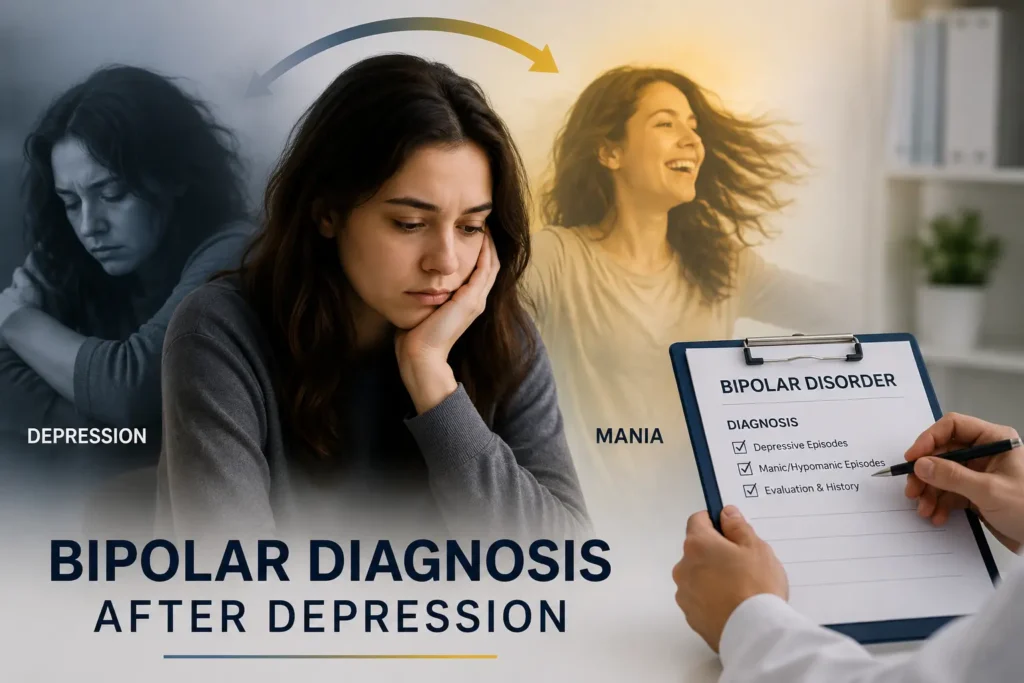
Bipolar Diagnosis After Depression: Bipolar diagnosis after depression is common because bipolar disorder frequently begins with a depressive episode, sometimes years before the first manic or hypomanic episode appears. A diagnosis usually shifts from depression to bipolar disorder when a person experiences a period of elevated mood, high energy, or decreased need for sleep—either on their own or after starting an antidepressant—that meets DSM-5 criteria for mania or hypomania.
Table of Contents
Key Takeaways
- Many people with bipolar disorder are diagnosed with depression first, since the earliest episodes are often depressive rather than manic.
- A re-diagnosis to bipolar disorder typically happens after a manic or hypomanic episode is identified, sometimes years into treatment.
- Antidepressants can trigger or unmask hypomania/mania in people with an underlying bipolar vulnerability.
- Certain features in a depressive episode — early onset, psychotic symptoms, family history of bipolar disorder — raise the likelihood of an eventual bipolar diagnosis.
- A diagnosis shift isn’t a sign your original treatment was a mistake; it reflects new information as the illness reveals itself over time.
- Never stop or change psychiatric medication without medical guidance, even if you suspect your diagnosis needs revisiting.
Why Bipolar Disorder Often Starts as a Depression Diagnosis
This is one of the most common and least talked-about realities in mood disorder care: many people who eventually receive a bipolar disorder diagnosis were treated for depression first, sometimes for years.
The reason comes down to how the illness typically unfolds. Research on the course of bipolar disorder consistently finds that depressive episodes tend to appear before the first manic or hypomanic episode, in a substantial share of cases. If you’ve never had an obvious manic episode, there’s often nothing in a first appointment to distinguish your depression from any other case of major depressive disorder. A hypomanic episode, in particular, can be easy to miss — it doesn’t always feel like a problem at the time. It can feel like finally having energy, motivation, and confidence after a long depressive stretch, which many people don’t think to mention to a doctor.
This is why an initial depression diagnosis isn’t a mistake in most cases — it’s an accurate read of the information available at that point in time. The diagnosis can shift later because the illness itself unfolds gradually, not because anyone got it wrong the first time.
Signs During “Depression” Treatment That May Point to Bipolar Disorder
Certain patterns during a depressive episode or its treatment tend to raise a clinician’s suspicion that something more than unipolar depression is going on. For a full symptom breakdown, see bipolar disorder symptoms. The most clinically relevant signals include:
- A history of at least one period of unusually high energy, elevated mood, or decreased need for sleep — even briefly
- Depression that started very early, such as in the teenage years
- Multiple short depressive episodes rather than one long one
- Depression accompanied by psychotic features, like delusions or hallucinations
- “Atypical” depression features — sleeping and eating more than usual, rather than less
- A poor or unusual response to antidepressants, including agitation or restlessness
- A strong family history of bipolar disorder, particularly in a parent or sibling
- Mood that feels unstable or reactive rather than steadily low
None of these signs alone confirms bipolar disorder. Together, though, they’re the pattern clinicians are trained to watch for when a depression diagnosis doesn’t fully explain what’s happening.
How Antidepressants Can Reveal an Underlying Bipolar Vulnerability
One of the more important — and least understood — parts of this topic is what happens when someone with undiagnosed bipolar disorder starts an antidepressant for what looks like ordinary depression.
In some people, antidepressants can trigger a switch into hypomania or mania, sometimes called antidepressant-emergent mood switching. Research reviewing tens of thousands of patients treated with antidepressants who had no prior history of mania found mood switching in roughly the high single digits as a percentage, occurring most often within the first two years of treatment, and the risk was notably higher in adolescents and young adults than in adults. The DSM-5 now recognizes that a full manic or hypomanic episode triggered by an antidepressant — one that goes beyond the medication’s expected short-term effects — can be enough to justify a bipolar diagnosis, rather than being dismissed as a simple drug reaction.
This is precisely why psychiatrists watch new antidepressant users closely, especially in the first several weeks. Symptoms like unusual agitation, racing thoughts, dramatically reduced need for sleep, or a sudden burst of grandiosity after starting an antidepressant are taken seriously as a possible sign of bipolar disorder, not just a side effect to push through.
Depression vs. Bipolar Depression: How Clinicians Tell Them Apart
Bipolar depression and unipolar (major) depression can look nearly identical day to day, which is exactly why history-taking matters so much. Here’s how clinicians typically distinguish them:
| Feature | Unipolar Depression | Bipolar Depression |
| History of mania/hypomania | Never present | At least one episode required for diagnosis |
| Age of onset | Often mid-20s or later | Frequently earlier, sometimes in the teens |
| Sleep and appetite | Often decreased | Often increased (hypersomnia, increased appetite) |
| Episode pattern | Fewer, longer episodes | More frequent, sometimes shorter episodes |
| Family history | Depression more common | Bipolar disorder more common among relatives |
| Response to antidepressants alone | Typically improves mood | May trigger agitation, mixed symptoms, or a switch into hypomania/mania |
| Psychotic features | Less common | Somewhat more common during severe episodes |
This distinction matters clinically because treatment approaches differ. For a deeper look at how bipolar depression specifically presents, see our guides on bipolar 1 vs bipolar 2 depression and bipolar 2 depression.
How a Re-Diagnosis From Depression to Bipolar Disorder Actually Happens
A diagnosis rarely flips overnight. It typically follows one of a few paths:
- A spontaneous hypomanic or manic episode occurs. The person or a family member notices a distinct period of elevated mood, high energy, or reduced need for sleep, and reports it at a follow-up appointment.
- An episode emerges during antidepressant treatment. A clinician recognizes a mood switch as clinically significant rather than a minor side effect.
- A more detailed history-taking process uncovers a past episode. Sometimes a new clinician, or a more thorough interview, uncovers a hypomanic period from years earlier that was never flagged as relevant.
- A structured screening tool raises concern. Questionnaires like the Mood Disorder Questionnaire (MDQ) can prompt a more detailed follow-up conversation.
- A formal reassessment confirms the diagnosis. The clinician applies DSM-5 criteria for mania or hypomania and updates the diagnosis and treatment plan accordingly.
For a broader look at how bipolar disorder is identified in general, see how bipolar disorder is diagnosed and bipolar disorder diagnosis.
Who Makes the Call on a Diagnosis Change?
A shift from depression to bipolar disorder should come from a psychiatrist or other licensed mental health professional experienced in mood disorders — not a self-assessment, however compelling the pattern seems. If you suspect your diagnosis doesn’t fit, the right move is to raise it directly with your prescriber rather than adjusting medication on your own. See who can diagnose bipolar disorder for more on which providers are equipped to make this determination.
Risk Factors That Make a Future Bipolar Diagnosis More Likely
Certain factors, identified through research on people who were later found to have bipolar disorder after an initial depression diagnosis, are worth being aware of. Our bipolar disorder causes guide covers the broader picture; specific to this topic, the most consistently reported factors include:
- A family history of bipolar disorder, especially in a first-degree relative
- Early age of onset for the first depressive episode
- A pattern of rapid-cycling depressive episodes
- Postpartum depressive episodes, which show a documented association with later bipolar diagnosis in some individuals
- A depressive episode marked by psychotic or highly atypical features
Checklist: What to Track If You Suspect Your Diagnosis Might Change
If something about your depression diagnosis doesn’t feel like the full picture, structured tracking makes the conversation with your provider far more productive. Consider tracking:
- [ ] Any period, even brief, of unusually high energy, elevated mood, or reduced need for sleep
- [ ] How you felt in the days and weeks after starting or changing an antidepressant
- [ ] Sleep and appetite patterns during both low and higher-energy periods
- [ ] Any family history of bipolar disorder, mania, or hospitalization for mood symptoms
- [ ] Episodes of unusually fast talking, racing thoughts, or impulsive decisions
- [ ] How long your depressive episodes typically last and how often they recur
Bringing this information to an appointment, rather than a general sense that “something’s off,” gives your provider what they need to reassess accurately.
Myths vs. Facts About Bipolar Diagnosis After Depression
| Myth | Fact |
| A depression diagnosis was a mistake if bipolar disorder is found later | It reflects new information over time, not an error — hypomania is often invisible or unreported early on |
| Antidepressants cause bipolar disorder | Antidepressants can unmask or trigger a switch in someone with an underlying vulnerability; they don’t create bipolar disorder in people without that vulnerability |
| Feeling “better than normal” after starting an antidepressant is always a good sign | It can sometimes signal hypomania rather than genuine improvement, especially if it comes with reduced need for sleep or racing thoughts |
| Only people with obvious manic episodes get re-diagnosed | Hypomania is often subtle, and many re-diagnoses come from careful history-taking rather than a dramatic episode |
| Bipolar disorder only gets diagnosed once, early in life | Diagnosis can shift at any point, including years or decades into treatment for depression |
For a wider set of misconceptions, see bipolar disorder myths.
Warning Signs That Need Prompt Medical Attention
Some symptoms during depression treatment warrant urgent contact with your provider rather than waiting for a routine appointment:
- Sudden, dramatic increase in energy with very little sleep
- Racing thoughts, pressured speech, or a sense that your mind won’t slow down
- Impulsive or risky decisions that feel out of character
- Any thoughts of suicide or self-harm, whether during a low or high period
- Symptoms of psychosis, such as unusual beliefs or hearing things that aren’t there
If you’re having thoughts of suicide or self-harm, this is an emergency. In the U.S., call or text 988 to reach the Suicide & Crisis Lifeline, available 24/7, or text HOME to 741741 for the Crisis Text Line. If there is immediate danger, call 911 or go to the nearest emergency room.
What Happens After a Diagnosis Changes to Bipolar Disorder
Once bipolar disorder is confirmed, treatment usually looks different from standard depression treatment — often involving a mood stabilizer, sometimes alongside or instead of an antidepressant, since antidepressants alone can be destabilizing for some people with bipolar disorder. We cover this in detail in our bipolar disorder treatment guide. It’s also worth understanding bipolar disorder complications that can arise without an accurate diagnosis, and reading our bipolar disorder prognosis guide for a realistic sense of outlook once treatment is properly matched to the diagnosis.
Many people find it helpful to understand exactly which type of bipolar disorder they’ve been diagnosed with, since bipolar 1 vs bipolar 2 differ in episode severity and treatment approach — our comparison guide walks through the distinction clearly.
Frequently Asked Questions
How long after a depression diagnosis can bipolar disorder appear? There’s no fixed timeline. For some people, a manic or hypomanic episode emerges within a year or two; for others, it surfaces a decade or more into depression treatment.
Does everyone with depression eventually get diagnosed with bipolar disorder? No. Most people diagnosed with major depression never develop bipolar disorder. A re-diagnosis only happens when a genuine manic or hypomanic episode is identified.
Can antidepressants alone cause someone to develop bipolar disorder? Current understanding is that antidepressants can trigger or reveal hypomania/mania in someone who already has an underlying vulnerability to bipolar disorder — they aren’t understood to create bipolar disorder in people without that susceptibility.
Why didn’t my doctor catch this earlier? Hypomanic episodes are often subtle, brief, and don’t feel like a problem while they’re happening, so they frequently go unreported. This isn’t a failure of care — it’s a well-documented pattern in how bipolar disorder tends to present.
Should I stop my antidepressant if I think I actually have bipolar disorder? No — never stop or adjust psychiatric medication without medical guidance. Stopping abruptly can cause its own problems. Raise your concerns with your prescriber so any changes happen safely.
What questions should I ask my doctor if I suspect a bipolar diagnosis? Consider asking whether your symptom history includes any signs of hypomania, whether a screening tool like the MDQ would be useful, and whether your current medications are appropriate if the diagnosis changes.
Is bipolar II more likely to be missed than bipolar I? Yes, generally. Hypomanic episodes in bipolar II are less dramatic and disruptive than full manic episodes in bipolar I, making them easier to overlook or dismiss as simply “feeling good.”
Summary
Bipolar diagnosis after depression is far more common than most people realize, largely because bipolar disorder frequently announces itself first as depression, with the defining manic or hypomanic episode appearing later — sometimes triggered or revealed by antidepressant treatment. A shift in diagnosis reflects the natural course of the illness becoming clearer over time, not a mistake in your original care. If your depression treatment doesn’t feel like it’s telling the whole story, tracking your symptoms and raising the pattern directly with your psychiatrist is the most reliable path to getting an accurate diagnosis.
This article is for educational purposes and isn’t a substitute for a professional psychiatric evaluation. If you’re concerned about your mental health or your current diagnosis, consult a qualified healthcare provider.