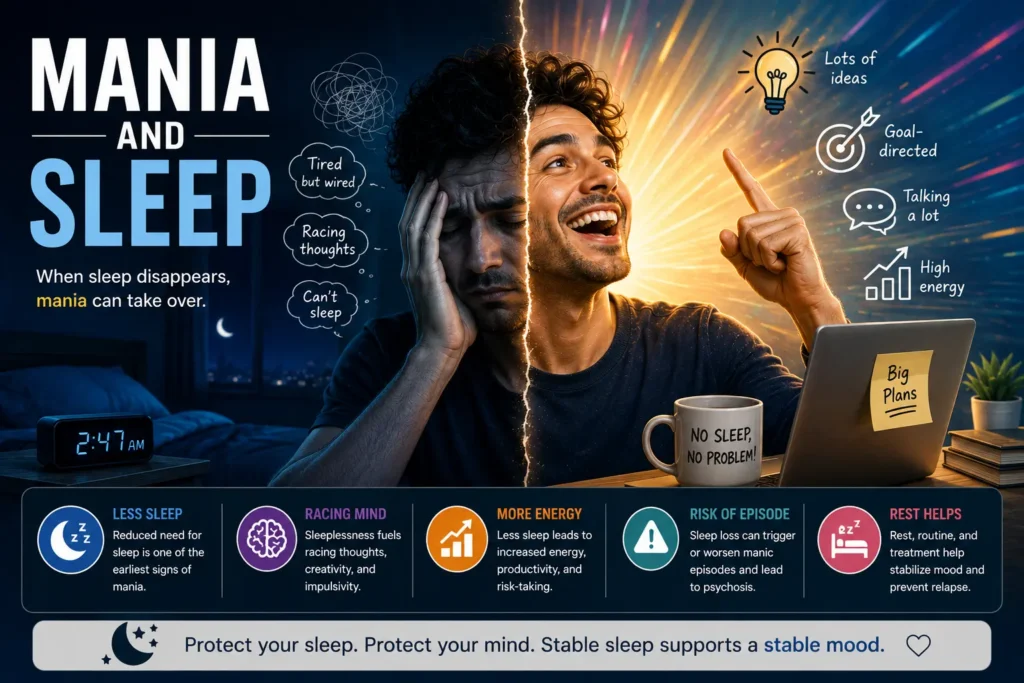
Mania and sleep have a bidirectional relationship: losing sleep can trigger a manic episode, and mania itself dramatically reduces the need for sleep — sometimes down to just a few hours a night without any feeling of tiredness. This isn’t simple insomnia; it’s a core diagnostic feature of mania. Protecting sleep is one of the most effective, evidence-based tools for both preventing and managing manic episodes.
Table of Contents
Key Takeaways
- Decreased need for sleep is one of the official DSM-5 criteria for a manic episode — it’s different from ordinary insomnia.
- Sleep loss doesn’t just accompany mania; it can actively trigger or worsen an episode.
- The relationship runs both ways, creating a cycle that can be hard to break without treatment.
- Regulating sleep and daily rhythm is a core part of long-term bipolar disorder treatment, not just a lifestyle add-on.
- Consistent sleep tracking is one of the simplest early-warning tools available.
Why Sleep and Mania Are So Closely Linked
Sleep regulates far more than energy levels — it plays a direct role in mood stability, particularly for people with bipolar disorder. Research summarized by the National Institute of Mental Health points to sleep and circadian rhythm disruption as one of the most consistent biological links to mood episodes in bipolar spectrum conditions.
For someone with bipolar disorder, sleep isn’t just “nice to have” — it functions almost like a mood-stabilizing mechanism on its own. When that mechanism breaks down, either through poor sleep habits or the internal changes that come with mania itself, mood regulation tends to break down along with it.
Decreased Need for Sleep: A Core Symptom of Mania
One of the most distinctive features of mania is that a person can function — often at a high, energetic level — on very little sleep, without feeling tired the next day. This is different from the exhaustion most people feel after a poor night’s sleep.
| Feature | Ordinary Poor Sleep | Decreased Need for Sleep in Mania |
| Feeling the next day | Tired, sluggish, foggy | Energized, alert, sometimes euphoric |
| Duration | Usually resolves after one good night’s sleep | Can persist for days without the person seeking rest |
| Awareness of the problem | Person usually notices and wants more sleep | Person often doesn’t see it as a problem at all |
| Underlying cause | External (stress, noise, schedule) | Internal shift in the brain’s sleep-wake regulation during mania |
This distinction matters clinically. A clinician diagnosing mania isn’t just asking “are you sleeping poorly” — they’re specifically listening for a reduced need for sleep alongside high energy, which is one of the core criteria outlined in the full mania symptoms picture.
The Bidirectional Relationship: How Sleep Loss and Mania Feed Each Other
The connection between sleep and mania works in both directions, which is part of what makes it so important to address early.
Sleep loss as a trigger. Losing even one or two nights of sleep — from travel, stress, shift work, or a late-night deadline — can be enough to trigger a manic or hypomanic episode in someone with an underlying vulnerability to bipolar disorder. This is covered in more depth in our guide to mania triggers.
Mania reducing sleep further. Once an episode begins, the person often needs less sleep and may actively resist rest, since they don’t feel tired. This creates less recovery time for the brain, which can intensify manic symptoms further.
The result is a feedback loop: less sleep worsens mania, and mania further reduces sleep, often escalating an episode’s severity the longer it goes untreated. Breaking this loop — usually through medication and structured sleep intervention — is often one of the first priorities in acute treatment.
Sleep Patterns Across the Bipolar Spectrum
Sleep changes don’t look the same at every point on the bipolar mood spectrum. Understanding where a pattern falls can help distinguish ordinary stress from something that needs clinical attention.
| Mood State | Typical Sleep Pattern |
| Hypomania | Reduced sleep need, but still some rest; person often reports feeling “fine” or even great |
| Full mania | Severely reduced sleep, sometimes near-total sleeplessness for days |
| Depression | Often the opposite — oversleeping (hypersomnia) or difficulty falling asleep tied to low mood |
| Euthymia (stable mood) | Regular, consistent sleep pattern |
For the difference between the milder and more severe ends of this spectrum, see mania vs hypomania and hypomania symptoms.
Common Sleep Disruptors That Precede Manic Episodes
While the full picture of what can set off an episode is covered in our mania triggers guide, these are the sleep-specific disruptors most frequently reported before a manic episode begins:
- Jet lag or crossing multiple time zones
- Shift work or irregular work hours
- All-nighters for school, work, or social events
- New parenthood and infant-related sleep disruption
- Chronic untreated insomnia
- Late-night screen use disrupting the body’s natural wind-down process
- Excessive caffeine intake, especially later in the day
Why Treating Sleep Problems Is Part of Treating Mania
Sleep isn’t a side issue in bipolar disorder care — it’s frequently one of the first things a psychiatrist addresses during an acute episode and one of the most important habits to maintain during stable periods.
During an Acute Episode
Medication that promotes rest — sometimes a short-term sedating agent alongside a mood stabilizer or antipsychotic — is often used specifically to help restore sleep, since sleep restoration itself can help bring the episode under control. This is one reason sleep-focused treatment gets prioritized early, alongside the broader approach covered in mania treatment.
During Maintenance and Prevention
Interpersonal and Social Rhythm Therapy (IPSRT) is a therapy model built specifically around stabilizing daily routines, including sleep and wake times, because irregular rhythms are such a strong predictor of relapse.
Sleep hygiene practices — consistent bedtime, limiting screens before bed, reducing late-day caffeine, and keeping a cool, dark sleep environment — support medication and therapy rather than replacing them.
Mood and sleep tracking helps both the individual and their psychiatrist catch early warning signs before a full episode develops.
Building a Sleep-Protective Routine
| Strategy | Why It Helps |
| Fixed bedtime and wake time (even on weekends) | Stabilizes circadian rhythm, which is closely tied to mood regulation |
| Limit screens 60+ minutes before bed | Reduces light exposure that delays natural sleep onset |
| Avoid caffeine after early afternoon | Prevents stimulant interference with sleep onset |
| Track sleep hours daily | Creates an early-warning system for emerging episodes |
| Plan recovery time after travel or big events | Reduces the sleep-debt window that can trigger symptoms |
| Communicate changes to your psychiatrist promptly | Allows for early medication or plan adjustments before an episode fully develops |
Myths vs. Facts About Mania and Sleep
| Myth | Fact |
| “Needing less sleep during mania means the person is just more energetic.” | It’s a core symptom of mania tied to disrupted sleep-wake regulation, not a positive trait. |
| “Catching up on sleep afterward fixes the problem.” | Recovery sleep helps, but the underlying episode still needs proper treatment. |
| “Only stress-related insomnia can trigger mania.” | Any significant sleep disruption — including travel, shift work, or celebration-related late nights — can act as a trigger. |
| “Sleep problems in bipolar disorder are the same as ordinary insomnia.” | The pattern, awareness, and underlying mechanism are meaningfully different, especially during mania. |
| “Sleep aids are the entire treatment for manic sleep loss.” | Sleep support usually works alongside mood stabilizers and antipsychotics, not as a stand-alone fix. |
For broader misconceptions about bipolar disorder, see bipolar disorder myths.
Warning Signs Your Sleep Changes May Signal a Manic Episode
Pay attention if you or someone you know notices:
- Needing far less sleep than usual without feeling tired
- Staying up most or all of the night with high energy
- Racing thoughts that make it hard to wind down, even when tired
- Increasing irritability alongside reduced sleep
- A growing sense of not needing rest at all
If these signs appear alongside grandiosity, rapid speech, or impulsive decisions, it may indicate a developing manic episode rather than ordinary sleep trouble. Reach out to a psychiatrist as early as possible — early intervention at this stage often prevents escalation.
When to Seek Emergency Help
Seek immediate help if sleep loss is accompanied by:
- Hallucinations or delusions (see psychosis in mania for more on this)
- Extreme agitation or inability to communicate clearly
- Dangerous or highly impulsive behavior
- Any thoughts of self-harm or harming others
In the US, call 988 (Suicide & Crisis Lifeline) or 911 in an emergency. In the UK, contact the Samaritans at 116 123 or call 999. Don’t wait to see if the episode resolves on its own.
Frequently Asked Questions
Does poor sleep cause bipolar disorder? No. Poor sleep doesn’t cause bipolar disorder itself, but it’s a well-documented trigger for manic episodes in people who already have the underlying condition. See causes of mania for the biological factors behind bipolar disorder.
Why don’t people feel tired during mania even with almost no sleep? Mania involves a shift in the brain’s sleep-wake regulation, not just willpower or excitement — this is why the person genuinely doesn’t feel the fatigue most people would after similar sleep loss.
Can fixing sleep alone stop a manic episode? Sleep restoration helps, but it’s rarely sufficient on its own for a full manic episode — medication and clinical support are typically needed alongside it.
Is insomnia during mania treated differently than regular insomnia? Yes. It’s usually addressed as part of the broader manic episode treatment, often with a mood stabilizer or antipsychotic rather than a standard sleep aid alone.
How much sleep loss can trigger mania? Even one or two nights of significant sleep loss has been documented as a trigger in vulnerable individuals, though this varies by person.
Can naps make up for lost sleep during a manic episode? Naps may offer some relief, but they don’t replace the deeper, more restorative overnight sleep needed to help stabilize mood.
Does hypomania affect sleep the same way as full mania? The pattern is similar but usually less extreme — reduced sleep need without the severe, prolonged sleeplessness sometimes seen in full mania. See hypomania for more detail.
Summary
Sleep and mania are tightly connected in both directions — sleep loss can trigger an episode, and mania itself reduces the need for sleep in a way that isn’t ordinary tiredness or insomnia. Because this relationship feeds itself, protecting sleep through consistent routines, tracking, and prompt communication with a psychiatrist is one of the most practical tools for preventing and managing manic episodes. If sleep changes escalate alongside other symptoms, treat it as an early warning sign, not just a scheduling issue.
To understand how sleep fits into the bigger picture, explore our guides on manic episode, mania treatment, and bipolar disorder symptoms.