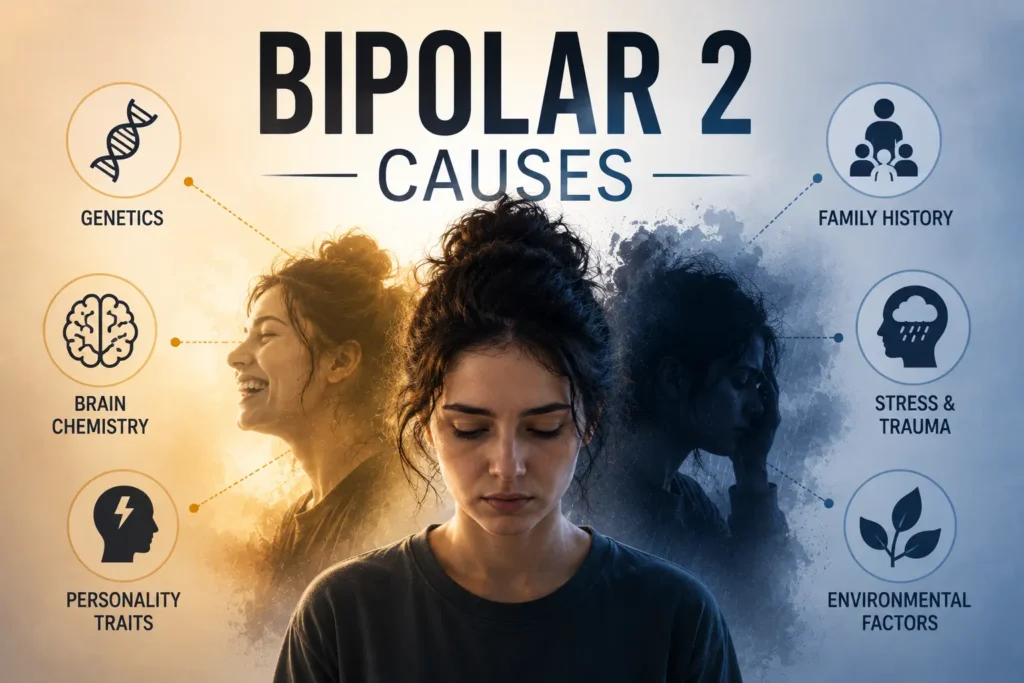
Bipolar 2 Causes: Bipolar 2 doesn’t have one single cause. It develops from a combination of genetic vulnerability, differences in brain structure and chemistry, and environmental triggers like chronic stress, trauma, or major sleep disruption. Genetics plays the largest known role, but having a family history doesn’t guarantee someone will develop bipolar 2—it raises the odds, while environmental and biological factors often determine whether and when it actually appears.
Table of Contents
Key Takeaways
- Bipolar 2 arises from an interaction between genetic predisposition and environmental triggers, not a single identifiable cause.
- Family history is the strongest known risk factor, but most people with a bipolar relative never develop the condition themselves.
- Brain imaging studies show differences in regions that regulate mood, emotion, and reward processing in people with bipolar disorder.
- Neurotransmitter systems, particularly dopamine, serotonin, and norepinephrine, appear to function differently in bipolar 2.
- Environmental stressors don’t cause bipolar 2 on their own, but they can trigger onset or episodes in someone already genetically vulnerable.
Introduction
“What causes bipolar 2?” is one of the most common questions people ask after a diagnosis, or while trying to understand a loved one’s mood patterns. It’s a fair question, and also a genuinely complicated one. Unlike a broken bone or an infection, bipolar 2 doesn’t trace back to one clear origin. Researchers describe it instead as a condition that emerges from multiple interacting factors — some you’re born with, some shaped by your environment.
This guide breaks down what’s currently understood about bipolar 2’s causes, based on research referenced by organizations including the National Institute of Mental Health (NIMH), the American Psychiatric Association (DSM-5), and the World Health Organization (WHO). If you’re looking for symptoms or diagnosis information instead, see our guides to bipolar 2 symptoms and bipolar disorder diagnosis. This article focuses specifically on the “why.”
There’s No Single Cause of Bipolar 2
It’s worth saying plainly: no single gene, event, or experience causes bipolar 2 by itself. Current research points to a biopsychosocial model — a framework where biological vulnerability, psychological factors, and social or environmental circumstances all interact to shape whether and how the condition develops. This is consistent with how bipolar disorder causes are understood across the broader bipolar spectrum, including bipolar 1.
This matters because it pushes back against two common but inaccurate beliefs: that bipolar 2 is “just genetic” and therefore inevitable for people with a family history, or that it’s “caused by stress” and therefore something a person could have avoided through lifestyle choices alone. Neither framing holds up. The reality is more layered.
Genetic Causes of Bipolar 2
Genetics is the most well-established risk factor for bipolar disorder as a category, including bipolar 2.
| Genetic Factor | What Research Shows |
| Family history | Having a first-degree relative (parent or sibling) with bipolar disorder significantly increases risk compared to the general population |
| Twin studies | Identical twin studies show substantially higher concordance rates for bipolar disorder than fraternal twin studies, pointing to a strong heritable component |
| Polygenic influence | Researchers have not identified a single “bipolar gene” — instead, many genes each contribute a small amount of risk |
| Shared genetic risk with other conditions | Some genetic risk factors for bipolar disorder overlap with those for schizophrenia and major depressive disorder |
It’s important to understand what “genetic risk” actually means in practice. Genes don’t determine an outcome the way they determine eye color. They create a predisposition — a higher baseline vulnerability — that still depends on other factors to become an active illness. Many people with a bipolar parent or sibling never develop the condition themselves.
Brain Structure and Function
Neuroimaging research has identified differences in the brains of people with bipolar disorder compared to the general population, particularly in regions involved in regulating mood, emotional response, and reward processing.
| Brain Region or System | Role in Bipolar 2 |
| Prefrontal cortex | Involved in emotional regulation and decision-making; differences here may relate to mood instability |
| Amygdala | Processes emotional responses; altered activity patterns have been observed in bipolar disorder |
| Limbic system | Broadly involved in emotion and motivation regulation |
| Neural connectivity | Some studies point to differences in how mood-regulating brain regions communicate with one another |
These findings help explain bipolar 2 as a condition rooted in how the brain processes and regulates mood, rather than something resulting from personal weakness or a lack of willpower — a distinction that matters both clinically and for reducing stigma.
Neurotransmitter and Brain Chemistry Factors
Neurotransmitters are the brain’s chemical messengers, and irregularities in several key systems are consistently linked to bipolar disorder:
| Neurotransmitter | Function | Connection to Bipolar 2 |
| Dopamine | Regulates motivation, reward, and pleasure | Dysregulation is linked to both hypomanic and depressive symptoms |
| Serotonin | Regulates mood, sleep, and appetite | Imbalances are associated with depressive episodes |
| Norepinephrine | Involved in alertness and stress response | Fluctuations may contribute to mood episode onset |
This is part of why medications used to treat bipolar 2 — covered in detail in our guide to bipolar disorder treatment — often work by helping stabilize these neurotransmitter systems rather than targeting a single “cause.”
Environmental and Psychological Risk Factors
Biology sets the stage, but environmental factors often influence whether, when, and how severely bipolar 2 develops or flares up.
| Risk Factor | How It Contributes |
| Chronic stress | Sustained stress can trigger the onset of mood episodes in someone genetically predisposed |
| Early-life trauma or adversity | Childhood trauma is associated with earlier onset and, in some studies, more severe illness course |
| Sleep disruption | Irregular sleep patterns are a well-documented trigger for both hypomanic and depressive episodes |
| Major life changes | Both negative and positive major life events (a new job, a loss, a move) can act as triggers |
| Substance use | Alcohol and drug use can trigger episodes and complicate the overall clinical picture |
| Postpartum period | Hormonal shifts after childbirth are a recognized trigger window for mood episodes in vulnerable individuals |
None of these factors “cause” bipolar 2 in isolation. Someone without genetic vulnerability who experiences significant stress typically won’t develop bipolar 2 as a result. The condition tends to emerge when biological vulnerability and environmental triggers intersect.
Bipolar 2 Risk Factors at a Glance
| Category | Risk Factor |
| Genetic | First-degree relative with bipolar disorder or major depression |
| Demographic | Onset most commonly occurs in late teens to mid-20s |
| Clinical history | Prior major depressive episode, especially one involving hypomania triggered by antidepressants |
| Psychological | High baseline stress reactivity or anxiety disorders |
| Environmental | History of trauma, chronic stress, or significant sleep disruption |
Recognizing these risk factors isn’t about predicting the future with certainty — it’s about understanding who may benefit from closer monitoring, earlier evaluation, or preventive mental health support.
Common Misconceptions About What Causes Bipolar 2
| Myth | Fact |
| “Bipolar 2 is caused by bad parenting.” | There’s no credible evidence that parenting style alone causes bipolar disorder; genetics and brain biology are central factors. |
| “It’s purely genetic — if no one in my family has it, I can’t have it.” | Many cases occur without a clearly identifiable family history, since genetic risk is polygenic and not always visible across generations. |
| “Stress alone causes bipolar 2.” | Stress can trigger episodes in someone already vulnerable, but it doesn’t create the underlying condition on its own. |
| “It’s caused by personal weakness or poor coping skills.” | Bipolar 2 is a neurobiological condition involving brain chemistry and structure, not a character flaw. |
| “Substance use is always the root cause.” | Substance use can trigger or worsen episodes, but bipolar 2 exists independently of substance use in most cases. |
For a broader set of misconceptions across the bipolar spectrum, see our full guide to bipolar disorder myths.
Can Bipolar 2 Be Prevented?
There’s currently no known way to prevent bipolar 2 in someone genetically predisposed to it, since the underlying vulnerability is biological. That said, managing known environmental triggers — protecting sleep, reducing chronic stress, avoiding heavy substance use, and seeking early support after major life changes — may help delay onset or reduce the severity of episodes in someone at higher risk. This is different from prevention in the traditional sense; it’s closer to risk reduction.
If you have a family history of bipolar disorder and you’re noticing early mood changes in yourself, early evaluation is the most useful step. Learn what that process involves in our guide to bipolar 1 vs 2 diagnosis.
How Understanding Causes Shapes Treatment
Knowing that bipolar 2 stems from a mix of genetic, neurological, and environmental factors directly shapes how it’s treated. Medication typically targets the neurotransmitter systems involved, therapy addresses environmental and psychological triggers, and lifestyle strategies focus on stabilizing the factors — like sleep — most within a person’s control. For the full breakdown of treatment approaches, see bipolar 1 vs 2 treatment and our comprehensive bipolar disorder treatment guide.
When to Seek Help
Understanding causes is useful context, but it isn’t a substitute for evaluation. If you’re noticing patterns of mood episodes in yourself, especially alongside known risk factors like a family history of bipolar disorder, a psychiatrist or psychologist can help determine what’s going on. For an overview of what symptoms to watch for, see bipolar 2 symptoms.
If you’re experiencing thoughts of suicide or self-harm, don’t wait for a scheduled appointment. Call or text 988 (the Suicide & Crisis Lifeline in the U.S.) or go to the nearest emergency room.
Frequently Asked Questions
Is bipolar 2 genetic? Genetics plays a significant role and is the strongest known risk factor, but bipolar 2 isn’t determined by genes alone. Environmental and biological factors also contribute to whether it develops.
Can bipolar 2 be caused by trauma? Trauma doesn’t directly cause bipolar 2, but early-life trauma or chronic stress can act as a trigger in someone who already has a genetic or biological vulnerability, and is associated with earlier onset in some studies.
Does bipolar 2 run in families? Yes. Having a parent or sibling with bipolar disorder significantly raises the risk, though most relatives of someone with bipolar disorder never develop it themselves.
Can stress alone cause bipolar 2? No. Stress is a well-documented trigger for episodes, but it doesn’t create the underlying condition in someone without an existing predisposition.
Is bipolar 2 caused by a chemical imbalance? Differences in neurotransmitter systems, including dopamine, serotonin, and norepinephrine, are associated with bipolar 2, but “chemical imbalance” is a simplification of a more complex picture involving genetics and brain structure as well.
Can you develop bipolar 2 with no family history at all? Yes. While family history raises risk, bipolar 2 can occur without a clearly identifiable genetic pattern, since risk involves many genes and isn’t always visible across a family tree.
Is there a way to know if I’m at risk before symptoms appear? There’s no definitive predictive test, but family history, early mood pattern changes, and known risk factors can help a clinician assess risk and recommend monitoring or early support.
Summary
Bipolar 2 develops from a combination of genetic vulnerability, differences in brain structure and neurotransmitter function, and environmental triggers like chronic stress, trauma, or sleep disruption. No single factor causes it on its own, and understanding this combination helps explain why treatment for bipolar 2 typically addresses biology, psychology, and lifestyle together rather than targeting one isolated cause. If these risk factors sound familiar, the most useful next step is a conversation with a mental health professional. For the complete picture of bipolar 2, including symptoms, diagnosis, and treatment, visit our full guide to bipolar 2 disorder.
This article is for educational purposes and is not a substitute for professional medical advice. Always consult a qualified healthcare provider for diagnosis and treatment.