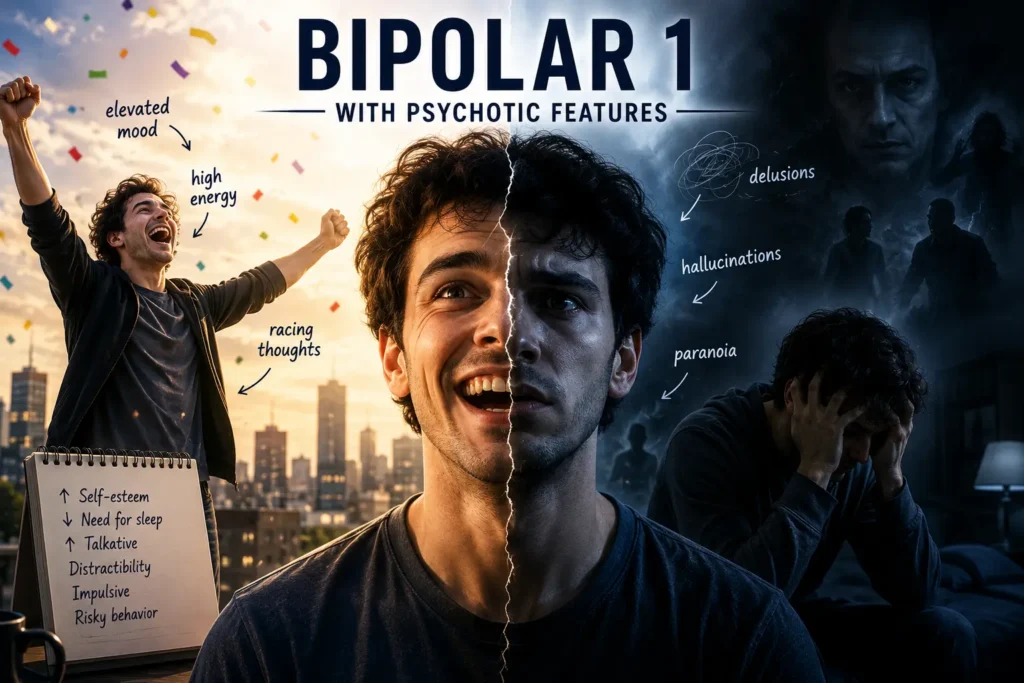
Bipolar 1 with psychotic features is a specifier used when a manic or depressive episode includes psychosis — hallucinations, delusions, or a significant break from shared reality. It doesn’t represent a separate diagnosis from bipolar 1 disorder; rather, it describes a more severe presentation of an episode. Psychotic features typically require prompt psychiatric treatment, often including hospitalization and antipsychotic medication, but they respond well to appropriate care.
Table of Contents
Introduction
Hearing that a manic or depressive episode involved psychosis can be frightening — both for the person experiencing it and for the people around them. Words like “hallucination” and “delusion” carry a lot of weight, and it’s natural to wonder what this means for the diagnosis, the treatment plan, and the road ahead.
Here’s the reassuring part: psychotic features in bipolar 1 disorder are a recognized, well-studied presentation, not a sign of a different or untreatable condition. Psychiatrists see this regularly, and there are clear, effective approaches to managing it.
This guide explains exactly what “bipolar 1 with psychotic features” means, what it looks like, how it’s diagnosed and treated, and how it differs from conditions like schizophrenia that also involve psychosis. If you’re still getting familiar with bipolar 1 mania generally, our guide on bipolar 1 manic episodes is a helpful companion to this one.
Key Takeaways
- “With psychotic features” is a DSM-5 specifier added to a manic or depressive episode, not a separate bipolar diagnosis.
- Psychosis in bipolar 1 can appear as hallucinations, delusions, or disorganized thinking, and can be mood-congruent or mood-incongruent.
- Psychotic features occur in a portion of bipolar 1 cases, most often during severe mania, though they can occur during depression too.
- Treatment typically combines mood stabilizers or antipsychotics with close psychiatric monitoring, and often requires short-term hospitalization.
- Psychotic features are treatable, and most people recover full clarity of thought once the episode resolves with treatment.
What Does “With Psychotic Features” Actually Mean?
In the DSM-5, “with psychotic features” is what’s known as a specifier — an add-on descriptor clinicians attach to a manic or major depressive episode when psychosis is present. It’s not a standalone diagnosis and it doesn’t replace the core bipolar 1 diagnosis; it simply describes the episode as more severe.
This matters because it shapes the treatment approach. An episode with psychotic features generally needs more intensive, faster intervention than one without, since impaired reality testing raises safety concerns and can make self-awareness of the illness harder during the episode itself.
For the general diagnostic criteria that apply to bipolar 1 overall, see our bipolar 1 diagnosis guide, which covers how a manic episode is confirmed before this specifier is even considered.
What Psychosis Looks Like During a Manic or Depressive Episode
Psychosis in bipolar 1 disorder generally shows up in one of two forms.
Hallucinations
Hallucinations involve perceiving something that isn’t actually there. In bipolar 1, this most commonly involves hearing voices, though other senses can be involved less commonly. During mania, these experiences often align with the person’s elevated, grandiose mood state.
Delusions
Delusions are fixed, false beliefs that persist despite evidence against them. In bipolar 1, delusions often reflect the person’s current mood state:
| Delusion Type | Common in Mania | Common in Depression |
| Grandiose (special powers, importance, mission) | Yes | Rare |
| Paranoid (being watched, targeted, or persecuted) | Sometimes | Sometimes |
| Guilt or worthlessness-based delusions | Rare | Yes |
| Somatic delusions (false beliefs about illness or the body) | Rare | Sometimes |
Mood-Congruent vs. Mood-Incongruent Psychosis
Clinicians further classify psychotic features based on whether the content matches the person’s mood.
| Type | Description | Example |
| Mood-congruent | Psychotic content matches the episode’s mood | Believing you have a special mission during a manic episode |
| Mood-incongruent | Psychotic content doesn’t match, or contradicts, the mood | Paranoid, persecutory beliefs occurring during a manic episode |
Mood-incongruent psychosis is sometimes associated with a somewhat more complex clinical picture and may prompt a psychiatrist to look more closely at the full diagnostic picture, since it can occasionally raise questions about overlapping conditions.
How Common Are Psychotic Features in Bipolar 1?
Psychotic features occur in a meaningful subset of bipolar 1 cases, particularly during severe manic episodes, according to research reviewed by the American Psychiatric Association and National Institute of Mental Health. They’re less common, but still possible, during depressive episodes. Having psychotic features doesn’t mean bipolar 1 is more “real” or more severe as a lifelong condition — it means that particular episode was more intense and required a correspondingly more intensive treatment response.
Bipolar 1 With Psychosis vs. Other Conditions
Because psychosis appears in multiple psychiatric conditions, distinguishing bipolar 1 with psychotic features from other diagnoses is an important part of accurate diagnosis.
| Condition | Key Distinguishing Feature |
| Bipolar 1 with psychotic features | Psychosis occurs only during manic or depressive episodes, not between them |
| Schizophrenia | Psychosis is persistent and not tied to distinct mood episodes |
| Schizoaffective disorder | Psychosis occurs both during and independent of mood episodes |
| Substance-induced psychosis | Symptoms are directly tied to intoxication or withdrawal and resolve once substances clear the system |
| Brief psychotic disorder | A short, standalone psychotic episode unrelated to an ongoing mood disorder |
The defining clue for bipolar 1 is timing: psychotic symptoms appear specifically during a manic or depressive episode and typically resolve as the mood episode resolves with treatment. If psychosis persists well outside of mood episodes, a psychiatrist will look closely at other diagnoses, including schizoaffective disorder.
What Causes Psychotic Features in Bipolar 1?
The exact mechanism isn’t fully understood, but psychotic features are thought to emerge from the same underlying neurobiological processes that drive bipolar 1 more broadly — genetic vulnerability, neurotransmitter activity (particularly dopamine), and brain regions involved in mood and perception, pushed to a more extreme state during a severe episode. Some risk factors associated with a higher likelihood of psychotic features include:
- A family history of psychotic symptoms or bipolar disorder with psychosis
- Earlier age of onset of bipolar 1
- More severe or longer untreated manic episodes
- Significant sleep deprivation during an episode
For a broader explanation of what drives bipolar 1 disorder overall, see our bipolar 1 causes guide.
How Bipolar 1 With Psychotic Features Is Diagnosed
Diagnosis follows the same clinical process used for bipolar 1 generally — a detailed psychiatric interview, mood history, and DSM-5 criteria — with additional attention paid to:
- The specific content and timing of hallucinations or delusions
- Whether psychotic symptoms occur only during mood episodes or persist independently
- Ruling out substance use, medical conditions, or neurological causes that can mimic psychosis
- Family history of psychotic or mood disorders
Because psychosis can affect a person’s insight into their own symptoms, input from family members or close contacts is often especially valuable during this evaluation. Our full bipolar 1 diagnosis guide walks through what the broader evaluation process looks like.
Treatment for Bipolar 1 With Psychotic Features
Treatment closely mirrors standard bipolar 1 treatment but is typically more urgent and intensive when psychosis is present.
| Treatment Component | Role |
| Antipsychotic medication | Often central to treatment, addressing psychotic symptoms directly |
| Mood stabilizers | Used alongside antipsychotics to address the underlying mood episode |
| Hospitalization | Common during acute psychotic episodes, primarily for safety and rapid stabilization |
| Close psychiatric monitoring | Needed to adjust medication as psychosis and mood symptoms resolve |
| Psychotherapy (after stabilization) | Supports recovery, insight, and relapse prevention once the acute episode passes |
Our bipolar 1 treatment guide covers medications and therapy approaches used across bipolar 1 disorder overall, most of which apply here as well, often with antipsychotic medication playing a more central role during psychotic episodes specifically.
What Recovery Looks Like
The reassuring reality is that psychotic features during a bipolar 1 episode are typically responsive to treatment, and most people regain full clarity of thought as the episode resolves. Once stabilized, ongoing maintenance treatment focuses on preventing future episodes — including future psychotic ones — through consistent medication and lifestyle strategies. Our bipolar disorder prognosis guide covers what long-term outcomes generally look like with consistent care.
Complications If Psychotic Features Go Untreated
Untreated psychosis during a manic or depressive episode raises meaningful safety concerns, including impaired judgment leading to dangerous decisions, difficulty maintaining relationships or employment, and a higher likelihood of hospitalization becoming necessary later rather than being used as an early, stabilizing intervention. Our bipolar disorder complications guide explores the broader risks of untreated bipolar 1.
Myths vs. Facts About Bipolar 1 With Psychotic Features
| Myth | Fact |
| “Psychotic features mean it’s actually schizophrenia.” | Bipolar 1 with psychotic features is distinct from schizophrenia; psychosis is tied specifically to mood episodes rather than being persistent. |
| “Psychosis means someone is dangerous.” | Most people experiencing psychosis are not violent; the greater risk is typically to their own safety and judgment. |
| “Once psychosis happens, it will always come back.” | With consistent treatment, many people never experience another psychotic episode. |
| “People with psychotic features can’t recover full insight.” | Most people regain complete clarity of thought once the episode resolves with treatment. |
For more misconceptions about the broader condition, see our bipolar disorder myths guide.
A Quick Checklist: Could This Be Psychosis?
- Is the person expressing beliefs that seem clearly disconnected from reality?
- Do they report hearing, seeing, or sensing things others don’t?
- Does this coincide with an existing period of unusually elevated or low mood?
- Has their speech become disorganized or difficult to follow?
- Are they acting on these beliefs in ways that could be unsafe?
Any “yes” here warrants prompt psychiatric evaluation. This is a starting checklist for a conversation with a professional, not a diagnostic tool on its own.
When to Seek Emergency Help
Psychotic features during a bipolar 1 episode should always be treated as urgent. Seek emergency medical attention immediately if:
- The person is acting on delusional beliefs in a way that endangers themselves or others
- There are any thoughts of self-harm or suicide
- The person is severely disorganized, agitated, or unable to care for themselves safely
- Paranoid beliefs are escalating toward confrontation or danger
Contact emergency services or go to the nearest emergency department rather than waiting for a scheduled psychiatric appointment. Early intervention during psychosis significantly improves both safety and recovery.
Frequently Asked Questions
Is bipolar 1 with psychotic features a separate diagnosis? No. It’s a specifier added to a manic or depressive episode within a bipolar 1 diagnosis, describing a more severe presentation rather than a distinct condition.
What’s the difference between bipolar 1 psychosis and schizophrenia? In bipolar 1, psychosis occurs specifically during manic or depressive episodes and typically resolves as the episode does. In schizophrenia, psychosis is persistent and not tied to mood episodes.
Can someone with bipolar 1 have psychosis without having severe mania? Psychotic features are most common during severe manic episodes but can also occur during major depressive episodes in bipolar 1.
Do all people with bipolar 1 eventually experience psychosis? No. Many people with bipolar 1 disorder never experience psychotic features, even over a lifetime with the condition.
How is bipolar 1 with psychotic features treated differently from regular bipolar 1? Treatment often places greater emphasis on antipsychotic medication and may require hospitalization more frequently, particularly during the acute phase, compared with episodes without psychosis.
Does having psychotic features mean a worse long-term outlook? Not necessarily. With consistent treatment, many people who experience psychotic features achieve the same long-term stability as those without them. Our prognosis guide covers this in more detail.
Can psychotic features happen during bipolar depression, not just mania? Yes, though it’s somewhat less common than during manic episodes. Depressive psychosis in bipolar 1 often involves themes of guilt, worthlessness, or physical illness.
Is medication for life required if someone has had psychotic features? Long-term maintenance treatment is typically recommended for bipolar 1 overall, and this is often especially emphasized after a psychotic episode, given the added safety considerations. This decision is always individualized with a psychiatrist.
Summary
Bipolar 1 with psychotic features describes a manic or depressive episode that includes hallucinations, delusions, or a significant break from reality. It’s a recognized, treatable presentation of bipolar 1 disorder — not a separate or more permanent diagnosis — and most people recover full clarity of thought with appropriate psychiatric care.
Because psychosis raises safety considerations, prompt treatment matters more here than with milder episodes. If you or someone you love is navigating this, understanding the full diagnosis process and available treatment options is the most useful next step toward stability and recovery.