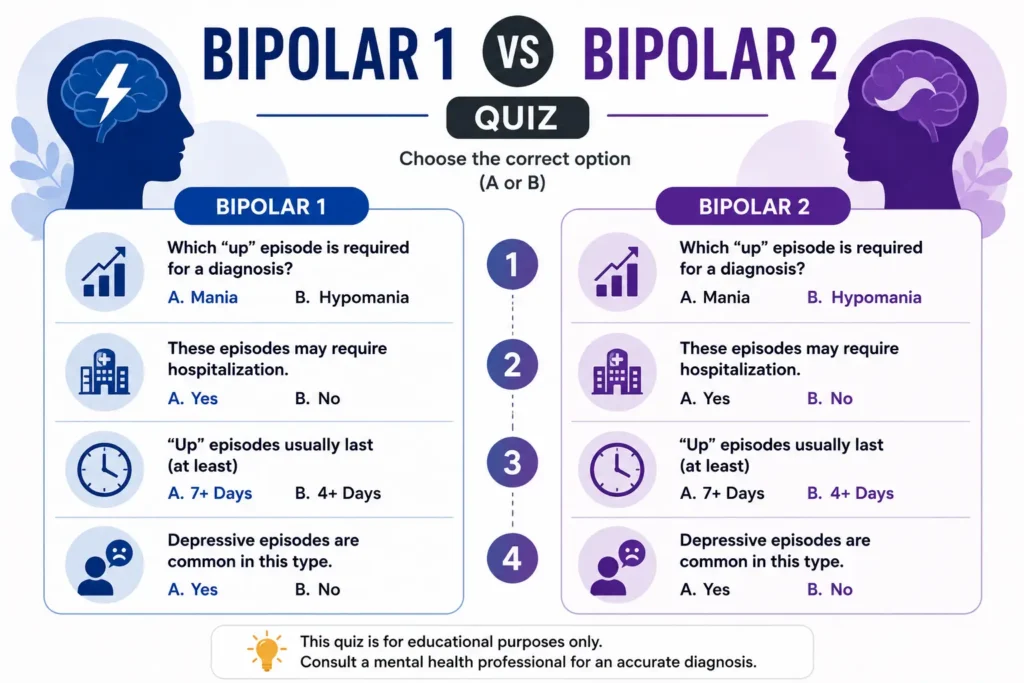
A bipolar 1 vs 2 quiz can be a useful way to organize your thoughts about mood, energy, and sleep patterns before talking to a professional, but it can’t tell you which type of bipolar disorder you have. Most quizzes you’ll find online are built around general bipolar spectrum symptoms, not the specific criteria that separate bipolar 1 from bipolar 2. If a quiz result feels relevant to you, the right next step is a conversation with a mental health professional, not a final answer.
Table of Contents
Key Takeaways
- Bipolar quizzes are self-reflection tools, not diagnostic tests.
- Most quizzes screen for general bipolar spectrum symptoms, not bipolar type specifically.
- Quiz questions typically focus on mood, energy, sleep, and behavior patterns over time.
- A “high-risk” quiz result means it’s worth talking to a professional, not that you have bipolar disorder.
- Quizzes work best when paired with honest reflection and, ideally, input from someone who knows you well.
- Distinguishing bipolar 1 from bipolar 2 always requires a clinical evaluation.
What People Are Really Looking For With a “Bipolar Quiz”
Searching for a bipolar quiz usually comes from one of two places: noticing something has shifted in your mood or energy and wanting a low-pressure way to explore it, or trying to make sense of patterns you’ve seen in someone you care about. Both are reasonable starting points. The important thing is understanding what a quiz format can realistically offer.
If you want the bigger picture of how bipolar 1 and bipolar 2 differ before taking any kind of self-assessment, our guide on bipolar 1 vs bipolar 2 walks through the core distinctions. And if you’re specifically comparing formal screening tools rather than casual quizzes, our guide on bipolar 1 vs 2 test covers validated instruments like the MDQ in more detail.
What a Bipolar Quiz Typically Asks About
Most bipolar-focused quizzes, whether built by mental health organizations or wellness sites, tend to cluster questions around a few core areas:
| Category | What It’s Exploring |
| Mood changes | Periods of unusually elevated, irritable, or low mood |
| Energy and activity levels | Bursts of high energy or activity, or periods of low motivation |
| Sleep patterns | Reduced need for sleep during “up” periods, oversleeping during depression |
| Thought patterns | Racing thoughts, difficulty concentrating, or slowed thinking |
| Behavior changes | Impulsivity, risk-taking, or withdrawal from usual activities |
| Duration and recurrence | Whether these patterns have happened more than once, and for how long |
Notice that these categories map closely to the mood episode criteria used in clinical diagnosis, just phrased more casually. That’s intentional — quizzes are meant to translate clinical concepts into everyday language so people can reflect on their own experience.
Why a Quiz Can’t Tell You Bipolar 1 From Bipolar 2
This is the part most quizzes gloss over: even a well-designed bipolar quiz generally can’t distinguish between bipolar 1 and bipolar 2, because that distinction depends on details a multiple-choice format struggles to capture.
- Duration matters precisely. Mania has to last at least a week (or any length if it led to hospitalization), while hypomania only needs four days. Quiz answers like “yes, I’ve had periods of high energy” don’t capture that difference.
- Severity is a judgment call. Whether an episode caused “significant impairment” versus a “noticeable change” is something a clinician evaluates by asking follow-up questions, not something you can self-rate on a 1–5 scale.
- Recall bias is real. People often forget or downplay hypomanic periods because they didn’t feel like a problem at the time, which can skew quiz answers.
- Overlapping conditions aren’t ruled out. ADHD, anxiety, and substance use can all produce quiz answers that look similar to hypomania or mania.
For a full explanation of how clinicians actually make this distinction, our guide on bipolar 1 vs 2 diagnosis breaks down the DSM-5 criteria and evaluation process step by step.
How to Use a Bipolar Quiz Responsibly
A quiz can still be genuinely useful if you approach it the right way. Here’s how to get real value out of one:
- Answer honestly, including things that felt positive at the time. Periods of high energy or confidence are easy to skip past, but they matter just as much as low periods.
- Think in terms of episodes, not single days. Clinically relevant patterns last days to weeks, not just a rough afternoon.
- Note approximate timing. When did these periods happen, how long did they last, and how often have they recurred?
- Consider getting a second perspective. A partner, close friend, or family member sometimes notices patterns you don’t, especially during elevated periods.
- Treat any result as a conversation starter, not a conclusion. Bring your answers to a professional rather than stopping at the quiz.
Self-Reflection Prompts (Not a Scored Quiz)
Rather than offering a scored quiz, which can create a false sense of certainty, it’s more useful to reflect honestly on questions like these before speaking with a professional:
- Have I had a period of at least several days where I needed much less sleep than usual but didn’t feel tired?
- Have I noticed times when my thoughts felt like they were racing, or I was talking faster than usual?
- Have there been stretches where I felt unusually confident, energetic, or “unstoppable,” followed later by a crash?
- Have I made impulsive decisions during a high-energy period that I later regretted?
- Have I had episodes of low mood lasting two weeks or more, with changes in sleep, appetite, or motivation?
- Have people close to me commented on noticeable shifts in my mood or behavior that I didn’t fully recognize myself?
If several of these feel familiar, that’s meaningful information to bring to a mental health professional, not something to try to score or diagnose on your own.
Bipolar Quiz vs Formal Screening Tool vs Clinical Diagnosis
| Casual Bipolar Quiz | Validated Screening Tool (e.g., MDQ) | Clinical Diagnosis | |
| Purpose | General self-reflection | Structured symptom screening | Confirmed diagnosis |
| Can identify bipolar type? | No | No | Yes |
| Based on DSM-5 criteria? | Loosely, if at all | Closely, but not identical | Directly |
| Requires professional review? | Recommended | Recommended | Performed by a professional |
| Where to learn more | This guide | Bipolar 1 vs 2 test | Bipolar 1 vs 2 diagnosis |
Myths vs Facts About Bipolar Quizzes
| Myth | Fact |
| “A quiz can tell me if I have bipolar 1 or bipolar 2.” | No quiz format can make that distinction. It requires a full clinical evaluation. |
| “If I don’t score high on a quiz, I’m fine.” | Quizzes can miss subtler patterns, especially hypomania, which is easy to underreport. |
| “Quizzes are just for fun and don’t mean anything.” | Well-designed quizzes, taken honestly, can surface patterns worth discussing with a professional. |
| “I should retake the quiz until I get a result that fits.” | Repeating a quiz to get a specific outcome undermines its usefulness. Honest, one-time reflection is more valuable. |
| “A low score means I never need to see a professional.” | If you’re still concerned about your mood or behavior, a low quiz score shouldn’t stop you from seeking an evaluation. |
For more common misunderstandings about bipolar disorder in general, see our bipolar disorder myths guide.
What to Do After Taking a Quiz
If your quiz answers or self-reflection point toward patterns that concern you, here’s a reasonable next step sequence:
- Write down the specific patterns you noticed, including rough timing and duration
- Mention any feedback from people close to you about your mood or behavior
- Schedule an appointment with a primary care provider, psychiatrist, or psychologist
- Ask specifically about a bipolar disorder evaluation, rather than describing it only as “stress” or “mood swings”
- Be prepared to discuss both elevated and low periods, since both matter for an accurate picture
Our guide on bipolar disorder diagnosis explains what to expect once you take that step, and our bipolar 1 vs 2 treatment guide covers what typically happens after a diagnosis is confirmed.
Warning Signs That Go Beyond a Quiz
Regardless of any quiz result, certain symptoms call for prompt professional attention rather than more self-assessment:
- Thoughts of suicide or self-harm
- Days without sleep combined with high energy or agitation
- Hallucinations or delusions
- Impulsive behavior that puts you or others at risk
- A sudden, dramatic shift in mood or functioning
Getting Emergency Help
If you or someone you know is in crisis or having thoughts of suicide, reach out for immediate support:
- 988 Suicide & Crisis Lifeline (US): call or text 988
- Emergency services: call 911 (US) or your local emergency number
- Outside the US, search for your country’s crisis line or go to the nearest emergency department
A quiz result, high or low, should never delay getting help in a crisis.
Frequently Asked Questions
Is there a reliable bipolar 1 vs 2 quiz online? Not one that can reliably distinguish between the two types. Even validated screening tools are designed to flag bipolar spectrum symptoms broadly, not to identify a specific type.
How accurate are free online bipolar quizzes? It varies widely. Quizzes based on validated instruments tend to be more consistent, but none are designed to replace a clinical evaluation, and informal quizzes can vary a lot in quality.
Should I take a bipolar quiz for someone else, like a partner or family member? Quizzes are designed for self-report, so answering on someone else’s behalf has real limits. It’s more helpful to share your observations directly with them and encourage a professional evaluation.
What’s the difference between a bipolar quiz and a bipolar test? In casual use, the terms are often interchangeable. More formally, “test” sometimes refers to validated screening instruments like the MDQ, while “quiz” often describes more informal self-assessments. Neither can determine bipolar type.
Can I take a quiz multiple times to track changes over time? Reflecting on your patterns periodically can be useful, but quizzes aren’t designed as ongoing monitoring tools. A mood journal, discussed with a professional, is generally more reliable for tracking changes.
Does a low quiz score mean I definitely don’t have bipolar disorder? No. A low score reduces the likelihood but doesn’t rule it out, especially for bipolar 2, where hypomanic symptoms are commonly underreported or overlooked.
Summary
A bipolar 1 vs 2 quiz is best understood as a starting point for reflection, not a diagnostic shortcut. These self-assessments can help you organize your thoughts about mood, energy, and sleep patterns, but they aren’t built to distinguish between bipolar 1 and bipolar 2, since that distinction depends on episode severity and duration that only a clinical evaluation can properly assess. If your reflection or quiz answers point toward a pattern that concerns you, the most useful next step is a conversation with a licensed mental health professional.
For a deeper look at what that professional evaluation involves, visit our guide on bipolar 1 vs 2 diagnosis, or start with our overview of bipolar 1 vs bipolar 2 if you’re still getting familiar with the basics.
This article is for educational purposes and is not a substitute for professional medical advice, diagnosis, or treatment. Self-assessment quizzes are not diagnostic tools. Always consult a qualified healthcare provider with questions about a medical condition.