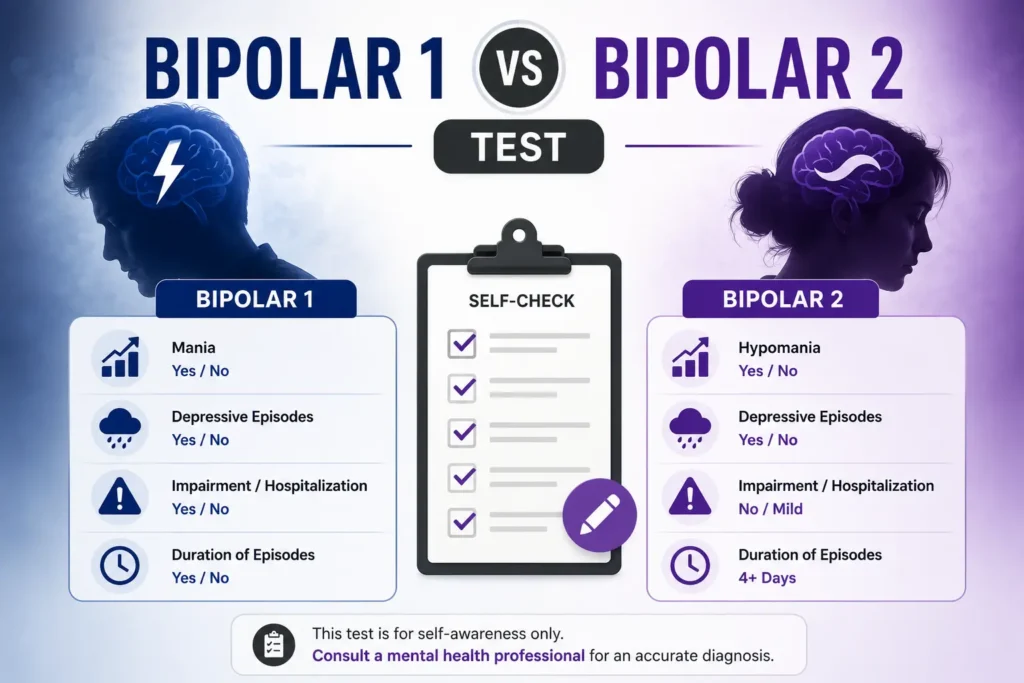
There isn’t a single Bipolar 1 vs 2 Test that can tell you whether you have bipolar 1 or bipolar 2 on its own. Screening tools like the Mood Disorder Questionnaire (MDQ) can flag symptoms worth discussing with a professional, but they’re designed to screen for bipolar spectrum symptoms in general, not to distinguish between bipolar 1 and bipolar 2. That distinction requires a full clinical evaluation, since it depends on the specific severity, duration, and history of your elevated mood episodes — details a self-report questionnaire can’t fully capture.
Table of Contents
Key Takeaways
- No online quiz or screening tool can officially diagnose bipolar 1 or bipolar 2.
- Screening tools are useful as a first step, not a final answer.
- The MDQ is one of the most studied bipolar screening tools, but it screens for bipolar spectrum symptoms broadly, not specific type.
- Distinguishing bipolar 1 from bipolar 2 requires a clinical evaluation of episode severity and duration.
- A positive screening result means “talk to a professional,” not “you have bipolar disorder.”
- A negative screening result doesn’t rule out bipolar disorder either, especially in bipolar 2, where hypomania is easy to underreport.
Why “Bipolar 1 vs 2 Test” Is a Common but Tricky Search
A lot of people searching for a bipolar test aren’t looking for general information — they want a fast way to figure out what’s going on with their mood. That’s understandable. But it’s worth being upfront about something important: no self-administered test, however well-designed, can reliably tell the difference between bipolar 1 and bipolar 2.
That’s not a limitation of any specific quiz. It’s built into how the two conditions are actually defined. If you want the full picture of how they differ before looking at testing, our guide on bipolar 1 vs bipolar 2 and our comparison chart lay out the core distinctions clearly.
Why a Self-Test Can’t Distinguish Bipolar 1 From Bipolar 2
The difference between bipolar 1 and bipolar 2 isn’t about which symptoms you have — it’s about how severe, how long, and how impairing your elevated episodes were. That kind of assessment depends on:
- Duration tracking over time. Mania (bipolar 1) must last at least a week, or any length if it led to hospitalization. Hypomania (bipolar 2) only needs to last four days. A one-time questionnaire can’t accurately capture this unless it’s paired with a detailed history.
- Severity and functional impact. The core distinction is whether the episode caused significant impairment or psychosis (bipolar 1) versus a noticeable but non-disabling change in functioning (bipolar 2). This requires clinical judgment, not a checklist score.
- Recall accuracy. People often don’t remember hypomanic or manic periods clearly, especially since those episodes can feel like increased energy or productivity rather than a “symptom.”
- Ruling out other explanations. A questionnaire can’t screen for thyroid conditions, substance use, or other psychiatric conditions that can mimic bipolar symptoms.
This is exactly why our bipolar 1 vs 2 diagnosis guide walks through what a full clinical evaluation actually involves — it’s a fundamentally different process from filling out a quiz.
What Screening Tools Actually Do
Screening tools serve a real and useful purpose: they help identify whether bipolar spectrum symptoms are present and worth discussing with a professional. They are not diagnostic instruments, and legitimate mental health organizations are consistent about saying so.
| Tool | What It Screens For | What It Can’t Do |
| Mood Disorder Questionnaire (MDQ) | Lifetime history of manic or hypomanic symptoms | Can’t distinguish bipolar 1 from bipolar 2, or confirm a diagnosis |
| Hypomania Checklist (HCL-32) | Symptoms specifically associated with hypomania | Can’t confirm diagnosis or replace clinical evaluation |
| General mental health screeners (e.g., those used by organizations like Mental Health America) | Broad mood symptom patterns that may warrant further evaluation | Not specific to bipolar type and not diagnostic on their own |
These tools are typically used by clinicians as a starting point in an evaluation, or by individuals to decide whether it’s worth bringing symptoms up with a doctor. According to guidance referenced by organizations including the NHS and the National Institute of Mental Health, any positive screening result should lead to a conversation with a healthcare provider, not a self-applied label.
What a Real Evaluation Adds That a Test Can’t
A structured clinical evaluation goes well beyond a symptom checklist. It typically includes:
- A full mood history, often covering months or years, not just current symptoms
- A review of how episodes affected functioning — work, relationships, sleep, judgment
- Input from someone close to the patient, since hypomanic or manic periods are often remembered differently by others
- Screening for co-occurring or overlapping conditions, like ADHD, anxiety, or substance use
- Clinical judgment applied to DSM-5 criteria, weighing duration, severity, and impact together, not just symptom presence
For the full breakdown of how this process works, see our guide on bipolar disorder diagnosis.
Bipolar 1 vs Bipolar 2: What a Clinician Looks For (Not a Quiz Score)
| What’s Being Assessed | Bipolar 1 Indicator | Bipolar 2 Indicator |
| Elevated episode type | Full manic episode | Hypomanic episode |
| Minimum duration | 7+ days (or hospitalized) | 4+ consecutive days |
| Impact on functioning | Significant impairment, may require hospitalization | Noticeable change, not severely impairing |
| Psychosis | Can occur | Never occurs |
| Depressive episode | Not required for diagnosis | Required for diagnosis |
| How it’s confirmed | Clinical history + evaluation | Clinical history + evaluation |
Notice that “how it’s confirmed” is identical for both. There’s no test-based shortcut around a proper evaluation.
Should You Take an Online Bipolar Screening Tool?
There’s nothing wrong with taking a validated screening questionnaire as a starting point, as long as you understand what it can and can’t tell you. It may be useful if:
- You’ve noticed patterns of mood, energy, or sleep changes that concern you
- You’re unsure whether what you’re experiencing is worth bringing up with a doctor
- You want a structured way to organize your symptoms before an appointment
It’s not useful, and can even be misleading, if you treat the result as:
- A confirmed diagnosis
- Proof that you don’t have bipolar disorder, if the score is low
- A way to determine which type you have
Checklist: Getting the Most Out of a Screening Result
If you’ve taken a screening tool and want to take the next step responsibly, this checklist can help:
- Write down your score or result, along with the specific symptoms it flagged
- Add context the tool didn’t ask about: how long symptoms lasted, how they affected your daily life
- Note any patterns others have pointed out to you, even if you didn’t notice them yourself
- Bring this information to a psychiatrist, psychologist, or your primary care provider
- Ask directly about a full bipolar evaluation, rather than just discussing “mood swings” in general terms
Myths vs Facts About Bipolar Testing
| Myth | Fact |
| “An online quiz can tell me if I have bipolar 1 or bipolar 2.” | No self-report tool can distinguish between the two types. That requires a clinical evaluation. |
| “If my screening score is low, I definitely don’t have bipolar disorder.” | Screening tools can miss cases, especially bipolar 2, where hypomania is often underreported. |
| “Screening tools are the same as a diagnosis.” | Screening tools flag symptoms worth discussing with a professional; they don’t diagnose anything. |
| “Only people in crisis need to get evaluated.” | Milder, non-crisis symptoms, especially hypomania, still warrant a professional evaluation. |
| “A high score guarantees a bipolar diagnosis.” | A high score suggests further evaluation is warranted, but conditions like ADHD or anxiety can also produce elevated scores. |
For a broader list of common misconceptions, see our bipolar disorder myths guide.
What Happens After a Positive Screening Result
If a screening tool suggests bipolar spectrum symptoms may be present, the next reasonable step is scheduling an appointment with a psychiatrist, psychologist, or your primary care provider to discuss a full evaluation. From there, if a diagnosis is confirmed, treatment planning typically follows. Our guides on bipolar 1 vs 2 treatment and bipolar disorder treatment explain what that process generally looks like.
It’s also worth understanding the symptoms clinicians are trained to distinguish between the two types, which our bipolar 1 vs 2 symptoms guide covers in more detail.
Warning Signs That Need Immediate Attention
Regardless of any screening result, certain symptoms should prompt urgent care rather than waiting to schedule a routine evaluation:
- Thoughts of suicide or self-harm
- Severe agitation or an inability to sleep for multiple days
- Hallucinations or delusions
- Reckless or dangerous behavior
- A sudden, severe shift in mood or functioning
Getting Emergency Help
If you or someone you know is in crisis or having thoughts of suicide, reach out for immediate support:
- 988 Suicide & Crisis Lifeline (US): call or text 988
- Emergency services: call 911 (US) or your local emergency number
- Outside the US, search for your country’s crisis line or go to the nearest emergency department
You don’t need a completed screening tool or a confirmed diagnosis to reach out for help.
Frequently Asked Questions
Is there an official bipolar 1 vs 2 test? No single test distinguishes between the two. Validated screening tools like the MDQ can flag bipolar spectrum symptoms in general, but determining the specific type requires a clinical evaluation.
How accurate are online bipolar tests? Validated tools used in clinical research, like the MDQ, have documented accuracy for screening purposes when used as intended. However, informal online quizzes that aren’t clinically validated can be unreliable, and none are designed to specify bipolar type.
Can a primary care doctor diagnose bipolar 1 or bipolar 2? A primary care doctor can screen for symptoms and make a referral, but a definitive diagnosis is usually made by a psychiatrist or clinical psychologist with experience evaluating mood disorders.
What should I do if I score high on a bipolar screening tool? Schedule an appointment with a mental health professional and bring your results with you. A high score is a signal to seek evaluation, not a diagnosis on its own.
Can a bipolar test rule out bipolar disorder completely? No. A low or negative screening result reduces the likelihood but doesn’t rule it out entirely, particularly for bipolar 2, where hypomanic symptoms are often underreported or missed.
Do I need to take a test before seeing a doctor? No. You can go directly to a mental health professional and describe your symptoms and history without taking a screening tool first. A screener can be a helpful organizing step, but it isn’t required.
Summary
A bipolar 1 vs 2 test, in the sense of a single tool that tells you your exact type, doesn’t exist. Validated screening questionnaires can flag bipolar spectrum symptoms worth discussing with a professional, but distinguishing bipolar 1 from bipolar 2 depends on a detailed clinical evaluation of episode severity, duration, and history. If you’re concerned about your symptoms, the most productive step is a conversation with a psychiatrist or licensed mental health professional, not a search for the “right” quiz.
To understand what that evaluation process looks like in more depth, visit our guide on bipolar 1 vs 2 diagnosis, or start from the beginning with our overview of bipolar 1 vs bipolar 2.
This article is for educational purposes and is not a substitute for professional medical advice, diagnosis, or treatment. Screening tools mentioned here are not a substitute for a clinical evaluation. Always consult a qualified healthcare provider with questions about a medical condition.