
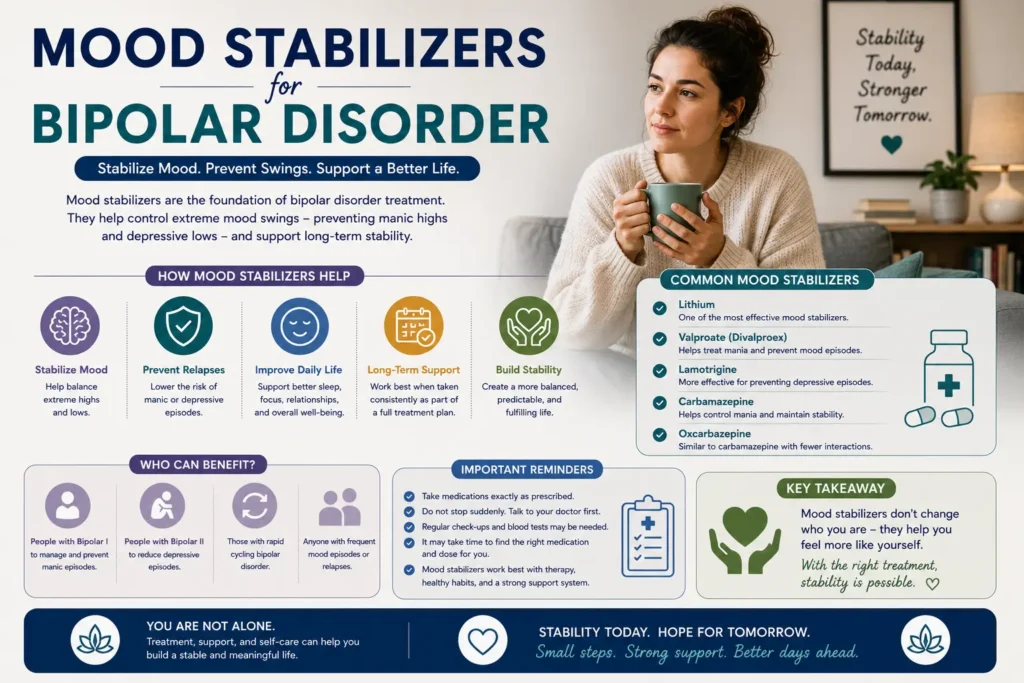
Mood Stabilizers for Bipolar Disorder: Mood stabilizers are medications that help reduce the frequency and severity of mood episodes in bipolar disorder. Lithium is one of the oldest and most extensively studied options, while medications such as valproate, lamotrigine, and carbamazepine may also be used depending on the person’s symptoms, medical history, and whether mania or depression is the primary concern.
Table of Contents
Introduction
“Mood stabilizer” is a term that gets used loosely, but it refers to something specific: a medication that keeps mood within a workable range in both directions, rather than just lifting a low mood or calming an agitated one.
That distinction matters in bipolar disorder, where treating one mood state carelessly can worsen the other — an antidepressant taken alone, for example, can push someone into mania. Mood stabilizers are built to avoid that problem.
This guide focuses specifically on how mood stabilizers work, what separates one from another, and what long-term use actually involves. For a broader overview of all bipolar medication classes, including antipsychotics and antidepressants, see our bipolar medications guide. If you’re newer to the diagnosis itself, start with what bipolar disorder is and bipolar disorder diagnosis.
Key Takeaways
- Mood stabilizers treat and prevent both manic and depressive episodes — that dual action is what defines the category.
- Lithium is the most extensively studied mood stabilizer and is specifically linked to reduced long-term suicide risk.
- Several mood stabilizers are technically anticonvulsant medications, originally developed for epilepsy.
- Not all mood stabilizers work equally well for mania and depression — lamotrigine, for instance, is stronger for depression prevention than for treating mania.
- Regular bloodwork is a standard part of care for several mood stabilizers, not a sign of a problem.
What Makes a Medication a “Mood Stabilizer”?
A true mood stabilizer does two things: it treats an active mood episode (mania, depression, or a mixed state), and it reduces the risk of future episodes in either direction. This dual-direction effect is what separates mood stabilizers from medications that only treat depression or only treat mania.
This is also why mood stabilizers sit at the center of long-term bipolar management rather than being used only during a crisis. According to the National Institute of Mental Health (NIMH), long-term medication management is central to reducing relapse in bipolar disorder — and mood stabilizers are typically the medications built specifically for that ongoing role.
The Main Mood Stabilizers Used in Bipolar Disorder
| Medication | Drug Class | Strongest For | Requires Blood Monitoring |
| Lithium | Classic mood stabilizer | Mania and depression prevention; suicide risk reduction | Yes |
| Valproate (valproic acid) | Anticonvulsant | Acute mania, mixed episodes | Yes |
| Lamotrigine | Anticonvulsant | Depressive episode prevention | Not routinely |
| Carbamazepine | Anticonvulsant | Mania, especially treatment-resistant cases | Yes |
Lithium
Lithium is the original mood stabilizer and remains a first-line option for many people with Bipolar 1. It’s effective for both manic and depressive episodes and is the only bipolar medication specifically associated with reduced long-term suicide risk, according to the American Psychiatric Association.
Lithium has a narrow therapeutic window — the gap between an effective dose and a dose that causes side effects is relatively small. This is why lithium levels are checked with regular blood tests, along with periodic kidney and thyroid function tests, since lithium is processed by the kidneys and can affect thyroid function over time.
Valproate
Valproate acts quickly for acute mania and mixed episodes, which makes it a common choice when symptoms need to be brought under control fast. It requires blood monitoring for both drug levels and liver function, since the liver metabolizes it.
Valproate carries specific risks during pregnancy and is generally avoided for people who are pregnant or planning to become pregnant, which is a conversation to have directly with a psychiatrist well before conception when possible.
Lamotrigine
Lamotrigine stands out because it’s notably better at preventing depressive episodes than manic ones, which makes it a frequent choice for Bipolar 2, where depression tends to dominate the illness course. It doesn’t require the routine blood-level monitoring that lithium and valproate do.
Its dosing schedule is unusually slow and deliberate — increased gradually over weeks — because rapid increases raise the risk of a rare but serious skin reaction called Stevens-Johnson syndrome. Skipping doses and then “catching up” with a higher dose is specifically dangerous with this medication and should never be done without medical guidance.
Carbamazepine
Carbamazepine is typically used when other mood stabilizers haven’t worked well enough on their own. It requires monitoring of blood counts and liver function, and it can interact with a wide range of other medications, so it’s important that every prescriber involved in someone’s care knows it’s being used.
Mood Stabilizers vs. Other Bipolar Medications
| Category | Main Role | Example |
| Mood stabilizers | Prevent and treat both mania and depression long-term | Lithium, lamotrigine |
| Atypical antipsychotics | Often faster-acting for acute mania; some treat depression too | Quetiapine, aripiprazole |
| Antidepressants | Used cautiously, almost always with a mood stabilizer | SSRIs |
Mood stabilizers and antipsychotics are frequently combined, especially during an acute manic episode, where an antipsychotic may act faster while a mood stabilizer is titrated to an effective long-term dose. Our full bipolar medications guide covers how all three categories work together.
How Long Do Mood Stabilizers Take to Work?
| Medication | Time to Initial Effect | Time to Full Effect |
| Lithium | 1–3 weeks | Several months |
| Valproate | Days to about a week (for acute mania) | Weeks |
| Lamotrigine | Several weeks (due to slow titration) | 2–3 months |
| Carbamazepine | 1–2 weeks | Several weeks |
Because full effects build gradually, judging a mood stabilizer as “not working” too early is a common and avoidable mistake — most require weeks of consistent use before their full benefit is clear.
Side Effects and What They Usually Mean
| Medication | Common Side Effects | When to Contact a Doctor Promptly |
| Lithium | Tremor, increased thirst, mild nausea | Persistent vomiting, severe tremor, confusion, slurred speech (possible toxicity) |
| Valproate | Drowsiness, weight gain, hair thinning | Signs of liver problems (yellowing skin/eyes, severe fatigue) |
| Lamotrigine | Headache, mild nausea, dizziness | Any new rash — always stop and call your doctor immediately |
| Carbamazepine | Dizziness, drowsiness, mild nausea | Fever, sore throat, unusual bruising (possible blood count changes) |
Most early side effects settle within the first few weeks. Any of the “contact promptly” symptoms above warrant same-day medical attention rather than waiting for a routine appointment.
Myths vs. Facts About Mood Stabilizers
| Myth | Fact |
| “Mood stabilizers are just sedatives.” | They work through distinct mechanisms that regulate mood circuitry, not simple sedation, though mild drowsiness can occur early on. |
| “If it’s not working in a week, switch it.” | Most mood stabilizers take weeks to reach full effect — early switching often means never seeing the real benefit. |
| “Lithium is outdated.” | Lithium remains a first-line treatment in major clinical guidelines and is uniquely linked to reduced suicide risk. |
| “You can stop once you feel better.” | Feeling stable is often evidence the medication is working — stopping it is one of the leading causes of relapse. |
See our broader bipolar disorder myths guide for more.
Monitoring: What Ongoing Care Looks Like
Mood stabilizer treatment typically includes periodic check-ins beyond the initial prescription:
- Blood level checks for lithium, valproate, and carbamazepine, to keep dosing in the effective and safe range
- Kidney and thyroid function tests for long-term lithium use
- Liver function tests for valproate and carbamazepine
- Weight and general health check-ins, especially when a mood stabilizer is combined with an antipsychotic
This is standard, ongoing care — not a signal that treatment isn’t working.
Mood Stabilizers and Pregnancy
Several mood stabilizers, particularly valproate, carry specific risks during pregnancy and require careful planning with both a psychiatrist and an OB-GYN. Lamotrigine is generally considered one of the better-studied options during pregnancy compared to some alternatives, but every decision here needs to be individualized. Never stop or switch a mood stabilizer during pregnancy without direct medical guidance — untreated bipolar disorder also carries real risks that need to be weighed against medication risks.
Checklist: Getting the Most From Mood Stabilizer Treatment
- Take the medication at consistent times, exactly as prescribed
- Keep all scheduled bloodwork appointments
- Track mood and side effects in a simple log
- Report any new rash immediately if taking lamotrigine
- Never stop abruptly — tapering, when appropriate, is done under medical supervision
- Tell every prescriber and pharmacist about all medications and supplements being taken
- Raise pregnancy plans with your psychiatrist as early as possible
Warning Signs and Emergency Help
Seek urgent medical attention for:
- Signs of lithium toxicity — persistent vomiting, severe tremor, confusion, or slurred speech
- Any new rash while taking lamotrigine
- Signs of liver problems — yellowing skin or eyes, severe fatigue, abdominal pain
- Thoughts of suicide or self-harm
If there’s any risk to safety, seek emergency care immediately or contact the 988 Suicide & Crisis Lifeline (in the U.S.), available 24/7 by call or text.
Frequently Asked Questions
What’s the difference between a mood stabilizer and an antipsychotic? Mood stabilizers are built for long-term prevention of both manic and depressive episodes, while atypical antipsychotics often act faster for acute mania and are sometimes used for bipolar depression too. The two are frequently combined rather than used as substitutes for each other.
Is lithium still commonly prescribed? Yes — lithium remains a first-line treatment in many clinical guidelines, largely because of its long track record and its specific link to reduced suicide risk.
Can mood stabilizers be combined with each other? Sometimes, particularly in treatment-resistant cases, though this is managed carefully by a psychiatrist because of interaction and side-effect considerations.
Do mood stabilizers work for Bipolar 2 the same way they do for Bipolar 1? The same medications are often used, but the emphasis shifts — since Bipolar 2 involves hypomania rather than full mania and tends to feature more depressive episodes, medications like lamotrigine that are stronger for depression prevention are frequently favored. See Bipolar 1 vs 2 treatment for a full comparison.
Why do I need blood tests while taking a mood stabilizer? Several mood stabilizers have a narrow gap between an effective dose and one that causes side effects, so blood tests keep dosing safe and effective — this is routine, ongoing care rather than a sign of a problem.
Summary
Mood stabilizers are the medications built specifically to manage bipolar disorder in both directions — reducing the risk of mania and depression alike, rather than treating one mood state at the expense of the other. Lithium remains the most established option, while anticonvulsant-based mood stabilizers like lamotrigine, valproate, and carbamazepine offer alternatives suited to different symptom patterns. Because full effects build gradually and monitoring is part of standard care, working closely with a psychiatrist over time — not switching medications too quickly — is usually what leads to the best outcome.
For the full picture of how mood stabilizers fit alongside antipsychotics, antidepressants, and therapy, see our bipolar medications guide, and visit our bipolar treatment FAQs for more common questions.
This article is for educational purposes only and isn’t a substitute for personalized medical advice. Always consult a licensed psychiatrist or healthcare provider before starting, stopping, or adjusting any medication.