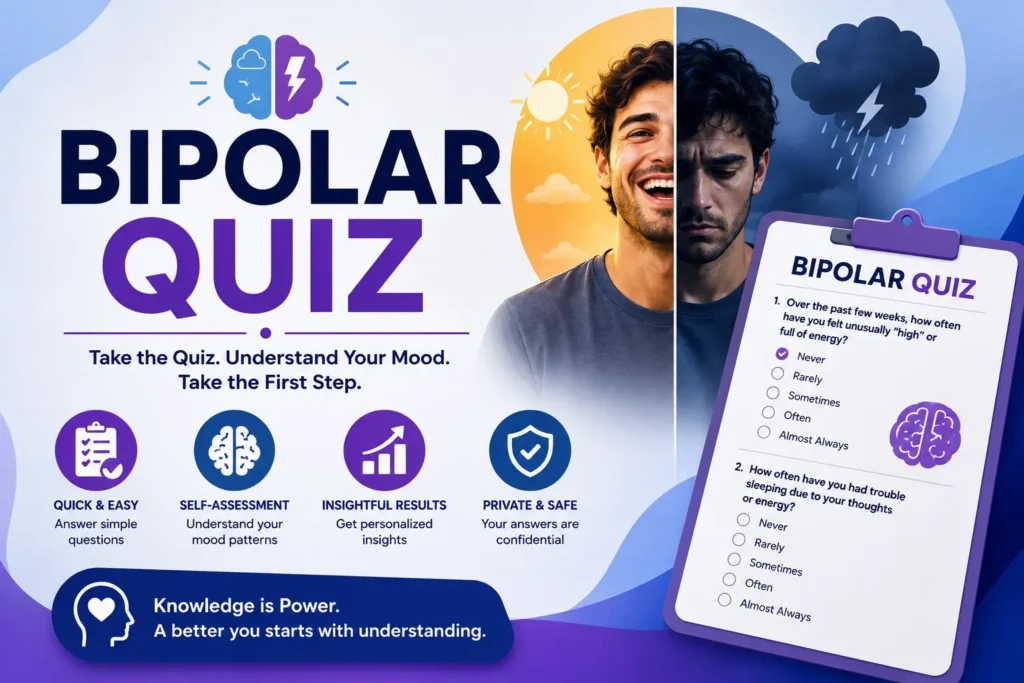
A bipolar quiz is a short self-screening tool. It asks about changes in your mood, energy, sleep, and behavior. It cannot diagnose bipolar disorder. Only a licensed mental health professional can do that, using a full clinical interview. This guide gives you an original screening quiz, explains what your score might mean, and walks you through what to do next.
Table of Contents
Key Takeaways
- A bipolar quiz screens for patterns, not a diagnosis.
- It checks for two things: manic/hypomanic symptoms and depressive symptoms.
- A high score means “talk to a doctor,” not “you have bipolar disorder.”
- Some symptoms overlap with ADHD, anxiety, and normal stress, which is why professional evaluation matters.
- If you’re having thoughts of harming yourself, skip the quiz and get help right now (details below).
What Is a Bipolar Quiz, Really?
Let’s clear something up first. A “bipolar quiz” is not a lab test. It’s not an X-ray. It’s a list of questions about your recent mood, energy, and behavior.
Think of it like a smoke detector, not a fire investigation. A smoke detector tells you “something might be wrong, go check.” It doesn’t tell you what caused the fire or how bad it is. A bipolar quiz works the same way.
These self-screening tools are built from common patterns seen in bipolar disorder symptoms, based on the diagnostic framework used by mental health professionals (DSM-5, published by the American Psychiatric Association). But answering “yes” to several questions does not mean you have the condition. It means it’s worth talking to someone qualified.
What a bipolar quiz can do:
- Help you notice patterns you might not have connected before.
- Give you language to describe what you’re feeling to a doctor.
- Point you toward the right next step.
What a bipolar quiz cannot do:
- Diagnose you.
- Tell you which type of bipolar disorder you might have.
- Replace a conversation with a psychiatrist or psychologist.
Take the Bipolar Screening Quiz
This checklist looks at two mood states: episodes of unusually high energy (mania or hypomania) and episodes of low mood (depression). Answer based on the last 12 months, not just how you feel today.
Part 1: Mood, Energy & Behavior Changes
Think about a period lasting several days where you felt noticeably different from your usual self. During that time, did you:
- Feel unusually upbeat, wired, or “on top of the world,” for no clear reason?
- Need much less sleep than usual, without feeling tired the next day?
- Talk faster than usual, or feel like your thoughts were racing?
- Feel unusually confident, like you could do anything, or take on far more than usual?
- Get distracted easily, jumping from one idea or task to another?
- Become more active than usual, physically restless, or unable to sit still?
- Do things that were out of character and risky, like spending large amounts of money, driving recklessly, or making impulsive decisions?
- Notice that people close to you were concerned or told you that you seemed “too much” or “not yourself”?
Part 2: Low Mood & Depressive Changes
Now think about periods, lasting two weeks or more, where you felt the opposite. During that time, did you:
- Feel sad, empty, or hopeless most of the day, nearly every day?
- Lose interest in things you normally enjoy?
- Sleep far more or far less than usual?
- Feel tired or low on energy most days?
- Have trouble concentrating or making decisions?
- Feel worthless or overly guilty about things?
- Have thoughts about death or that life isn’t worth living?
Scoring guide:
| Your Answers | What It Suggests |
| “Yes” to 4 or more items in Part 1 | Possible history of manic or hypomanic-type episodes. Worth discussing with a professional. |
| “Yes” to 5 or more items in Part 2 | Possible history of depressive-type episodes. Worth discussing with a professional. |
| “Yes” to items in both Part 1 and Part 2 | This pattern — mood swinging between high and low states — is worth a full evaluation for bipolar disorder, rather than assuming it’s one or the other. |
| “Yes” to item 15, regardless of other answers | See the Emergency Help section below right away. |
This scoring guide is a general guide, not a diagnostic cutoff. Clinicians weigh how long symptoms lasted, how much they disrupted your daily life, and whether other causes (like thyroid issues, substance use, or another mental health condition) could explain them.
What Your Results Actually Mean
If you scored low on both parts: Your current symptoms are less likely to match a bipolar pattern, but a quiz can’t rule anything out. If you’re still concerned, talk to a doctor anyway.
If you scored high on Part 1 only: This leans toward manic or hypomanic-type symptoms. A professional will look at how long these episodes lasted and how disruptive they were to sort out whether they match bipolar disorder criteria.
If you scored high on Part 2 only: Depressive symptoms alone are common in several conditions, not just bipolar disorder. This is worth checking with a doctor, who can also screen for major depressive disorder.
If you scored high on both: This combination — highs and lows — is the core pattern clinicians look for. It doesn’t confirm bipolar disorder, but it’s a strong reason to book a full evaluation soon.
Bipolar 1 vs Bipolar 2: Why One Quiz Doesn’t Sort This Out
A common mistake is expecting a quiz to tell you whether you have Bipolar I or Bipolar II. It can’t, and here’s why in one sentence: the difference between the two comes down to the severity and length of manic symptoms, which really needs a clinical interview to assess properly.
If your results suggest a bipolar-type pattern, the dedicated guides on Bipolar 1 vs Bipolar 2 differences and the Bipolar 1 vs 2 quiz go into that distinction in depth. This article focuses only on general bipolar screening.
Common Mistakes People Make With Online Quizzes
Mistake 1: Taking the quiz during a single bad day. A rough day doesn’t equal a mood episode. Clinicians look at sustained changes lasting days (mania/hypomania) or weeks (depression), not a single afternoon.
Mistake 2: Assuming a high score is a diagnosis. A quiz score is a conversation starter, not a verdict.
Mistake 3: Ignoring other possible causes. Thyroid conditions, sleep disorders, certain medications, and substance use can all produce mood symptoms that look similar to bipolar disorder. A professional evaluation checks for these.
Mistake 4: Comparing yourself to a family member’s diagnosis. Bipolar disorder does run in families, and the causes of bipolar disorder do include genetic factors. But a relative’s diagnosis doesn’t confirm yours; it’s a risk factor, not proof.
Myths vs Facts
| Myth | Fact |
| “A quiz can diagnose bipolar disorder.” | Only a licensed clinician can diagnose it, through interviews and clinical history. |
| “Bipolar disorder just means mood swings.” | It involves distinct episodes of mania/hypomania and depression, not everyday ups and downs. |
| “If I don’t feel manic right now, I can’t have bipolar disorder.” | Depressive episodes are often the most common phase people experience, and some people seek help during a low period, not a high one. |
| “Only adults get bipolar disorder.” | It can appear in adolescents too, though diagnosis in younger people takes extra care to rule out other causes. |
| “Bipolar disorder isn’t that common.” | The National Institute of Mental Health (NIMH) estimates about 2.8% of U.S. adults experience it in a given year, and about 4.4% at some point in their lifetime. |
Online Quiz vs Professional Diagnosis: A Quick Comparison
| Feature | Online Bipolar Quiz | Professional Diagnosis |
| Time required | 5–10 minutes | One or more appointments |
| Who conducts it | You, alone | Psychiatrist, psychologist, or trained clinician |
| Basis | General symptom checklist | Full clinical interview, history, and DSM-5 criteria |
| Can it diagnose? | No | Yes |
| Cost | Usually free | Varies, often covered by insurance |
| Best used for | Deciding whether to seek help | Confirming a diagnosis and planning treatment |
What Happens After You Take a Bipolar Quiz
If your results suggest a bipolar-type pattern, here’s a realistic next-step checklist:
- Write down specifics. When did the highs or lows happen? How long did they last? What changed in your daily life?
- Book an appointment with a primary care doctor, psychiatrist, or psychologist. A primary care doctor can also rule out physical causes and refer you onward.
- Bring your quiz results as a starting point for the conversation, not as a diagnosis to present.
- Ask about the full evaluation process. This typically covers your symptom history, family history, and sometimes basic health tests to rule out other causes. The bipolar disorder diagnosis guide covers this in detail.
- Ask about treatment options if a diagnosis is confirmed. The bipolar disorder treatment guide explains what this can include.
Risk Factors Worth Mentioning to a Doctor
You don’t need any of these to have bipolar disorder, and having them doesn’t guarantee it either. But mentioning them helps a clinician build a fuller picture:
- A close family member with bipolar disorder or major depression.
- A first episode of major depression before age 25.
- Periods of unusually low sleep need that didn’t feel exhausting.
- Past experiences of racing thoughts or impulsive spending/behavior during a “high” period.
- Current high stress, major life changes, or disrupted sleep patterns, which can trigger episodes in people already prone to them.
Warning Signs That Need Immediate Attention
Some symptoms are urgent. Don’t wait for a quiz score or an appointment if you notice:
- Thoughts of suicide or not wanting to be alive.
- A plan or intent to harm yourself.
- Severe confusion, or seeing/hearing things others don’t (psychosis).
- Extreme, dangerous risk-taking that could hurt you or someone else.
Get help right now:
- In the U.S., call or text 988 (Suicide & Crisis Lifeline), available 24/7.
- If there’s immediate danger, call emergency services (911 in the U.S.) or go to the nearest emergency room.
- Outside the U.S., search for your country’s crisis helpline, or contact local emergency services.
Frequently Asked Questions
1. Is this bipolar quiz an official diagnostic test? No. It’s a self-screening tool based on common symptom patterns. Only a licensed clinician can diagnose bipolar disorder.
2. How accurate are online bipolar quizzes? They can help flag patterns worth discussing with a doctor, but they aren’t validated diagnostic instruments on their own. Accuracy depends heavily on honest, careful self-reporting.
3. Can this quiz tell me if I have Bipolar 1 or Bipolar 2? No. That distinction depends on the severity and duration of manic symptoms, which needs a clinical interview. See the dedicated Bipolar 1 vs Bipolar 2 chart for how professionals tell them apart.
4. I scored high. Does that mean I definitely have bipolar disorder? No. It means your answers match patterns clinicians look for, which is a good reason to get a full evaluation, not a confirmed diagnosis.
5. Can I have bipolar disorder without ever feeling “manic”? Some people mainly experience hypomania, a milder form of elevated mood, along with depressive episodes. This pattern is closer to Bipolar II. A professional can clarify which pattern fits.
6. What’s the difference between mania and hypomania? Mania is more severe, often disrupts daily functioning significantly, and can include psychosis. Hypomania is milder and shorter. The mania vs hypomania guide breaks this down further.
7. Should teenagers take a bipolar quiz too? Mood symptoms in teens can look different from adults, and other conditions are common at that age too. If you’re concerned about a teenager, involve a pediatrician or child psychiatrist rather than relying on a self-quiz alone.
8. What should I do with my quiz results? Bring them to a doctor’s appointment as a starting point for discussion, along with specific examples of when and how your mood or energy changed.
9. Can stress cause bipolar-like symptoms without it being bipolar disorder? Yes. High stress, poor sleep, certain medications, and substance use can all produce mood changes that resemble bipolar symptoms. This is exactly why a full evaluation matters.
10. Where can I learn more about bipolar disorder symptoms in detail? See our full guide on bipolar disorder symptoms, which covers manic, hypomanic, and depressive symptoms individually.
Summary
A bipolar quiz is a starting point, not a diagnosis. This screening tool looks at two patterns: manic/hypomanic symptoms and depressive symptoms, and gives you a general sense of whether it’s worth a professional evaluation. If your answers point toward a bipolar-type pattern, the next real step is a conversation with a doctor or psychiatrist, not a final verdict from a quiz. And if you’re having thoughts of self-harm, reach out for help right now, using the crisis resources above, rather than waiting on any quiz result.
This article is for general educational purposes and does not replace professional medical advice, diagnosis, or treatment. If you’re concerned about your mental health, please consult a qualified healthcare provider.