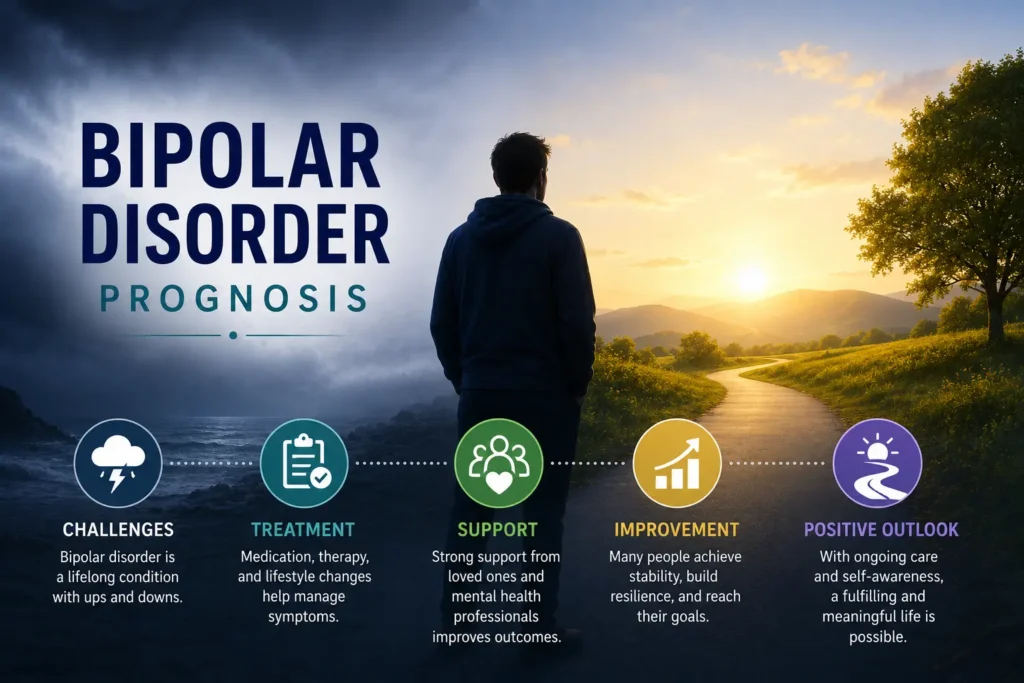
Bipolar Disorder Prognosis: Bipolar disorder is a lifelong condition, but it’s also a highly manageable one. With consistent treatment—including medication, therapy, and lifestyle structure—most people experience long stretches of stability and go on to build full, meaningful lives. The Bipolar Disorder Prognosis is not fixed at diagnosis. Instead, it often improves with early intervention, ongoing treatment, and long-term symptom management. The prognosis shifts, often for the better, based on how early treatment starts and how consistently it’s followed.
If you or someone you love was just diagnosed, the word “prognosis” can feel heavy. This guide breaks down what actually influences long-term outcomes, what recovery realistically looks like, and what you can do today to tilt the odds in your favor.
Table of Contents
Key Takeaways
- Bipolar disorder is a chronic condition, but chronic doesn’t mean unmanageable — many people achieve long periods of remission.
- Prognosis depends heavily on treatment adherence, early diagnosis, and support systems, not just symptom severity alone.
- Untreated bipolar disorder tends to worsen over time, with episodes becoming more frequent or severe (a pattern researchers call “kindling”).
- Life expectancy can be affected, mainly through elevated risks of cardiovascular disease and suicide — both of which are addressable with proper care.
- There’s a meaningful difference between bipolar 1 and bipolar 2 in terms of episode pattern, though long-term outlook depends more on management than subtype alone.
- Recovery is best understood as functional stability, not the absence of the condition.
Understanding Prognosis: What Are We Actually Predicting?
“Prognosis” simply means the expected course of a condition over time — how it’s likely to progress, respond to treatment, and affect daily life. For bipolar disorder, that course is highly individual. Two people with the same diagnosis can have very different trajectories depending on when they were diagnosed, how they respond to medication, and what support they have around them.
It helps to separate three distinct questions people often lump together:
- Will the condition go away? No — bipolar disorder is currently understood as a lifelong condition rather than one that’s “cured.” (More on what this means practically below.)
- Can symptoms be controlled long-term? Yes, for most people, with the right treatment plan.
- Will it shorten my life or limit what I can do? Not necessarily — but untreated bipolar disorder does carry real health risks worth taking seriously.
Understanding these separately makes the outlook feel less like a life sentence and more like a health condition you actively manage — similar in that sense to diabetes or hypertension.
What the Research Actually Shows About Long-Term Outcomes
Large longitudinal studies — research that follows people with bipolar disorder over many years — consistently point to a few patterns:
- Episodes tend to recur, but the frequency and severity can be significantly reduced with consistent treatment.
- People who start treatment early, after their first or second episode, generally have better long-term stability than those who go undiagnosed for years.
- Functional recovery (returning to work, relationships, daily routines) often takes longer than symptom recovery. Someone can feel emotionally stable months before they feel fully “back” at work or socially.
- Mixed episodes and rapid cycling (four or more mood episodes within a year) are associated with a more difficult course and typically need more intensive management.
The American Psychiatric Association’s DSM-5 and major organizations like the National Institute of Mental Health (NIMH) and the World Health Organization (WHO) all classify bipolar disorder as a chronic, recurrent condition — but “chronic” in psychiatry doesn’t mean “constant.” It means the underlying vulnerability persists even during periods of complete wellness.
Factors That Shape Bipolar Disorder Prognosis
No single factor determines outlook. It’s a combination of biological, behavioral, and social elements.
| Factor | Effect on Prognosis |
| Early diagnosis and treatment | Strongly improves long-term stability |
| Medication adherence | One of the biggest predictors of relapse prevention |
| Type of bipolar disorder | Bipolar 1 and Bipolar 2 have different episode patterns; see our Bipolar 1 vs Bipolar 2 guide |
| Presence of psychosis | Associated with more complex management, though still treatable |
| Substance use | Worsens outcomes and increases relapse risk significantly |
| Co-occurring conditions (anxiety, ADHD, thyroid issues) | Can complicate treatment but are manageable when addressed directly |
| Sleep regularity | Poor sleep is one of the most reliable relapse triggers |
| Social and family support | Strongly associated with better long-term functioning |
| Stress levels | High chronic stress increases episode frequency |
| Access to consistent care | Gaps in treatment are linked to more severe relapses |
If you’re unsure which category you or a loved one fits, our guide on types of bipolar disorder breaks down the distinctions in plain language.
Does Bipolar Disorder Get Worse Over Time?
This is one of the most common — and most anxiety-inducing — questions people ask after diagnosis. The honest answer: it depends almost entirely on whether the condition is treated.
Left untreated, bipolar disorder can follow a pattern researchers describe using the “kindling” model — similar to how a small fire eventually needs less fuel to catch. Each untreated episode can slightly lower the threshold for the next one, meaning episodes may become more frequent or harder to interrupt over time.
Treated bipolar disorder tells a very different story. With mood stabilizers, therapy, and routine, many people find that episodes become less frequent, shorter, and easier to catch early — sometimes years apart rather than months apart.
This is why early, consistent care isn’t just about comfort in the present — it’s directly tied to how the condition behaves in the future.
Bipolar Disorder and Life Expectancy
This is a sensitive but important topic to address honestly. Research has found that people living with bipolar disorder face, on average, some reduction in life expectancy compared to the general population. This isn’t because of the mood episodes themselves — it’s driven by two main, largely preventable factors:
- Cardiovascular and metabolic health. Higher rates of heart disease, obesity, and diabetes are seen in people with bipolar disorder, partly linked to medication side effects, lifestyle disruption during episodes, and reduced access to routine physical healthcare.
- Suicide risk. Bipolar disorder carries a meaningfully elevated suicide risk compared to the general population, particularly during depressive and mixed episodes.
Here’s the encouraging part: both of these risk factors are addressable. Regular physical health check-ups, metabolic monitoring while on certain medications, and consistent mental health treatment measurably reduce these risks. This is a major reason why psychiatrists often coordinate with primary care doctors, not just treat mood symptoms in isolation.
If thoughts of self-harm are involved, this isn’t something to manage alone — see the Emergency Help section below.
What Recovery Actually Looks Like
“Recovery” in bipolar disorder doesn’t mean the condition disappears. It means something more practical and, honestly, more achievable:
- Mood episodes become less frequent and less severe
- Early warning signs are recognized before a full episode develops
- Daily functioning — work, relationships, routines — becomes stable and predictable
- Treatment becomes a manageable part of life rather than a constant crisis response
- Periods of full wellness (called euthymia) last for months or years at a time
Many people describe reaching a point where bipolar disorder becomes “background noise” — something they manage with a morning medication and a few consistent habits, rather than something that defines every day.
Recovery isn’t linear, though. Setbacks happen, and they don’t erase progress. A single relapse after two stable years isn’t a sign that treatment failed — it’s a sign that the plan may need adjusting.
Bipolar 1 vs. Bipolar 2: Does Prognosis Differ?
Bipolar 1 and Bipolar 2 differ mainly in episode intensity — Bipolar 1 involves full manic episodes, while Bipolar 2 involves hypomania (a milder form) paired with depressive episodes. This distinction affects the shape of the condition more than the overall manageability of it.
Bipolar 2 is sometimes mistakenly viewed as “milder,” but depressive episodes in Bipolar 2 can be just as disabling — sometimes more so — because they tend to last longer. For a full breakdown of how these two subtypes compare and what that means for treatment planning, visit our dedicated guide: Bipolar 1 vs Bipolar 2.
The Role of Treatment in Long-Term Outlook
Treatment is the single biggest lever most people have over their own prognosis. This typically involves a combination of approaches rather than any one fix.
Medication
Mood stabilizers, certain antipsychotics, and in some cases antidepressants (used carefully, alongside a stabilizer) form the backbone of treatment for most people. Consistency matters more than perfection — stopping medication abruptly, even when feeling well, is one of the most common triggers for relapse. For a full explanation of options and how they’re chosen, see our guide to bipolar disorder treatment.
Therapy
Psychotherapy — particularly cognitive behavioral therapy (CBT), family-focused therapy, and interpersonal and social rhythm therapy (IPSRT) — helps people recognize early warning signs, manage stress, and stabilize daily routines. Therapy doesn’t replace medication for most people with bipolar disorder, but it substantially improves how well medication works.
Lifestyle Structure
Sleep regularity, stress management, and avoiding alcohol or recreational drugs aren’t “extra” advice — they’re core to relapse prevention. Sleep disruption in particular is one of the most well-documented triggers for both manic and depressive episodes.
Myths vs. Facts About Bipolar Disorder Prognosis
| Myth | Fact |
| “Bipolar disorder always gets worse with age.” | With treatment, many people experience fewer and milder episodes over time, not more. |
| “If I feel fine, I can stop my medication.” | Feeling well is often a result of the medication working — stopping it is a leading cause of relapse. |
| “People with bipolar disorder can’t hold stable jobs or relationships.” | Many people with well-managed bipolar disorder maintain long careers, marriages, and families. |
| “Bipolar 2 is a ‘lighter’ version and doesn’t need serious treatment.” | Bipolar 2’s depressive episodes can be long and severe; it requires the same level of care. |
| “A diagnosis means a shortened, limited life.” | Life expectancy risks are tied to modifiable factors — cardiovascular health and suicide risk — both of which respond to treatment. |
For a deeper look at common misconceptions, our full guide on bipolar disorder myths covers additional misunderstandings worth clearing up.
Complications That Can Affect Long-Term Outlook
Certain complications, when left unaddressed, can worsen prognosis over time:
- Substance use disorders, which often develop as an attempt to self-manage mood symptoms
- Relationship and family strain during untreated or poorly managed episodes
- Job or financial instability tied to unpredictable episodes
- Co-occurring anxiety disorders, which are common and can intensify mood symptoms
- Physical health conditions, particularly cardiovascular and metabolic issues
Our detailed guide on bipolar disorder complications covers each of these in depth, along with prevention strategies.
Living With Bipolar Disorder: A Realistic Day-to-Day Picture
Living well with bipolar disorder usually comes down to a small number of consistent habits rather than any dramatic overhaul:
- A fixed sleep and wake schedule, even on weekends
- A mood tracking routine — a simple daily log of mood, sleep, and energy can catch early warning signs weeks before a full episode
- A relapse prevention plan, developed with a psychiatrist or therapist, outlining specific steps to take when early warning signs appear
- Regular check-ins, not just during crises, with a psychiatrist or therapist
- Open communication with a small circle of trusted people who know the early signs to watch for
None of this eliminates the condition. What it does is shrink the window between “something feels off” and “getting support,” which is often the difference between a manageable dip and a full episode.
Checklist: Building a Stronger Long-Term Outlook
- [ ] Confirm diagnosis with a psychiatrist familiar with mood disorders
- [ ] Start or maintain consistent medication as prescribed
- [ ] Add therapy focused on routine and early-warning-sign recognition
- [ ] Track sleep, mood, and energy daily
- [ ] Schedule regular physical health check-ups (heart health, metabolic panels)
- [ ] Limit or avoid alcohol and recreational substances
- [ ] Build a written relapse prevention plan with your care team
- [ ] Identify 2–3 trusted people who know your early warning signs
- [ ] Avoid stopping medication without medical guidance, even when feeling well
Warning Signs to Watch For
Recognizing early signs of an emerging episode is one of the most effective tools for improving long-term outcomes.
Signs of an emerging manic or hypomanic episode:
- Reduced need for sleep without feeling tired
- Racing thoughts or rapid speech
- Increased impulsivity or risk-taking
- Inflated confidence or grandiosity
Signs of an emerging depressive episode:
- Persistent low energy or fatigue
- Loss of interest in previously enjoyable activities
- Withdrawal from friends and family
- Difficulty concentrating or making decisions
If you’re unsure whether what you’re noticing fits a bipolar pattern, our guide on bipolar disorder symptoms offers a full breakdown, and our diagnosis guide explains what the evaluation process involves.
Emergency Help
If you or someone you know is experiencing thoughts of suicide or self-harm, this needs immediate attention — please don’t wait it out alone.
- In the U.S., call or text 988 to reach the Suicide & Crisis Lifeline, available 24/7.
- In the UK, contact Samaritans at 116 123.
- Outside these regions, contact your local emergency number or nearest emergency room.
If someone is in immediate danger, call emergency services right away rather than waiting for a scheduled appointment.
Frequently Asked Questions
Is bipolar disorder a lifelong condition? Yes. Bipolar disorder is currently understood as a chronic condition without a cure, but it’s highly manageable, and many people experience long stretches — sometimes years — of full stability.
Can someone with bipolar disorder live a normal life? Yes. With consistent treatment, many people with bipolar disorder maintain careers, relationships, and families much like anyone else. “Normal” often just includes a few extra habits, like medication routines and sleep consistency.
Does bipolar disorder shorten life expectancy? Research shows some reduction in average life expectancy, primarily linked to cardiovascular health risks and elevated suicide risk — both of which are significantly reduced through consistent treatment and regular physical health monitoring.
Does bipolar disorder get worse with age if untreated? Untreated bipolar disorder often does follow a worsening pattern, with episodes becoming more frequent over time. Treated bipolar disorder frequently shows the opposite trend — fewer, milder episodes as management improves.
What’s the difference in prognosis between Bipolar 1 and Bipolar 2? The core difference lies in episode type — full mania versus hypomania — rather than overall manageability. Both require consistent long-term treatment. See our Bipolar 1 vs Bipolar 2 comparison for details.
Can bipolar disorder go into remission? Yes. Many people experience extended periods of remission — sometimes years — where symptoms are minimal or absent, especially with consistent treatment adherence.
Is bipolar disorder considered a disability? In some cases, particularly when episodes significantly impair work or daily functioning, bipolar disorder can qualify for disability protections or benefits, depending on jurisdiction and severity. This varies by individual circumstances and legal criteria.
What increases the risk of relapse? The most common triggers include stopping medication, sleep disruption, high stress, substance use, and major life changes — even positive ones like a new job or relationship.
How common is bipolar disorder? Bipolar disorder affects a meaningful portion of the population worldwide, with onset most commonly occurring in the late teens to mid-twenties. For detailed prevalence data, see our bipolar disorder statistics page.
Summary: A Realistic, Hopeful Outlook
Bipolar disorder prognosis isn’t a single fixed number or outcome — it’s a trajectory shaped largely by the choices and support available after diagnosis. Untreated, the condition tends to become more difficult over time. Treated consistently, most people find real stability, often reaching long stretches of wellness that make the condition feel far less central to daily life.
The most protective steps are also the most practical: early diagnosis, consistent treatment, sleep regularity, and a support system that knows the warning signs. None of this promises a life without any bumps — but it does meaningfully shift the odds toward a stable, full life.
If you’re newly diagnosed or supporting someone who is, working closely with a psychiatrist to build a personalized treatment and relapse-prevention plan is the single most effective step you can take. For related reading, explore our guides on bipolar disorder causes, what bipolar disorder is, and bipolar disorder treatment to build a fuller picture of the condition and its management.
This article is for educational purposes and is not a substitute for professional medical advice. Please consult a qualified healthcare provider for diagnosis and treatment tailored to your situation.