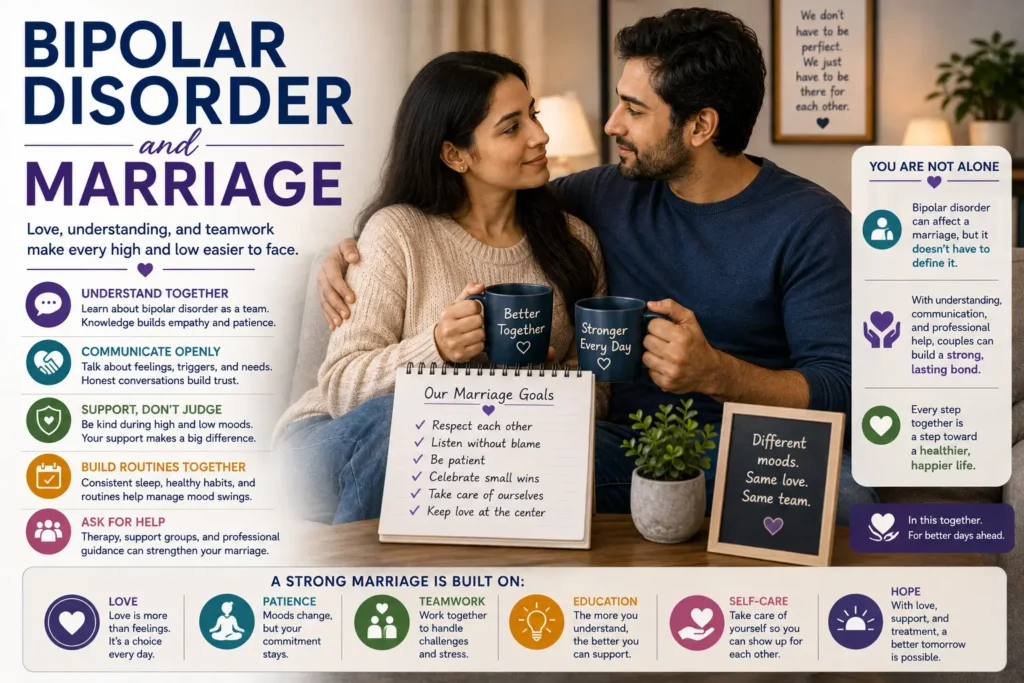
Bipolar Disorder and Marriage can absolutely succeed when one or both spouses have bipolar disorder, but it usually requires more structure than marriages without a chronic mood condition involved. The marriages that hold up best combine consistent treatment, a shared understanding of how episodes show up for that specific person, clear roles during a crisis, and ongoing communication built during stable periods — not invented mid-conflict. Bipolar disorder adds real strain to a marriage, but it’s the lack of a plan around it, more than the diagnosis itself, that tends to cause lasting damage.
Table of Contents
Introduction
Marriage is already one of the harder long-term commitments people make. Add bipolar disorder into the mix — for either spouse — and the day-to-day demands multiply. Finances, parenting, intimacy, and basic communication all get filtered through the unpredictability of mood episodes.
If you’re the spouse of someone with bipolar disorder, you may be exhausted, scared, or simply confused about what’s “the illness” and what’s “them.” If you’re the spouse who has the diagnosis, you may be carrying guilt about the strain your symptoms have put on your marriage. Both experiences are valid, and neither one means the marriage is doomed.
This guide is specifically about the long-term, day-in-day-out reality of marriage with bipolar disorder — not general dating advice. If you’re earlier in a relationship, our broader guide to bipolar disorder and relationships covers dating and early-stage dynamics in more depth. If you’re newer to the diagnosis itself, start with what bipolar disorder is and the core symptoms to build a shared vocabulary before diving into the marriage-specific challenges below.
Key Takeaways
- Marriages affected by bipolar disorder face real, documented strain — but treatment adherence is the strongest predictor of long-term stability, not the diagnosis itself.
- Each mood state (mania, hypomania, depression, mixed episodes) creates a distinct kind of marital stress, not a single generic “bad mood.”
- Spouses without the diagnosis are at real risk of caregiver burnout and need their own support.
- Written, pre-agreed crisis and communication plans prevent most marital blowups from spiraling.
- Parenting together while managing bipolar disorder benefits from explicit division of responsibilities during high-risk periods.
- Divorce rates are elevated in couples affected by bipolar disorder, but this reflects a lack of support and untreated illness more than an inevitable outcome.
Understanding the Strain: What Research Actually Shows
Research on mood disorders and marriage, including work published through the National Institute of Mental Health (NIMH) and peer-reviewed clinical literature, consistently finds that untreated or poorly managed bipolar disorder is associated with higher rates of marital conflict and divorce compared to the general population. The key word is “untreated” — studies on couples where the diagnosed spouse maintains consistent treatment show meaningfully better relationship outcomes.
This distinction matters. Bipolar disorder itself doesn’t doom a marriage. What tends to predict divorce is a combination of inconsistent treatment, lack of communication about the illness, and the non-diagnosed spouse burning out without support. All three of those are things a couple can actively address.
How Each Phase of Bipolar Disorder Shows Up in a Marriage
| Phase | What a Spouse Often Experiences |
| Mania | Sudden major decisions made without discussion (spending, career changes), irritability, reduced ability to compromise, higher conflict intensity |
| Hypomania | Increased energy and ambition that can feel positive short-term, but often comes with impatience and overcommitment to plans |
| Depression | Emotional and physical withdrawal, reduced participation in household or parenting duties, low libido, spouse feeling alone in the marriage |
| Mixed episodes | Volatile combination of high energy and despair — often the most disorienting phase for a spouse to respond to |
| Stable/euthymic periods | The baseline where most marital repair, planning, and connection actually happens |
Understanding mania and hypomania as distinct states — not just “worse” and “milder” versions of the same thing — helps spouses respond appropriately to each rather than treating every episode identically. Whether the diagnosed spouse has bipolar 1 or bipolar 2 also shapes what the marriage typically deals with, since full mania (bipolar 1) carries different risks than hypomania (bipolar 2).
The Financial Reality of Marriage With Bipolar Disorder
Money is one of the most commonly reported sources of marital conflict tied to bipolar disorder, largely due to impulsive spending during manic or hypomanic episodes. This isn’t a character flaw — it’s a well-documented symptom pattern involving impaired judgment and reduced impulse control during those states.
Practical safeguards couples use, set up during stable periods rather than after a financial crisis:
- Shared visibility into all accounts, with no hidden spending on either side
- Pre-agreed spending limits that trigger a conversation before a purchase, not after
- A cooling-off period (24–72 hours) for non-essential purchases above an agreed threshold
- A trusted third party (financial advisor, family member) with temporary account oversight during a confirmed manic episode, agreed to in advance by both spouses
Parenting Together
Raising children while managing bipolar disorder in the marriage adds another layer of coordination. What tends to work:
- A written parenting backup plan — who takes over specific duties (school pickup, meals, bedtime routines) if one spouse is in an episode
- Age-appropriate honesty with kids — children usually do better with a simple, calm explanation (“Mom’s brain sometimes needs extra rest and medicine to feel balanced”) than with silence that leaves them guessing or blaming themselves
- Protecting the non-episode spouse’s capacity — if one parent is consistently covering for the other during episodes, burnout affects the whole household, not just the marriage
- Consistency in the household routine — since routine disruption is a known trigger, protecting kids’ schedules also indirectly protects the ill spouse’s stability
Intimacy and Connection Over Time
Physical and emotional intimacy shift noticeably across mood states — often reduced during depression, and sometimes increased or less inhibited during mania or hypomania. Over years of marriage, this can create a pattern where the non-diagnosed spouse feels intimacy is unpredictable or symptom-driven rather than a reflection of the relationship itself.
Couples who maintain stronger intimacy over the long term tend to separate the symptom from the relationship explicitly — naming, out loud, “this is the depression talking, not us” — while also protecting non-episode time specifically for connection, rather than letting the relationship exist only in reaction to crises.
Warning Signs the Marriage Needs More Support
| Sign | Likely Meaning |
| Repeated financial crises during episodes despite prior agreements | Safeguards need to be more concrete and less dependent on willpower in the moment |
| The non-diagnosed spouse consistently exhausted, resentful, or isolated | Caregiver burnout — this spouse needs their own therapy or support group |
| Children showing anxiety, confusion, or behavioral changes | Family needs age-appropriate communication and possibly family therapy |
| The diagnosed spouse skipping or stopping treatment repeatedly | Review of the treatment plan is overdue — this is a leading cause of relapse and marital strain |
| Conversations about the illness always happening mid-crisis, never during stability | The couple needs a proactive plan, not just reactive conversations |
Reviewing the early signs of bipolar disorder together, as a couple, during a calm period makes it far easier to recognize and respond to these patterns before they escalate into marital crises.
Building a Marriage-Specific Crisis Plan
A written plan, created together while both spouses are stable, should cover:
- Early warning signs specific to that person — sleep changes, spending patterns, withdrawal, irritability
- Who to contact — psychiatrist, therapist, a trusted family member — and in what order
- Financial safeguards that activate automatically once warning signs appear
- Childcare coverage if kids are involved
- Agreed language both spouses will use to raise a concern without it turning into an accusation (“I’m noticing some of your warning signs — can we talk?” works better than “You’re doing that thing again”)
- When to involve emergency services — including recognizing signs that require immediate professional intervention, such as psychosis or safety risk
For the clinical side of this planning, our guides to bipolar relapse prevention and treatment options provide the medical framework this plan should be built around.
Treatment Support From a Spouse’s Perspective
A spouse can’t force treatment adherence, but can meaningfully support it:
- Encouraging (not policing) medication consistency, and understanding the risks of stopping bipolar medication abruptly
- Attending appointments together when invited, to better understand the treatment plan
- Learning about the specific medications involved, since side effects can affect mood, energy, and intimacy in ways worth understanding rather than misreading
- Supporting therapy involvement, including couples-oriented or family-focused approaches alongside individual treatment
Myths vs. Facts About Bipolar Disorder and Marriage
| Myth | Fact |
| “Marriage with bipolar disorder is statistically doomed.” | Elevated divorce risk is associated with untreated illness and lack of support — not the diagnosis itself. |
| “The non-diagnosed spouse should manage the other’s illness.” | Treatment is the diagnosed spouse’s responsibility with professional support; the marriage works better when both partners have their own resources. |
| “Mania during marriage shows a spouse’s ‘true self.'” | Mania reflects altered brain chemistry and impaired judgment, not a hidden authentic personality. |
| “Bringing up the diagnosis will make things worse.” | Proactive, calm conversation during stable periods consistently reduces conflict compared to avoidance. |
For a wider set of common misconceptions, see our bipolar disorder myths page.
When to Seek Professional Help as a Couple
Consider couples or family therapy, in addition to the diagnosed spouse’s individual treatment, if:
- Conflict during episodes is escalating rather than de-escalating over time
- Financial or safety agreements keep breaking down despite repeated conversations
- One or both spouses feel isolated within the marriage
- Children’s wellbeing appears affected
- The non-diagnosed spouse is showing signs of their own anxiety, depression, or burnout
Family-focused therapy approaches designed specifically for bipolar disorder — distinct from general marriage counseling — have research support for reducing relapse and improving household functioning. Ask a psychiatrist or therapist for a referral to a clinician experienced specifically with mood disorders in couples.
Emergency Help
If a spouse shows signs of psychosis, expresses suicidal thoughts, or poses a safety risk to themselves or others during an episode, this is a medical emergency, not something to manage through communication alone. In the U.S., call or text 988 (Suicide & Crisis Lifeline) at any time, or call 911 if there’s immediate danger. Short-term hospitalization during a severe episode is a stabilization step, not a marital failure.
Frequently Asked Questions
Does bipolar disorder cause divorce? Bipolar disorder itself doesn’t directly cause divorce, but research links untreated or poorly managed illness with higher divorce rates. Consistent treatment and open communication significantly improve marital outcomes.
How do I stay married to someone with bipolar disorder without burning out? Build your own support system — individual therapy, trusted friends, or a caregiver support group — rather than carrying the marriage’s stability alone. Burnout prevention protects both the marriage and your own wellbeing.
Should we tell our children about a parent’s bipolar disorder? Yes, in age-appropriate terms. Simple, honest explanations reduce children’s confusion and self-blame far more than silence does.
Can a marriage survive a manic episode involving infidelity or major financial damage? Many marriages do recover from serious incidents during a manic episode, especially with professional support, but it requires honest acknowledgment of the harm, a concrete relapse-prevention plan, and often couples therapy — recovery isn’t automatic and takes real work from both spouses.
Is it fair to ask my spouse to stick to a treatment plan? Yes. Requesting consistent treatment isn’t controlling — it’s a reasonable boundary in a marriage, similar to expecting a spouse to manage any other serious health condition responsibly.
What’s the difference between supporting a spouse and enabling their illness? Support means encouraging treatment and communicating calmly about patterns; enabling means covering up consequences or avoiding the topic entirely to keep the peace. The first strengthens the marriage long-term; the second usually delays a necessary conversation.
Summary
Bipolar disorder brings real, well-documented strain into a marriage — financial risk, communication challenges, and periods of real distance between spouses. But the marriages that endure aren’t the ones without struggle; they’re the ones with a plan. Consistent treatment, a written crisis plan built during stable periods, honest conversations with kids, and support for both spouses — not just the one with the diagnosis — are what separate marriages that survive bipolar disorder from ones that don’t. If your marriage is struggling right now, that’s a sign to build more structure around the illness, not necessarily a sign the marriage itself has failed.
This article is for educational purposes and isn’t a substitute for personalized medical or marital counseling advice. If you or your spouse are experiencing symptoms of bipolar disorder or significant relationship distress, consider speaking with a licensed healthcare professional or couples therapist.