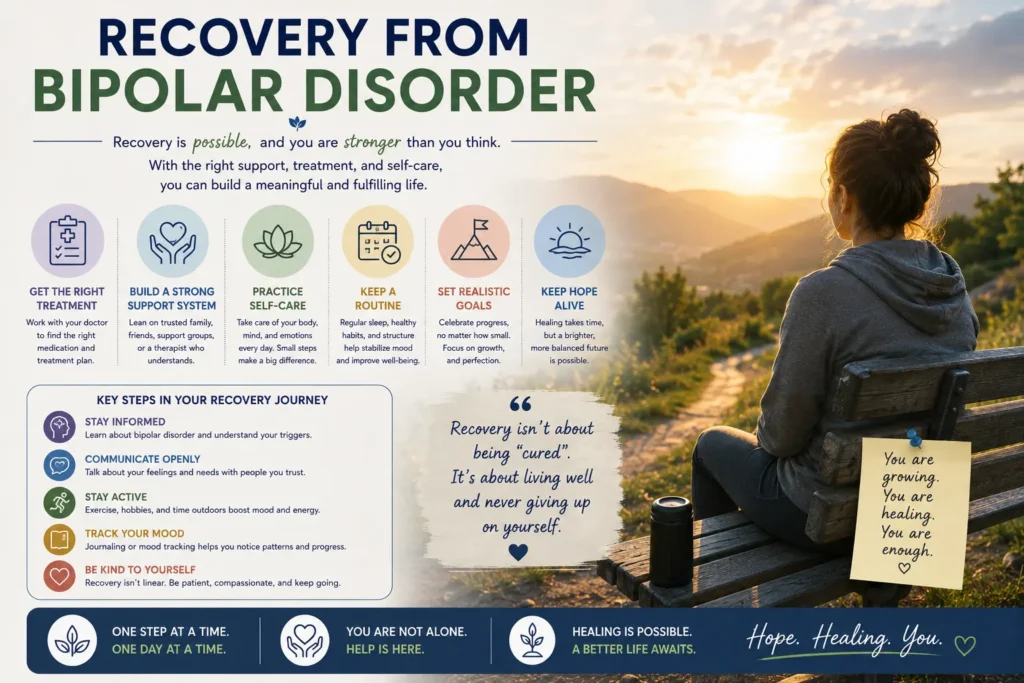
Recovery from bipolar disorder doesn’t mean the condition disappears — it means reaching a stable, manageable place where symptoms are controlled, daily functioning returns, and life feels meaningful again. Clinicians actually break recovery into distinct stages: symptom improvement, functional recovery (getting back to work, relationships, and daily life), and personal recovery (a subjective sense of living well despite the diagnosis). Understanding this distinction matters, because functional recovery often takes longer than symptoms taking. This guide focuses on what long-term recovery looks like; for day-to-day strategies, see our guide on how to manage bipolar disorder.
Table of Contents
Key Takeaways
- Recovery from bipolar disorder is usually described in three layers: symptomatic, functional, and personal recovery — and they don’t happen at the same pace.
- Functional recovery (returning to work, relationships, and daily routines) often lags behind symptom improvement, sometimes by months or longer.
- Bipolar disorder is a lifelong condition, so recovery is generally understood as ongoing stability rather than a cure.
- Consistent medication, therapy, and self-management all contribute meaningfully to long-term recovery.
- Setbacks and occasional relapses don’t erase progress — they’re a common part of the overall recovery process for a recurring illness.
- Quality of life and a person’s own sense of meaning matter just as much as clinical symptom scores in defining recovery.
Redefining What “Recovery” Means
For a long time, recovery from bipolar disorder was measured almost entirely by symptoms — whether someone still met the criteria for a manic or depressive episode. That’s an important marker, but researchers and clinicians have increasingly recognized it’s an incomplete one.
A person can be free of active mood symptoms and still struggle to return to work, maintain relationships, or feel like themselves again. This gap between “no longer having an episode” and “actually feeling recovered” is well documented in bipolar disorder research, and understanding it can shift how you measure your own progress — hopefully in a more realistic, less discouraging direction.
The Three Layers of Recovery
Clinical literature on bipolar disorder generally separates recovery into three distinct, related concepts. Knowing the difference helps set more accurate expectations for your own timeline.
| Type of Recovery | What It Means | Typical Timeline |
| Symptomatic recovery | Mood symptoms fall within a normal range; no longer meeting criteria for an active episode | Weeks to months |
| Functional recovery | Return to prior levels of work, relationships, and daily functioning | Often months to over a year |
| Personal recovery | A subjective sense of living a meaningful, satisfying life despite the diagnosis | Ongoing, individual, less tied to a fixed timeline |
Symptomatic Recovery
This is the most familiar form of recovery — the resolution of active mood symptoms. Clinically, this is sometimes broken down further into “syndromal recovery,” meaning someone no longer meets full diagnostic criteria for an episode, and “symptomatic recovery” or remission, meaning that <cite index=”72-1″>any remaining symptoms fall within the normal range of experience for someone without the diagnosis</cite>.
Functional Recovery
Functional recovery refers to something more practical: returning to the level of functioning — work, relationships, independent living — that existed before the most recent episode. Research has consistently found that <cite index=”70-1″>restoration of functioning tends to lag behind improvement in mood symptoms</cite>, sometimes considerably.
One study following people through treatment found this gap clearly: by a certain point in treatment, a large majority had reached syndromal recovery, but functional recovery <cite index=”70-1″>was reached by a noticeably smaller portion of participants at the same time point</cite>, only catching up closer to the end of the treatment period studied. Other research has found that functional recovery can <cite index=”76-1″>take up to a year after symptoms have resolved</cite>, particularly when residual depressive symptoms linger below the threshold of a full episode.
This matters because it explains something many people experience but don’t always hear named clearly: feeling okay symptom-wise but still not feeling “back to normal” in daily life isn’t a failure — it’s a documented, common pattern in bipolar disorder recovery.
Personal Recovery
The third layer is less about clinical measurement and more about a person’s own experience of their life. Personal recovery reflects a sense of meaning, hope, and identity that isn’t always closely tied to symptom severity. Research reviewing this concept has found that <cite index=”78-1″>personal recovery does not correlate very closely with symptomatology</cite> — in other words, someone can be doing relatively well symptomatically and still feel far from “recovered” in a personal sense, or vice versa.
This layer of recovery often involves things clinical scales don’t directly measure: self-esteem, a sense of purpose, quality of relationships, and how someone relates to their own diagnosis over time.
Why Functional Recovery Lags Behind Symptoms
It’s worth understanding why this gap exists, because it can be genuinely reassuring to know it’s a documented pattern rather than something going wrong with your specific recovery.
A few contributing factors identified in research include:
| Factor | How It Affects Functional Recovery |
| Residual subthreshold symptoms | Mild lingering symptoms, even below full-episode level, can still affect daily functioning |
| Cognitive effects | Attention, memory, and executive function can be affected during and after episodes |
| Length and number of past episodes | More frequent or longer episodes are associated with slower functional recovery |
| Rebuilding disrupted routines | Work, relationships, and responsibilities often need to be actively rebuilt, not just resumed |
| Psychosocial factors | Education, relationship stability, and time since diagnosis all play a role |
Research has specifically identified factors like psychomotor slowing, low motivation, guilt, and somatic anxiety — even at subthreshold levels — as meaningful barriers to functional recovery, which is part of why <cite index=”75-1″>psychosocial functional recovery often remains difficult even when symptoms have technically resolved</cite>. This is also why treatment increasingly aims beyond symptom control alone, toward those specific functional barriers.
What Supports Long-Term Recovery
Recovery isn’t passive — it’s built through a combination of consistent treatment and daily habits, layered over time.
Medical Treatment
Ongoing psychiatric care remains the foundation. This includes:
- Consistent medication management, adjusted as needed over time
- Regular psychiatric follow-up, even during stable periods
- Prompt attention to early warning signs rather than waiting for a full relapse
Our guide on bipolar disorder treatment covers this foundation in more depth, and our guide on bipolar relapse prevention explains how to catch problems early.
Therapy
Several therapy approaches specifically support functional and personal recovery, not just symptom control:
- Cognitive behavioral therapy (CBT) — supports functional rebuilding by addressing unhelpful thought patterns; see our guide on cognitive behavioral therapy for bipolar disorder
- Dialectical behavior therapy (DBT) — builds emotional regulation skills that support daily functioning; see our guide on dialectical behavior therapy for bipolar disorder
- Functional remediation and cognitive rehabilitation approaches — increasingly used specifically to target the cognitive and functional gaps that persist after symptoms improve
Self-Management and Daily Habits
Recovery is also built through the kind of daily structure covered in our guide on how to manage bipolar disorder, including consistent sleep, stress management, and mood tracking. These habits don’t just prevent relapse — they support the slower work of functional recovery too.
Support Systems
Recovery tends to go better with support around it, not in isolation. Our guide on support for bipolar disorder covers peer support groups, family involvement, and caregiver resources that can meaningfully contribute to a person’s broader recovery journey.
What Recovery Timelines Can Look Like
There’s no single, universal recovery timeline — it depends heavily on episode severity, treatment response, and individual circumstances. That said, research gives a general sense of how the different layers of recovery tend to unfold relative to each other.
| Recovery Stage | General Pattern |
| Early treatment weeks | Acute symptoms begin to improve with treatment |
| Weeks to a few months | Syndromal recovery — no longer meeting full episode criteria |
| Months | Symptomatic recovery — residual symptoms fall within a normal range |
| Months to a year or more | Functional recovery — return to prior work, relational, and daily functioning |
| Ongoing | Personal recovery — a subjective, evolving sense of living well |
This isn’t a strict sequence for everyone, and it isn’t always linear. Some people experience these layers overlapping or moving at different speeds depending on the episode and their circumstances.
Recovery Is Not the Same as “Cured”
Because bipolar disorder is a recurring, lifelong condition, recovery is generally understood as an ongoing process rather than a permanent endpoint. This isn’t meant to be discouraging — it’s meant to set expectations that match reality, which tends to support more sustainable long-term stability than expecting symptoms to disappear forever after one period of treatment.
Recovery in this context looks more like: knowing your warning signs, staying engaged with treatment, having a plan for setbacks, and building a life that isn’t defined by the illness even though it remains part of your ongoing care. Our guide on bipolar disorder prognosis covers what long-term outlook generally looks like in more detail.
Handling Setbacks Without Losing Progress
Setbacks — a difficult stretch, a partial relapse, or even a full episode — are a common part of the overall recovery picture for a condition like bipolar disorder, not evidence that recovery has failed.
A few things worth keeping in mind if a setback happens:
- A relapse doesn’t erase functional or personal recovery gains already made
- Getting back to your treatment plan quickly matters more than dwelling on the setback itself
- Reviewing what led up to it, ideally with your treatment team, can inform your ongoing relapse prevention plan
- Many people experience more than one episode over the course of long-term recovery, and that’s part of managing a recurring condition, not a sign the overall trajectory is wrong
If you want to build a structured plan for recognizing warning signs and reducing the frequency or severity of future setbacks, our guide on bipolar relapse prevention walks through this in detail.
Myths vs. Facts About Bipolar Recovery
| Myth | Fact |
| Recovery means bipolar disorder is gone for good | Recovery generally refers to sustained stability and functioning, not a cure, since bipolar disorder is a lifelong condition |
| If symptoms are gone, recovery is complete | Functional and personal recovery often take longer than symptom improvement |
| A relapse means recovery has failed | Setbacks are a common part of managing a recurring illness and don’t erase prior progress |
| Recovery looks the same for everyone | Recovery timelines and experiences vary significantly based on episode history and individual circumstances |
| Feeling “not back to normal” despite treatment means something is wrong | This is a well-documented pattern, since functional recovery often lags behind symptomatic recovery |
Checklist: Signs of Meaningful Progress
Rather than measuring recovery only by the absence of symptoms, it can help to track progress across a broader range of markers:
- Mood symptoms are within a manageable, stable range
- Sleep and daily routine feel more consistent
- You’re able to maintain work, school, or other responsibilities
- Relationships feel more stable and less strained
- You’re engaging with treatment consistently
- You have a support system and lean on it when needed
- You feel a growing sense of purpose or meaning, even if gradually
Not every marker needs to be fully checked off for progress to be real — recovery tends to build unevenly across these areas over time.
Warning Signs That Need Attention
Recovery doesn’t mean ignoring symptoms that return. Seek support promptly if you notice:
- Escalating mood symptoms that don’t resolve with your usual coping strategies
- Withdrawal from your support system or treatment
- Thoughts of suicide or self-harm
- Signs of a developing manic or depressive episode
Emergency Help
If you or someone you know is in crisis or experiencing thoughts of suicide, don’t wait. Contact a crisis line or emergency services immediately, or go to the nearest emergency room. In the United States, you can call or text 988 to reach the Suicide & Crisis Lifeline, available 24/7.
Frequently Asked Questions
Can someone fully recover from bipolar disorder? Bipolar disorder is generally considered a lifelong condition, so “full recovery” is usually understood as sustained stability and functioning rather than the condition disappearing entirely. Many people go on to live full, stable lives with ongoing treatment.
Why do I still feel “off” even though my symptoms have improved? This is a well-documented pattern called the gap between symptomatic and functional recovery. Functioning in work, relationships, and daily life often takes longer to rebuild than mood symptoms take to resolve.
How long does recovery from a bipolar episode usually take? It varies significantly, but research suggests symptomatic recovery often occurs within weeks to a few months, while functional recovery can take considerably longer — sometimes up to a year or more after symptoms improve.
Does having another episode mean I haven’t recovered? Not necessarily. Bipolar disorder is a recurring condition, and experiencing another episode doesn’t erase the functional and personal progress made beforehand. Our guide on bipolar relapse prevention can help you build a plan for managing this over time.
What’s the difference between remission and recovery? Remission generally refers to the resolution of active symptoms, while recovery is broader — including functional recovery (returning to daily life and responsibilities) and personal recovery (a subjective sense of living well).
Can therapy help with recovery beyond just managing symptoms? Yes. Therapy approaches like CBT and functional remediation programs are increasingly used specifically to address the functional and cognitive gaps that can persist even after mood symptoms improve.
Is it normal to define recovery differently than my doctor does? Yes — clinical recovery (symptom-based) and personal recovery (your own sense of a meaningful, satisfying life) don’t always move together, and research shows they aren’t closely correlated. Both are valid ways to think about progress.
Summary
Recovery from bipolar disorder is more layered than simply feeling “better” — it includes symptom improvement, a return to daily functioning, and a personal sense of living well, and these three don’t always move at the same pace. Functional recovery in particular often takes longer than symptoms resolving, which is a well-documented, common experience rather than a sign of falling behind. With consistent treatment, therapy, self-management, and support, long-term recovery is a realistic, well-supported goal — even though bipolar disorder remains a condition to manage over time rather than one that simply goes away.
This article is for educational purposes and is not a substitute for professional medical advice. If you are having thoughts of suicide or self-harm, please contact a crisis line or emergency services in your area immediately.