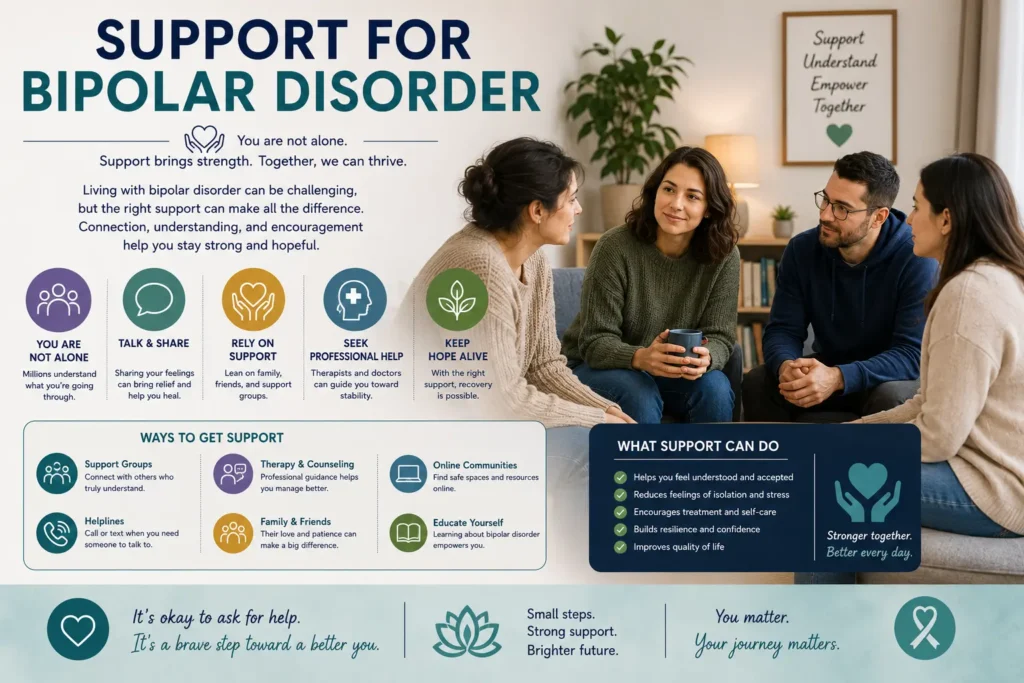
Support for bipolar disorder comes in several forms: professional treatment, peer support groups, family and friend involvement, and caregiver resources. No single source of support does everything — most people benefit from a combination, built around their psychiatric care rather than replacing it. This guide focuses specifically on the support network side of living with bipolar disorder; for day-to-day symptom management strategies, see our guide on how to manage bipolar disorder.
Table of Contents
Key Takeaways
- Support for bipolar disorder isn’t one thing — it includes clinical care, peer support groups, family involvement, and caregiver resources, each serving a different purpose.
- Peer support groups, run by organizations like the Depression and Bipolar Support Alliance (DBSA) and the National Alliance on Mental Illness (NAMI), offer connection with people who understand the condition firsthand.
- Family members and friends play a meaningful role, especially in recognizing warning signs, but support works best when it doesn’t try to replace professional treatment.
- Caregivers need their own support too — supporting someone with bipolar disorder can be demanding, and caregiver burnout is real.
- Good support respects the person’s autonomy rather than taking over their treatment decisions.
- The World Health Organization recognizes bipolar disorder as a significant contributor to disability worldwide, underscoring why structured support matters at both the individual and public health level.
Why Support Matters Alongside Treatment
Bipolar disorder is a lifelong condition, and medication and therapy — covered in depth in our guide to bipolar disorder treatment — form the clinical backbone of managing it. But treatment alone doesn’t cover everything a person needs.
Support fills in the rest: the sense of not being alone, the practical help during a hard stretch, the person who notices a warning sign before you do, the space to talk with others who genuinely understand. The World Health Organization has identified bipolar disorder as one of the leading causes of disability globally, which is part of why organized, accessible support systems — not just individual willpower — matter so much for people living with the condition.
The Different Types of Support Available
Support for bipolar disorder isn’t a single resource — it’s a layered system, and different types serve different needs.
| Type of Support | What It Offers | Best For |
| Clinical care (psychiatrist, therapist) | Diagnosis, medication, therapy | The foundation of treatment |
| Peer support groups | Shared experience, practical coping tips | Feeling less alone, learning from others further along |
| Family and friend support | Day-to-day encouragement, help spotting warning signs | Ongoing relational support |
| Caregiver-specific resources | Education, coping tools, respite | Family members and partners providing regular support |
| Crisis resources | Immediate safety support | Acute crises or emergencies |
Most people benefit from combining several of these rather than relying on just one. If you’re building a plan, it helps to think of clinical care as the base layer, with the others layered on top.
Peer Support Groups: What They Are and How They Help
Peer support groups bring together people who live with bipolar disorder — and often their families — to share experiences, coping strategies, and encouragement. They’re not a replacement for therapy or medication, but they offer something clinical care generally can’t: the specific comfort of talking to someone who has actually been there.
What to Expect From a Support Group
Groups vary quite a bit in structure. Some are professionally facilitated, others are peer-led. Some meet in person, others online. A few tend to be more casual and conversational, while others follow more of a structured curriculum. It’s worth trying more than one to find a good fit, since the tone and community of a group matters as much as its format.
A few things worth checking before joining any group:
- Whether it’s moderated, and by whom
- Whether it feels like a genuinely safe space to speak openly
- What privacy protections are in place, particularly for online groups
- Whether it fits your specific need — general support, family-focused, or crisis-oriented
Well-Known Support Organizations
| Organization | Focus |
| Depression and Bipolar Support Alliance (DBSA) | Peer-led groups for individuals and families living with mood disorders |
| National Alliance on Mental Illness (NAMI) | Education, advocacy, and both individual and family support groups |
| International Bipolar Foundation (IBPF) | Education, webinars, and caregiver-focused resources |
The Depression and Bipolar Support Alliance describes itself as a resource reaching <cite index=”63-1″>more than 23 million people in the U.S. who live with mood disorders</cite>, offering both information and a searchable directory of in-person and online support groups for individuals and families. NAMI, meanwhile, operates as <cite index=”66-1″>a national umbrella organization connecting more than a thousand local support and advocacy groups</cite> for people affected by mental health conditions and their families.
Both organizations, along with groups like the International Bipolar Foundation, offer resources specifically built for family members and caregivers — not just the person diagnosed. It’s worth exploring options built for both roles, since the experience of living with bipolar disorder and the experience of supporting someone with it are genuinely different.
How Family and Friends Can Provide Meaningful Support
If someone you care about has bipolar disorder, your role matters — but it works best when it’s built around a few clear principles rather than trying to manage every part of their condition.
What Helps
- Learning about the condition. Understanding bipolar disorder symptoms and the difference between mania and depression helps you recognize what’s happening without guessing.
- Encouraging treatment, not replacing it. Supporting someone’s engagement with their psychiatrist or therapist is one of the most protective things you can do.
- Learning their warning signs. Loved ones often notice early signs of an episode before the person does. If they’ve shared their plan, knowing what to watch for — and how they want you to respond — makes a real difference.
- Being consistent, not just present during crises. Steady, ongoing support tends to matter more than only showing up during emergencies.
What to Keep in Mind
- Their condition isn’t something you caused, and it isn’t something you can fix on your own.
- You can offer support, encouragement, and hope — but the responsibility for treatment ultimately belongs to them and their care team.
- Respecting their autonomy, even when you’re worried, generally builds more trust than taking over decisions unilaterally.
If you’re trying to understand what specific behaviors to expect during an episode, our guides on mania symptoms and bipolar depression symptoms can help you tell the difference between ordinary mood changes and something that needs attention.
Supporting Someone Through a Crisis
Crisis moments call for a calmer, more structured kind of support than day-to-day encouragement.
If someone you know is showing signs of a severe episode:
- Stay calm and avoid arguing about their perception of reality during acute symptoms
- Encourage contact with their psychiatrist or a crisis line
- If there’s a written plan in place, follow it
- If there’s immediate danger, don’t hesitate to seek emergency help
For a deeper understanding of what a crisis situation might involve — including when hospitalization becomes necessary — see our guide on hospitalization for bipolar disorder. And if you want to understand how families can get ahead of a crisis by recognizing warning signs early, our guide on bipolar relapse prevention covers this in detail.
Caregiver Support: Taking Care of Yourself Too
Supporting someone with bipolar disorder over the long term can be genuinely demanding, especially for spouses, parents, and close family members providing regular support. Caregiver burnout is a real and well-recognized risk, not a sign that you’re not doing enough.
Signs of Caregiver Strain
- Persistent exhaustion, even after rest
- Growing resentment or irritability
- Neglecting your own health, sleep, or relationships
- Feeling isolated in your caregiving role
- Difficulty separating your own emotional state from your loved one’s mood
Resources Built Specifically for Caregivers
Several major organizations offer caregiver-specific programs, recognizing that the support needs of a caregiver differ from those of the person with the diagnosis:
- NAMI Family-to-Family — a free, peer-led course designed to <cite index=”62-1″>improve a caregiver’s coping and problem-solving abilities</cite>
- NAMI Basics — geared toward parents and caregivers of younger people with mental health conditions, including how to respond to crisis situations
- DBSA Parent and Caregiver Support Groups — organized by the age of the person being cared for, connecting caregivers at similar life stages
- IBPF caregiver webinars — educational sessions covering topics like treatment options and communicating with a loved one about seeking help
Caregivers deserve support in their own right — not just as a means of helping someone else, but because caregiving itself takes a real toll that’s worth acknowledging and addressing.
Support Groups vs. Therapy: What’s the Difference
It’s a common point of confusion, so it’s worth being direct about it: support groups and therapy are not the same thing, and one doesn’t replace the other.
| Feature | Support Groups | Therapy |
| Led by | Often peers; sometimes professionals | Licensed mental health professional |
| Focus | Shared experience, encouragement, practical tips | Structured treatment, clinical goals |
| Confidentiality | Varies by group | Legally protected |
| Cost | Usually free | Often requires insurance or payment |
| Clinical oversight | Limited or none in peer-led groups | Direct professional oversight |
Many people benefit from both. Support groups add a layer of shared understanding that therapy doesn’t always provide, while therapy offers structured, professional treatment that peer support isn’t designed to replace. If you’re weighing therapy options specifically, our guides on cognitive behavioral therapy for bipolar disorder and dialectical behavior therapy for bipolar disorder go into more depth.
Building Your Own Support Plan
A workable support plan doesn’t need to be complicated. It generally includes:
- Clinical care — a psychiatrist and/or therapist you trust
- At least one peer connection — a support group, whether in person or online
- One or two people in your daily life who understand your condition and warning signs
- A crisis resource you know how to reach if things escalate quickly
- Ongoing self-management habits — see our guide on how to manage bipolar disorder for specifics
Building this while you’re stable — rather than scrambling for it during a crisis — makes it far more useful when you actually need it.
Myths vs. Facts About Bipolar Support
| Myth | Fact |
| Support groups are only for people who can’t afford therapy | Many people use both together; they serve different purposes |
| Family support means managing someone’s treatment for them | Effective support respects the person’s autonomy in their own care |
| Caregivers don’t need their own support | Caregiver burnout is real, and dedicated caregiver resources exist for this reason |
| Online support groups aren’t as helpful as in-person ones | Both formats can be genuinely valuable; fit matters more than format |
| Needing support is a sign of weakness | Seeking and accepting support is a well-documented part of managing a chronic condition well |
Warning Signs a Loved One May Need More Support
Family and friends are often the first to notice when a support plan isn’t enough on its own. Signs that more active support or professional involvement may be needed include:
- Increasing withdrawal or isolation
- Noticeable changes in sleep, energy, or mood over several days
- Missed medication or treatment appointments
- Talk of hopelessness or self-harm
- Signs of escalating mania, such as reduced need for sleep or increasing impulsivity
Emergency Help
If you or someone you know is in crisis or having thoughts of suicide, don’t wait for a scheduled support group or appointment. Contact emergency services or go to the nearest emergency room. In the United States, you can call or text 988 to reach the Suicide & Crisis Lifeline, available 24/7.
Frequently Asked Questions
Are bipolar support groups free? Most peer-led support groups, including those run by DBSA and NAMI, are free to attend, though some require registration. Costs may apply for professionally facilitated programs.
Can support groups replace therapy for bipolar disorder? No. Support groups offer valuable peer connection and shared experience, but they aren’t a substitute for licensed clinical treatment. Most people benefit from combining both.
How can I find a bipolar support group near me? Organizations like DBSA and NAMI offer searchable directories of local and online support groups. Many also offer specific groups for family members and caregivers.
What’s the best way to support someone during a manic episode? Staying calm, avoiding confrontation over their perception of events, and encouraging contact with their psychiatrist or a crisis resource if things escalate are generally more helpful than trying to argue someone out of symptoms. Our guide on mania symptoms can help you recognize what’s happening.
Is it normal to feel exhausted from supporting someone with bipolar disorder? Yes. Caregiver fatigue is common and well recognized, and dedicated resources exist specifically to support caregivers, not just the person with the diagnosis.
Should I attend a support group even if my loved one, not me, has bipolar disorder? Many organizations offer groups specifically for family members and caregivers, separate from groups for people with the diagnosis themselves, because the two experiences are genuinely different.
How do I know if my loved one needs more support than I can provide? If you notice escalating symptoms, missed treatment, or signs of crisis, it’s time to involve their psychiatrist or a crisis resource rather than trying to manage the situation alone. Our guide on bipolar relapse prevention can help you recognize early warning signs together.
Summary
Support for bipolar disorder works best as a layered system — clinical treatment at the center, with peer support groups, family involvement, and caregiver resources built around it. No single source of support carries the whole weight, and that’s by design: people with bipolar disorder and the people who support them both benefit from having more than one place to turn. Whether you’re living with the condition yourself or supporting someone who is, you don’t have to build that network alone, and organizations like DBSA, NAMI, and IBPF exist specifically to help you find it.
This article is for educational purposes and is not a substitute for professional medical advice. If you are having thoughts of suicide or self-harm, please contact a crisis line or emergency services in your area immediately.