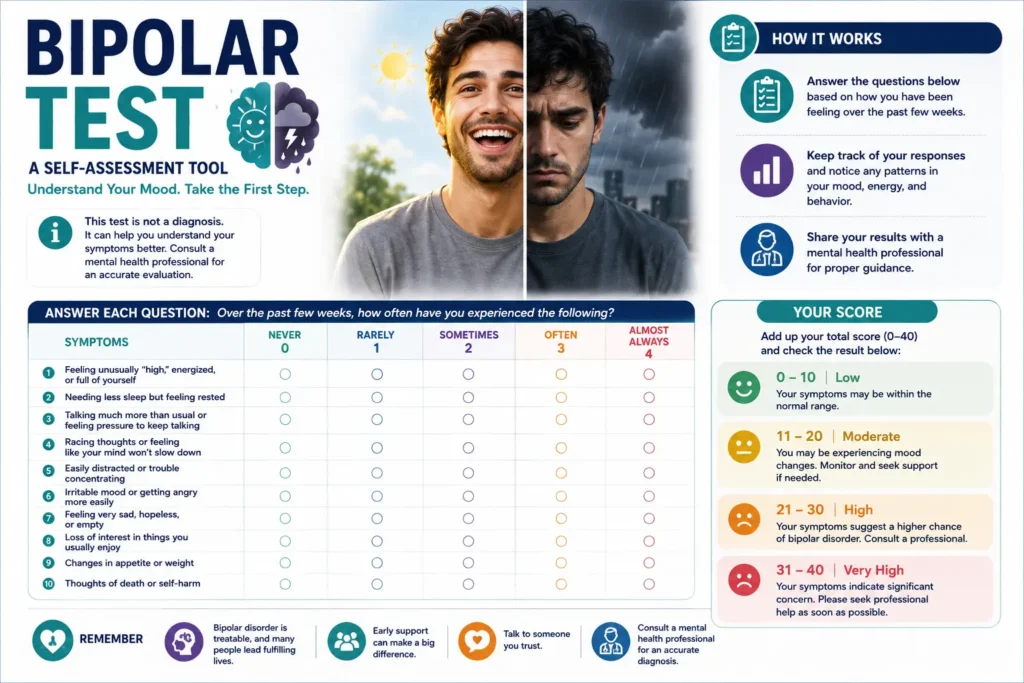
Typing “bipolar test” into a search bar is usually the first step someone takes when their mood patterns start feeling like more than just a rough patch. It’s a reasonable place to start. But it’s worth understanding, before you take one, what these tests are actually designed to do, how accurate they really are, and why a positive or negative result isn’t the end of the story.
This guide explains how bipolar screening tools work, what the most commonly used ones look like, how reliable they are according to published research, and what a responsible next step looks like based on your results. For a full explanation of how a clinical diagnosis actually gets made, see our dedicated guide to bipolar diagnosis.
Table of Contents
Key Takeaways
- A bipolar test is a screening tool, not a diagnostic tool. It can suggest that further evaluation may be worthwhile, but it cannot confirm or rule out bipolar disorder.
- The most widely studied bipolar screening tool is the Mood Disorder Questionnaire (MDQ), a short, self-reported symptom checklist.
- Research shows these tools produce meaningful numbers of false positives and false negatives, particularly in people with other conditions like anxiety, depression, or borderline personality disorder.
- A positive screening result means a conversation with a healthcare professional is worth having, not that a diagnosis is confirmed.
- Only a licensed clinician, using a full clinical evaluation and DSM-5 criteria, can actually diagnose bipolar disorder.
A bipolar test is a self-report screening questionnaire, most commonly the Mood Disorder Questionnaire (MDQ), designed to flag symptoms that may be consistent with bipolar disorder. These tests ask about past periods of elevated mood, energy, or behavior changes and take just a few minutes to complete. They are useful as a starting point for a conversation with a healthcare provider, but they are not diagnostic on their own, and research shows they can produce both false positives and false negatives.
What Is a Bipolar Test, Exactly?
A bipolar test, more accurately called a bipolar screening tool, is a short questionnaire designed to identify symptoms that might be consistent with bipolar disorder. These tools typically ask about past experiences of elevated mood, high energy, reduced need for sleep, and impulsive behavior, then compare the pattern of answers to a scoring threshold.
Screening tools were originally developed for use in clinical and research settings, as a quick way for doctors to decide who might benefit from a fuller psychiatric evaluation. Over time, many of these same instruments became available online for personal use, which is largely why “bipolar test” is such a common search today.
The Most Common Bipolar Screening Tools
Several validated screening tools exist, each with a slightly different focus and format.
| Tool | Format | What It Measures |
| Mood Disorder Questionnaire (MDQ) | 13 yes/no questions, plus follow-up on timing and impact | Lifetime history of manic or hypomanic symptoms |
| Hypomania Checklist (HCL-32) | 32-item self-report checklist | Hypomanic symptoms, with a focus on detecting bipolar II |
| Bipolar Spectrum Diagnostic Scale (BSDS) | Narrative-style checklist | How closely a person’s experience matches a bipolar symptom story |
The MDQ is the most widely used and studied of these tools. It asks whether someone has ever experienced a cluster of manic or hypomanic symptoms at the same time, whether several of these symptoms happened during the same period, and how much these symptoms affected daily functioning.
How Accurate Are Bipolar Screening Tools?
This is where a lot of online information falls short, and it’s worth being direct about it. Published research on the MDQ shows it performs reasonably well, but far from perfectly.
In studies comparing MDQ results to full clinical evaluations using structured diagnostic interviews, sensitivity (the ability to correctly identify people who do have bipolar disorder) and specificity (the ability to correctly rule out people who don’t) vary depending on the population studied and the cutoff score used. In outpatient samples with depression, one study found the MDQ correctly identified roughly seven out of ten people with bipolar disorder while correctly screening out around eight to nine out of ten people without it, at a commonly used cutoff score.
However, other research paints a more cautious picture. A well-known analysis of community survey data found that a majority of people who screened positive on the MDQ did not go on to meet full diagnostic criteria for bipolar disorder when evaluated with a structured clinical interview. Many of these false positives were instead linked to anxiety disorders, major depression, or substance use, not bipolar disorder.
The takeaway is not that these tools are useless. It’s that a screening result, positive or negative, is a starting point for further conversation, not a verdict.
Why Screening Tools Sometimes Get It Wrong
Several factors make bipolar screening genuinely difficult to get right with a short questionnaire.
- Symptom overlap with other conditions. Conditions like borderline personality disorder, ADHD, and anxiety disorders share several symptoms with bipolar disorder, which can trigger a false positive on a symptom checklist. A comparison of screening tools found that the MDQ and a borderline personality disorder screener sometimes flagged the same individuals, despite the two conditions requiring very different treatment approaches.
- Recall bias. Since the MDQ asks about lifetime symptoms, people may over- or under-report past experiences, especially hypomanic periods that felt pleasant or productive rather than distressing.
- Self-report limitations. People aren’t always the best judge of their own manic or hypomanic behavior, since these episodes can distort self-perception at the time they’re happening.
- Depression-focused help-seeking. People are more likely to seek help, and take a screening test, during a depressive episode, which can make bipolar-specific symptoms harder to recall accurately.
What a Bipolar Test Typically Asks About
While exact wording varies by tool, most bipolar screening questionnaires ask about a similar set of experiences, usually framed as “has there ever been a period when”:
- You felt unusually energetic, elevated, or “wired”
- You needed much less sleep than usual and didn’t feel tired
- You talked faster or more than usual, or felt your thoughts racing
- You felt much more self-confident than usual
- You were more impulsive, including with money, relationships, or decision-making
- Several of these experiences happened at the same time
- These experiences caused noticeable problems in your life
If several of these resonate strongly and occurred together during the same period, it may be worth discussing with a healthcare provider. For a deeper explanation of what these experiences look like clinically, see our guides to mania symptoms and hypomania symptoms.
Bipolar Test vs. Bipolar Diagnosis: What’s the Difference?
It’s worth being clear about this distinction, since the two terms often get used interchangeably online.
| Bipolar Test (Screening) | Bipolar Diagnosis | |
| Who administers it | Can be self-administered online or in a clinic | A licensed psychiatrist, psychologist, or other mental health professional |
| Time required | A few minutes | Multiple visits, sometimes over weeks or months |
| What it measures | Whether symptoms are worth discussing further | Whether DSM-5 diagnostic criteria are actually met |
| Includes physical exam or labs | No | Often, to rule out other medical causes |
| Result | A score suggesting possible risk | A formal clinical diagnosis |
| Reliability | Moderate; produces false positives and negatives | High, when conducted by a qualified professional |
Our full guide to bipolar diagnosis walks through exactly what a real clinical evaluation involves, step by step, if you’re ready to go beyond a screening questionnaire.
Bipolar 1 vs. Bipolar 2: Do Screening Tools Tell the Difference?
Most general bipolar screening tools, including the MDQ, aren’t designed to distinguish clearly between bipolar I and bipolar II. Some newer tools, like the HCL-32, have shown better sensitivity for detecting the milder hypomanic symptoms associated with bipolar II specifically, but even these require a full clinical evaluation to confirm which type, if any, a person actually has.
If you’re specifically curious about how the two conditions differ, our guide to bipolar 1 vs bipolar 2 breaks it down, and our related bipolar 1 vs 2 test and bipolar 1 vs 2 quiz pages go into more detail on tools specific to that comparison.
What to Do With Your Results
If You Score Positive on a Bipolar Test
A positive screening result doesn’t confirm bipolar disorder, but it’s a reasonable signal to schedule an appointment with a doctor or mental health professional. Bring your results with you, along with any notes about when these symptoms occurred and how they affected your life, since this can help guide a more detailed clinical conversation.
If You Score Negative but Still Have Concerns
Screening tools can miss real cases, especially if hypomanic symptoms were mild, brief, or not clearly remembered. If your gut sense doesn’t match a negative result, particularly if you’ve noticed a family history of bipolar disorder or ongoing depressive symptoms, it’s still worth raising the topic with a healthcare provider rather than dismissing it based on a questionnaire alone.
Either Way, Don’t Self-Diagnose or Self-Medicate
Whatever your score, avoid drawing firm conclusions or making treatment decisions, like starting or stopping medication, based on an online test alone. Our guide to bipolar disorder treatment explains why an accurate diagnosis matters so much before treatment begins, particularly since some medications used for depression alone can potentially worsen symptoms in someone who actually has undiagnosed bipolar disorder.
Common Mistakes People Make With Bipolar Tests
- Treating a positive result as a confirmed diagnosis rather than a reason to seek evaluation.
- Assuming a negative result rules out bipolar disorder entirely.
- Answering based on how they feel “right now” rather than reflecting on distinct past episodes.
- Taking a test during an active mood episode, which can skew self-perception in either direction.
- Sharing test results on social media for informal “diagnosis” instead of consulting a professional.
Myths vs. Facts About Bipolar Tests
Myth: An online bipolar test can diagnose bipolar disorder. Fact: These tools are screeners. Only a full clinical evaluation by a qualified professional can establish a diagnosis.
Myth: If you score negative, you definitely don’t have bipolar disorder. Fact: Screening tools can produce false negatives, especially for milder hypomanic symptoms that are easy to underreport.
Myth: A high score always means bipolar disorder. Fact: Research shows many people who screen positive actually have a different condition, such as depression, anxiety, or borderline personality disorder.
A broader look at common misunderstandings about the condition itself is available in our guide to bipolar disorder myths.
Checklist: Before and After Taking a Bipolar Test
- [ ] Understand that this is a screening tool, not a diagnosis
- [ ] Try to answer based on distinct past periods, not your current mood alone
- [ ] Consider asking a close family member if they’ve noticed similar patterns
- [ ] Save or print your results to bring to a healthcare provider
- [ ] Schedule an appointment regardless of a positive or borderline result if symptoms are affecting your life
- [ ] Avoid starting or stopping any medication based solely on test results
Warning Signs That Need Immediate Attention
No self-test, regardless of the result, should delay urgent care if any of the following are present:
- Thoughts of suicide or self-harm
- Hallucinations, delusions, or a significant break from reality
- Severe agitation combined with hopelessness
- Behavior that puts personal safety or others’ safety at risk
If you or someone you know is in crisis, contact the 988 Suicide & Crisis Lifeline (call or text 988 in the US) or local emergency services immediately. Our guide to psychotic symptoms in bipolar disorder explains this particular warning sign in more depth.
After a Positive Screen: What a Real Evaluation Involves
If your screening result points toward a possible bipolar diagnosis, a formal evaluation typically includes a detailed symptom history, a physical exam and lab tests to rule out other medical causes, and a comparison of your symptoms against DSM-5 criteria, often across more than one visit. Our full guide to bipolar diagnosis covers this entire process in detail, and our bipolar disorder glossary can help you understand any clinical terms that come up along the way.
Frequently Asked Questions
Is there an official test for bipolar disorder? There is no single official diagnostic test. Screening questionnaires like the MDQ are widely used as a first step, but a formal diagnosis requires a full clinical evaluation by a qualified professional.
How accurate is the Mood Disorder Questionnaire (MDQ)? Accuracy varies by study and population, but research generally shows moderate accuracy, correctly identifying a majority of people with bipolar disorder while also producing a meaningful rate of false positives, particularly in people with other mental health conditions.
Can a bipolar test tell me if I have bipolar 1 or bipolar 2? Most general screening tools don’t reliably distinguish between the two. Some tools are somewhat better at detecting the milder symptoms of bipolar II, but a clinical evaluation is needed to confirm which type applies.
What should I do if I score positive on a bipolar test? Schedule an appointment with a doctor or mental health professional and bring your results with you. A positive screen is a reason to seek further evaluation, not a confirmed diagnosis.
Can I trust a negative result on a bipolar test? Not entirely. Screening tools can miss real symptoms, especially milder hypomanic episodes that are easy to underreport or forget. If your concerns persist despite a negative result, it’s still worth discussing with a professional.
Why do some people score positive on a bipolar test but not actually have bipolar disorder? Symptom overlap with other conditions, like anxiety, depression, ADHD, or borderline personality disorder, can lead to false positives on general screening questionnaires.
Is it safe to take a bipolar test online? Reputable, validated questionnaires are generally safe to take as a starting point, but results should always be discussed with a healthcare professional rather than used to self-diagnose or make treatment decisions.
Summary
A bipolar test can be a useful first step, but it’s exactly that: a first step, not a finish line. Tools like the Mood Disorder Questionnaire are backed by real research, yet even the best-studied screeners produce false positives and false negatives, and none of them can replace a full clinical evaluation.
If your results, positive or negative, don’t fully settle your questions, the most reliable next step is a conversation with a qualified healthcare professional. From there, our guides on bipolar diagnosis, symptoms, and treatment can help you understand what comes next.